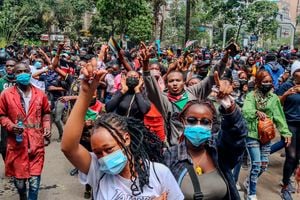
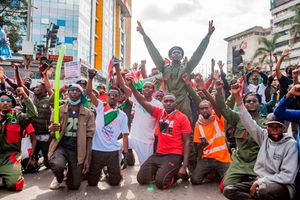
Anti-riot police officers block protesters from accessing State House road n Mombasa on June 25, 2025.
Photo by
When young Kenyans hit the streets in June 2024 as they pushed for good governance, it felt like the country was experiencing a rebirth.
The uprising by the Generation Z was devoid of political mobilisation unlike previous anti-government protests.
Organic and largely driven by hashtags and social media messaging, the young men and women – mostly in their early 20s – declared themselves partyless, leaderless and tribeless, posing a direct challenge to a political order built on ethnic patronage.
Hopes were high that Kenya was witnessing a new dawn – the birth of public defiance devoid of ethnic undertones.
However, the dream appears to be evaporating, going by a study by OdipoDev, a data analytics and research firm, and Tribeless Youth, a community-based organisation.
Politics appears to have turned once again to familiar grounds by gravitating towards ethnic lines.
Over the past year, narratives of regional unity, tribal loyalty and historical grievances have crept back into the national conversation.
According to the research, Kenya’s online spaces have become more tribal than a year before. Ironically, a movement calling for a tribeless Kenya seems to be playing along and falling for the bait by political actors, bots and influencers online.
Kenyan youth protest police brutality in Nairobi CBD on June 25, 2024.
Alarmingly, however, is the fact that the narratives are spreading fast and are no longer confined to political rallies or speeches. They are amplified by influencers, ordinary Kenyan internet users and through coordinated disinformation campaigns designed to inflame divisions.
The study, conducted between January 1, 2024 and October 31, 2025 analysed more than six million posts on X. It found out that the volume and tone of negative ethnic conversation online is worsening.
The research, based on data collected from online conversations around the 10-largest ethnic groups in Kenya, reveals that tribal rhetoric has sharply risen on X in 2025 compared to 2024.
Political actors have taken advantage by exploiting the organic energy, using disinformation to direct, focus and intensify the same for their own ends.
The research looked at data collected from X, with the study taking into account inauthentic and authentic activity with focus on the Kikuyu, Luhya, Luo, Kalenjin, Kamba, Somali, Kisii, Miji Kenda, Meru and Maasai communities.
In 2024, Kenyans sent out about 6,000 posts on ethnicity on X per day, while 2025 has witnessed a sharp increase, hitting an average of 10,000.
While June 2024 protests triggered changes in the government, they also resulted in a rise in tribal-related conversations.
The study reveals that posts mentioning tribes rose from slightly over two million in 2024 to more than three million in 2025.
Protesters march along Kenyatta Avenue in Nairobi during anti-Finance Bill demos on June 25, 2024.
Events that contributed to the rise in 2025 include Raila Odinga’s AU Commission chairperson seat loss, his death, the June 25 anniversary of the storming of Parliament, Saba Saba protests and the killing of blogger Albert Ojwang in detention.
Conversations around ethnicity in 2025 are more charged than they were in 2024. Posts and comments have proved to be more polarised and charged than before.
Not only are Kenyans talking more about tribes, half of the ethnicity-related posts in 2025 on the platform carry toxic tones.
The Kikuyu, Luo and Kalenjin experience the highest levels of polarisation. According to the research, 39 per cent of the posts in 2024 were negative but this has since jumped to 49 per cent.
The 44 per cent neutral posts recorded in 2024 have fallen to 37, with a three percentage points drop also experienced in positive posts – 17 in 2024 to 14 per cent this year.
OdipoDev Head of Research, Patricia Andago, says the greatest impact if the trend continues is that the efforts made in 2024 when the tribeless narrative came up could be erased.
“As we move close to 2027 and bearing in mind what happened in 2007 and 2008, what we are creating is animosity of tribes. The possibility of violence becomes high,” Ms Andago said.
When online users switch to Kiswahili or Sheng – the urban slang that blends Kiswahili and English with other languages – the likelihood of them using harmful speech rises.
Ms Andago said the findings largely speak to how people sometimes reach out to language that is able to convey more what they mean.
“There is a way meaning is conveyed better when one uses a certain language, especially when the language is native to them,” she said.
Kenyans under the age of 35 comprise 75 per cent of the country’s population. The number of registered voters in the 2022 rose from 19.6 million in 2017 to 22.12 million.
Protesters picket along Kimathi Street in Nairobi on June 25th 2025 during the commemoration of the 2024 Gen-Z protests.
For the 2027 elections, the Independent Electoral and Boundaries Commission targets at least 6.8 million new voters, a number that will mainly be made up of Gen Zs – people born between 1997 and 2012.
People aged 18 to 34, stood at 39.84 per cent of the registered voters, representing 7.7 million voters.
Ms Andago said the declaration of being leaderless, partyless and tribeless was not an all-generation thing, but a statement by a group of young people.
“It is not automatic that all Gen-Zs will think in that direction. It is for those who realised that tribalism is taking us back. Tribalism has been a default setting for decades, with a majority still finding the idea of being tribeless new,” she said.
Political commentator Javas Bigambo agrees with Ms Andago, saying there was no consensus that the Gen-Zs were tribeless, partyless and leaderless “as it was an amorphous group”.
“Are Gen-Zs really apolitical? The term has morphed into a political phrase in political parlance to refer to nearly any person or group that is opposed to the current government. Crafty politicians have taken advantage of this and are trying to position themselves as their leaders,” he said.
Tribeless Youth Executive Director Wanjiku Kihika, popularly known as Ciku, notes it is an open secret that politicians seek to control online narratives by paying influencers. She points out that prior research and press reports have covered these troll farms as being used to target activists, political opponents and media houses.
Ms Kihika says the research identified several hashtags and campaigns with tell-tale signs of inauthentic coordination, ranging from fresh accounts, sharp, artificial rises in volume and repetitive media, all likely aimed at gaming platform algorithms to sow ethnic division.
She says X has shaped bold political conversations and is a platform individuals have been bold about their political stands.
The platform has many Gen-Zs, contrary to opinion that it is elitist and mostly used by millennials.
At the height of the protests, President William Ruto organised a Twitter Space when he wanted to reach out to the youth. Police crackdowns targeting government critics have centred on the platform.
The Tribeless Youth boss says it is not all doom as there have been significant pushbacks from users who have refused to take the bait.
Prof Macharia Munene, a political commentator, agrees. He says the Gen-Z phenomenon was not a passing cloud but a movement that was derailed.
“It is possible to have tribeless Gen-Zs when it comes to politics. You also don’t want to underestimate their opponents who are seasoned operators trying to make such a movement an ethnic issue,” he said.
The study argues that Kenya’s civic stability hangs in the balance, but this time shaped by complex dynamics.
For many, the tension carries echoes of 2007/8, when more than 1,100 people were killed and 600,000 displaced. Back then, the internet was a minor factor in Kenya’s politics. Twitter was a year old, Facebook barely three and TikTok did not exist.
Today, connectivity is near universal and smartphones are everywhere. Social media is the main arena for political debate, mobilisation and dissent.