The Ethics and Anti-Corruption Commission (EACC) has won a major court battle allowing it to stop the payment of more than Sh6.1 billion in disputed National Youth Service (NYS) pending bills as it pursues a civil suit alleging fraud in the procurement process.
In a ruling delivered on July 31, 2026, Justice Rose Ougo dismissed attempts by businessman Benson Gethi and his firms to overturn temporary orders freezing the payments and instead allowed the anti-graft agency's application to preserve the money until the case is heard and determined.
The ruling means suppliers linked to the disputed claims cannot demand payment, while NYS has been barred from releasing the money pending the outcome of the suit.
The case was filed by the Ethics and Anti-Corruption Commission (EACC) against 15 defendants, with the National Youth Service named as an interested party.
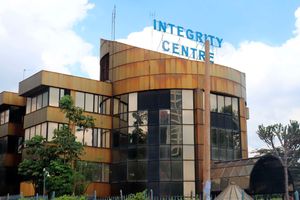
Integrity Centre in Nairobi which houses the Ethics and Anti Corruption Commission offices.
Photo credit: Pool I Nation Media Group
The defendants are accused of presenting questionable payment claims. They are businessman Benson Gethi Wangu, trading under Highview Trading, Schoolwork Enterprises, Newtool Mart Trading, Ratego Technologies, Realtool Trading and Comptool Trading, Horizon Limited, Elizabeth Wangeci Ngugi, trading as Liz Link General Suppliers, Susan Nyambura, trading as Link General, Jimchar Enterprise Limited, and Tison Limited.
The others are current or former NYS officers, Samwel Mudanyi Wachenje, Bernard Kipkoech Yatich, Bernard Nzioka Kioko, Julius Nyadimo Airo, John Nganga Gicharu, Titus Trouble Libondo, Isaac Wafula Kundu, Jane Wangechi Gichuki and Chemoss Kororia Ndiema.
EACC filed the suit on December 5, 2025, seeking orders to stop the suppliers from claiming Sh6,167,797,655 from NYS and to restrain the agency from paying the money.
According to court documents, the commission said it received a letter on July 15, 2022, from the Cabinet Secretary in the then Ministry of Public Service, Gender, Senior Citizens and Special Programmes requesting forensic investigations into payment claims exceeding Sh6 billion that had been lodged by various suppliers.
The anti-graft agency told the court that its investigations established that the suppliers submitted fraudulent claims for payment for goods allegedly supplied to NYS headquarters and its Mechanical and Transport Branch during the 2013/2014, 2014/2015 and 2015/2016 financial years.
EACC further alleged that the suppliers colluded with NYS officials to falsify procurement and accounting records, enabling the submission of payment claims based on fictitious procurement contracts.
The commission argued that unless the court intervened, public funds would be lost through payments allegedly supported by fraudulent documents.
On December 8, 2025, the court issued temporary orders stopping payment of the disputed claims.
The orders triggered applications by Mr Gethi and other firms seeking to have the injunction lifted. The suppliers argued that EACC had failed to disclose important information when obtaining the orders.
They told the court that the Office of the Director of Public Prosecutions had twice declined to approve criminal charges after reviewing EACC's investigation file and had advised the commission to close the inquiry.
They also argued that a government multi-agency team that included representatives of EACC, the Directorate of Criminal Investigations, the Office of the Attorney-General, the Office of the Auditor-General and procurement officials had verified the pending bills and recommended that most of them be paid.
They maintained that no public money had been released and therefore there was nothing to preserve through court orders.
They further argued that the suit had been filed years after the transactions under investigation and accused EACC of delaying the matter while frustrating efforts to verify and settle the claims.
Some of the suppliers insisted that they had supplied goods to NYS and that their claims were legitimate.
Horizon Limited, for example, said it had supplied more than 6.7million litres of diesel to NYS over three financial years and was owed Sh714.5 million.
Two former NYS officers told the court that they had disowned documents allegedly bearing their signatures, saying the signatures had been forged and that they had provided specimen signatures to investigators.
EACC opposed the applications, arguing that the civil proceedings were aimed at protecting public property and were independent of any criminal process undertaken by the ODPP.
It said the decision by the ODPP not to prosecute did not prevent it from filing a civil recovery case under its constitutional and statutory mandate.
The commission also distinguished its forensic investigations from the work of the multi-agency verification committee, saying the committee merely verified pending bills while its investigations examined the authenticity of procurement records and payment documents.
According to EACC, forensic investigations uncovered numerous irregularities, including missing requisitions, local purchase orders that lacked mandatory approvals and counterfeit procurement documents.
Justice Ougo agreed that the issues raised by the parties required a full trial but found that EACC had established sufficient grounds for the court to preserve the disputed funds in the meantime.
The judge rejected the argument that the anti-graft agency's case had collapsed because the ODPP had declined to prosecute.
She held that civil recovery proceedings and criminal prosecutions serve different purposes and operate under different legal standards.
Justice Ougo observed that EACC is an independent constitutional commission whose powers to protect public property are not taken away simply because another agency reaches a different conclusion in criminal investigations.
"The fact of those clearances by those bodies does not persuade the court that the orders were not reasonably issued," the judge held.
The court also rejected the defendants' argument that because the money had not yet been paid, there was nothing capable of being preserved.
Justice Ougo held that the suit had been filed under provisions of the EACC Act that empower the commission to institute proceedings to protect public property.
She said the preparation of payment vouchers and continued demands for payment presented a real risk that public money could be released before the dispute was resolved.
On whether EACC had met the threshold for an injunction, Justice Ougo found that the commission had established a case that was likely to succeed.
The judge also found that EACC had demonstrated that the public would suffer irreparable loss if the money was paid before the case was concluded.
She observed that the defendants had not shown they would be able to refund the billions of shillings if the court eventually found the payments to have been unlawful.
Justice Ougo said the balance of convenience favoured preserving the funds until the issues raised in the suit were fully determined.
The court therefore restrained the businessmen from claiming Sh6,167,797,655 from NYS and barred the agency from making any payment relating to the disputed vouchers until the case is heard and determined.