When government and the World Bank went out looking for youths to offer business grants and job skills in August last year, their target was 220,000 beneficiaries.
In just seven months, over 3 million youths have approached the National Youth Opportunities Towards Advancement (Nyota), exposing the depth of Kenya’s unemployment, even as majority have been rejected.
The 3,012,012 youths who applied to benefit from the Nyota project were 13.7 times the State and World Bank targets and have now exposed the desperation among youths, as unemployment litters the country.
Nyota plans to offer 110,000 youths with business capital, train and connect some 90,000 of them to jobs, and certify 20,000 skilled informal sector workers to get professional opportunities, over three years.
Overall, more than half (1.7 million) of the youths who applied to benefit from Nyota between August 2025 and last month were rejected for falling outside the project’s target age group and education level, suggesting that graduates and persons aged over 30 also came forward.
The project aims to benefit 820,000 youths, aged 18 to 30 and only educated until secondary school level, with job linkages, skills and business capital.
The business start-up capital initiative, which is offering youths Sh50,000 grants, has emerged as the most popular, attracting 2.36 million applications.
Only 90,319 (about one in 26) applicants have been funded under this component so far while two-thirds have been rejected, the World Bank says.
The World Bank’s Nyota Technical Team Lead Kevin Sanya says “oversubscription/demand for the project interventions from millions of Kenyans, far exceeding available resources to scale and cover every eligible applicant” has been one of the project’s main challenges over its initial seven months.
Nyota officially started in August last year and will run until December 2028. It is being funded to the tune of Sh29.5 billion ($229 million) by the World Bank while government will fund 10 percent of the project.
By end of February, the World Bank had released Sh5.9 billion ($45.8 million).
The multilateral lender says the high number of youths expressing interest in the project has forced implementing agencies to cut on administration costs “to increase the number of beneficiaries.”
“Agencies (are) also linking beneficiaries who were not successful in joining in to other programs (both development partners and government interventions),” Mr Sanya told the Nation.
The World Bank said out of the 3 million applicants for the three project components by end of February, 1.3 million were eligible for the project while 1.7 million were rejected.
Only a portion of the 1.3 million eligible applicants will make their way into the project since the number is still far higher than the 220,000 budgeted for.
Under on the job experience (OJE), one of the NYOTA components aiming to train and link some 90,000 youths with jobs, 566,972 applied to benefit, out of whom 463,172 were declared eligible.
Under the recognition for prior learning (RPL) component, which targets to certify 20,000 youths who already have knowledge and skills from working in the informal sector to access better jobs and contracts, 80,822 youths applied, but half were rejected.
The business grants component, whose total funding from the World Bank is Sh11.2 billion, had 2.36 million applicants, two-thirds of whom were rejected.
The high numbers of youths fighting for an opportunity in the NYOTA project reflects the dire state of unemployment in the country, with statistics showing that youths have suffered the most.
A recent report by the Kenya National Bureau of Statistics (KNBS) shows that unemployment in Kenya grew from 2.6 percent in 2014 to 5.6 percent in 2023.
“The unemployment challenge is particularly acute among the youth and women, whose unemployment rates far exceed those of adult men.
“Youth unemployment is more than twice the national average, highlighting a structural issue in the country’s labour market,” KNBS says in a poverty report published three months ago.
The report linked the unemployment to rapid population growth, mismatches between skills and job market demands, sluggish economic growth “and systemic issues such as inefficiencies and corruption.”
KNBS said that on top of the high unemployment rate, many Kenyans are engaged in jobs that do not fully utilize their skills or time, leaving them underemployed and economically vulnerable.
The Bureau’s latest labour force report captures data to end of 2022, when youths aged 20 to 34 formed three-quarters of unemployed Kenyans.
The age group specifically constituted 74.8 percent of the 626,279 Kenyans recorded under long term unemployment, those who had been without work and actively seeking employment for at least a year.
Overall, 210,000 beneficiaries have been shortlisted for different components of the NYOTA initiative and are at different stages of receiving business support and on the job experience, the World Bank says.
Another component targeting to offer digital training on access to government procurement opportunities (AGPO) is yet to be launched and will target some 600,000 youths, making it the biggest NYOTA component, at least from target beneficiaries perspective.
The high applications under the first three components have informed a decision to expand the AGPO component to include youths aged up to 35 and those educated above secondary, the World Bank said.
“In addition, there are ongoing discussions on labor mobility to Canada, that will include those who already have tertiary education in the selected areas of specialization. Once the discussions are concluded, the various project documents will be adjusted to reflect this position,” the lender said.
The World Bank shares government projections that about 80 percent of enteprises funded with grants will succeed, which would translate to a Sh1 billion failure rate, from a funding perspective.
The lender, however, says its measure of success from the billions put in to support the youth will be on numbers of youths who maintain jobs after end of the project.
Kenya’s labour force is largely composed of the informal sector, which employed 84 percent of the 20.8 million Kenyan workers in 2024.
“Based on the Bank’ s assessment, and subject to continued implementation progress, the Banks shares the same assessment with the government,” the World Bank said, terming the projections satisfactory.
The State Department for Micro, Small and Medium Enterprises (MSME) declined to respond to questions regarding status of NYOTA project.
The Cabinet approved NYOTA in July last year, paving way for implementation of the project that was conceived over a two year period to June 2023.
“The programme aims to enhance employability, skills recognition, and access to decent work, and is a key pillar of the Bottom-Up Economic Transformation Agenda,” a July 29, 2025 cabinet brief stated, adding that OJE beneficiaries would get Sh6,000 monthly stipends.
As the State charts the NYOTA path to address the high unemployment rate, the World Bank is, however, walking rather cautiously to avoid a scenario where some of the youths offered business grants during a similar programme that ended two years ago vanished without a trace.
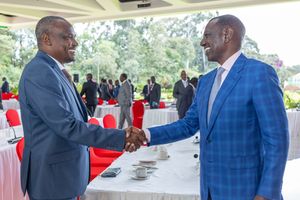
President William Ruto and his Deputy Kithure Kindiki during the Nyota Start-up Capital Disbursement at Garissa High School in Garissa County.
Photo credit: DPCS
The Kenya Youth Employment and Opportunities Project (KYEOP), benefitted 87,432 youths across 17 counties with a total funding of Sh15 billion, but an audit later established that about half of 553 beneficiaries sampled to assess impacts the initiative had in their enterprises “were either unreachable on phone or non-cooperative by not willing to give directions to their premises, while some indicated that their businesses had failed.”
The World Bank now says it has since employed Blockchain technology “to trace disbursements from the World Bank to the final beneficiary.”
“This has helped ensure that there are minimal discrepancies with utilization of funds for the intended purposes and ensured that resources reaching the intended beneficiaries can be traced,” the World Bank says.
The lender adds that it is approving procurements above certain (undisclosed) thresholds and also, performing regular financial and procurement audits, to ensure compliance with safeguards.
“The Bank is also planning a Midterm review of the project and will take any corrective action that may be required at this time,” it said without divulging into specifics.
The World Bank says it has so far disbursed Sh5.9 billion ($45.8 million) to government for the project, out of which Sh3.9 billion has been released in the current financial year.