The Ministry of Defence and the State Department for Agriculture, Higher Education and Medical Services are among the biggest winners in the Sh245.9 billion additional allocations in supplementary estimates I for the 2025/26 financial year presented to the National Assembly for approval.
The Sh245.9 billion mini-budget is on top of the Sh4.2 trillion budget approved by the National Assembly in June 2025.
Of the approved additional expenditure, Sh185.8 billion has already been disbursed and is now awaiting the post-facto approval by the National Assembly.
The mini estimates presented by the National Treasury Cabinet Secretary John Mbadi have, however, exceeded the threshold of 10 percent by 1.1 percent as provided for in the constitution.
Article 223(5) of the constitution stipulates that in any particular financial year, the national government may not spend under “this Article” more than 10 percent of the sum appropriated by parliament for the financial year unless, in special circumstances, parliament has approved a higher percentage.
“Since the approval of the 2025/26 budget estimates, the National Treasury has received additional expenditure requests to cater for emerging priorities and shortfalls under critical expenditures,” says CS Mbadi in the March 3, 2026 document to the National Assembly.
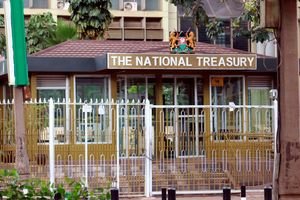
The National Treasury Building in Nairobi.
Photo credit: Pool
Included in the estimates is additional expenditure to cater for salary shortfalls for Ministries, Departments and Agencies (MDAs) staff, support for education through the Higher Education Loans Board (HELB), and scholarships and security operations.
The others are disaster response efforts addressing droughts, floods and mudslides, capital projects and development partners funded projects in roads, youth development, transport corridors, water and energy sectors, among others.
Of the approved additional expenditure, Sh101.6 billion is under ministerial gross expenditure, of which Sh44.8 billion is for recurrent budget and Sh56.7 billion under development budget, with Sh144.4 billion under the Consolidated Fund Services (CFS) to cater for the buyback and interest accrued at the Citi bank.
In the mini estimates, the Ministry of Defence is getting Sh24.4 billion on top of the Sh202.3 billion budget for the year, for a need that has not been explained.
The State Department for Agriculture gets additional Sh19 billion for fertilizer subsidy and sugar reforms, and Sh2.92 billion for seeds subsidy and crop diversification programmes.
John Mbadi, the Cabinet Secretary for National Treasury and Economic Planning.
Photo credit: File | Nation Media Group
The State Department for Higher Education gets additional Sh16.69 billion to cater for arrears for the Universities Collective Bargaining Agreement (CBA) and enhancement of provision for Higher Education Loan Board (Helb) for university scholarship.
The State Department for Special Programmes has been allocated Sh12.6 billion extra to cater for drought and floods mitigation efforts, and Sh270.5 million for personnel emolument shortfall and operations and maintenance.
The State Department for Basic Education gets Sh3.1 billion additional allocations to cater for the shortfall for national examinations.
The State Department for Medical Services has Sh8.31 billion allocated for the provision of the Covid-19 health emergency response project and Sh5.62 billion to cater for the primary health care fund.
Under the State Department for Health, there is Sh5.5 billion for the personnel emolument shortfall for health interns.
The National Police Service (NPS) gets an additional Sh7.5 billion for the enhancement of security operations.
State Department for Cooperatives has Sh2 billion allocation for “adequate preparation” of Milk glut and “to ensure timely mop up of excess milk, stabilization of raw milk price and timely payment of arrears to farmers.”
The State Department for Micro, Small and Medium Enterprises (MSMEs) Development gets Sh2.97 billion for the NYOTA project.
The State Department for Immigration and Citizen Services has additional Sh4.4 billion for the provision of the joint mobile registration outreach programme “for the national identity cards and birth certificates.”
State Department for the ASALs and Regional Development has Sh3.92 billion that includes Sh1.65 billion to cater for the shortfall for the hunger safety net programme and shortfall for personnel emolument, and Sh2.3 billion in additional expenditure for the shortfall in personnel emolument and provision for ongoing projects.
State Department for Economic Planning gets additional Sh566.1 million for support and capacity building of grassroots champions, data collection and management and for general administration planning and support services, Bottom-up Economic Transformation Agenda (BETA) indicator.
National Treasury Cabinet Secretary John Mbadi displays his briefcase before the reading of the National Budget on June 12, 2025.
Photo credit: Sila Kiplagat | Nation Media Group
In a document presented to the National Assembly, CS Mbadi says that the budget execution progressed well during the first half of the current financial year, though it has been “constrained by a combination of factors.”
They include slower-than-anticipated adoption of the e-procurement system, revenue underperformance, and emerging expenditure pressures.
According to CS Mbadi, by the end of December 2025, total revenue collection, including Appropriations-in-Aid (A-I-A), amounted to Sh1.53 trillion against a target of Sh1.64 trillion, representing a shortfall of Sh111.6 billion.
“The revenue shortfall recorded is due to under-performance in ordinary revenue by Sh110.6 billion and Sh1 billion from ministerial A.I.A,” said CS Mbadi.
The ordinary revenue collection, he said, stood at Sh1.24 trillion against a target of Sh1.4 trillion, while collections from ministerial A.I.A stood at Sh283.8 billion against a target of Sh284.8 billion.
CS Mbadi notes that despite the shortfalls, total revenue grew by 11.4 percent compared to a 4.2 percent growth recorded in December 2024, “indicating a positive trend in revenue mobilisation.”