Kenyans have been invited to give their views on a Bill that seeks to dissolve all six regional development authorities.
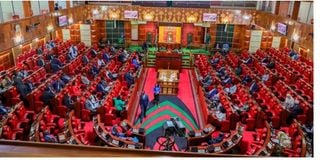
The National Assembly's committee on Regional Development is set to commence public participation on the proposed Regional Development Authorities Laws (Repeal) Bill, 2026.
The committee, chaired by Sigor MP Peter Lochakapong’ will conduct the first phase of the exercise on Friday, October 9, 2026, in Elgeyo Marakwet, Isiolo and Narok counties.
The committee will later seek views from residents of Mombasa, Embu and Kisumu counties, before preparing its report for consideration by the House.
The Regional Development Authorities Laws (Repeal) Bill, 2026 seeks to dissolve the Coast Development Authority (CDA), the Kerio Valley Development Authority (KVDA), the Lake Basin Development Authority (LBDA), the Tana and Athi Rivers Development Authority (Tarda), the Ewaso Ng'iro South Development Authority and the Ewaso Ng'iro North Development Authority.
The repeal is intended to wind up the institutions which have already fulfilled the mandate for which they were established, while aligning national development functions with the Fourth Schedule of the Constitution.
Eliminating the authorities is expected to ease pressure on the national budget while improving efficiency, accountability and service delivery through consolidation under existing institutions.
The Bill sponsored by the Leader of the Majority Party, Kimani Ichungw’ah, will see the National Treasury and the Public Service Commission (PSC) absorb major operations, staff and balance sheets of all six regional development authorities.
The National Treasury budget documents for the financial year 2025/26 show that the six authorities are to be disbanded in light of devolution and their impact on local governance.
The dissolution follows a Cabinet directive to review the authorities’ mandate following the constitutional requirement that recognised the existence of the national and county levels of government with the implementation of devolution.
The Cabinet, chaired by President William Ruto, on March 7, 2024, directed the Ministry of East African Community and Regional Development to review the relevance of the six authorities that were established under various Acts of Parliament that have since been overridden by the Constitution that was promulgated in 2010.
The Fourth Schedule of the Constitution empowers the 47 county governments to recognise the right of communities to manage their own affairs and to further their development and requires devolved units to facilitate the decentralisation of the State organs, their function and services, from the capital of Kenya, Nairobi.
“That, the Intergovernmental Relations Technical Committee (1GRTC) provides the National Assembly with a detailed roadmap and timelines on the proposed dissolution of the six regional development authorities and the eventual transfer of assets, liabilities and personnel to the two levels of government by June 30, 2025,” the MPs had earlier proposed.
“Following the publication of the re-validated sector exercise reports on the delineation of functions, IGRTC published the respective Gazette Notices (No. 16472 to 16483) on 16th December, 2024 on the delineated functions.”
In the budget documents for the financial year 2025/26, the Treasury Cabinet Secretary John Mbadi said the IGRTC, through the letter dated March 26, 2025, provided the status of the MPs' resolution.
“Annex 4 of this Budget Summary provides a statement of a detailed roadmap and timelines on the proposed dissolution of the six Regional Development Authorities and the Eventual Transfer of Assets, Liabilities and Personnel to the Two Levels of Government by 30t June 30, 2025,” Mr Mbadi said in the budget documents.
President Ruto announced sweeping reforms that will see 42 State corporations considered to have related or overlapping functions merged into 20 agencies.
The measures, announced following a Cabinet meeting at the Kakamega State Lodge, will also see several government agencies dissolved, and others restructured to reduce the wastage of public resources.
"These reforms have been necessitated by increasing fiscal pressures arising from constrained government resources, the demand for high-quality public services, and the growing public debt burden," a memo from the Cabinet meeting read in part.
The Cabinet decision followed the National Treasury’s assessment of 271 State corporations, excluding those earmarked for privatisation, identifying areas of inefficiency and redundancy.
The report revealed that many corporations have struggled to meet their statutory obligations, resulting in pending bills amounting to Sh94.4 billion as of March 31, 2024.
Topping the list of dissolutions and mergers of the 42 State corporations is the University Fund, which is set to be merged with the Higher Education Loans Board and the Kenya Rural Roads Authority, which will be consolidated with the Kenya Urban Roads Authority.
Others are the Kenya Tourism Board & Tourism Research Institute, the Export Processing Zones Authority & Special Economic Zones Authority, the Anti-Counterfeit Authority, Kenya Industrial Property Institute & Kenya Copyright Board.
Also in the list are the Kenya Industrial Research and Development Institute & Kenya Industrial Estates, the Agricultural Finance Corporation & Commodities Fund, the Kenya Forest Service & Kenya Water Towers Agency, the Agricultural Development Corporation & Kenya Animal Genetic Resource Centre, the National Irrigation Authority & National Water Harvesting and Storage Authority, and the Kenya Law Reform Commission & National Council for Law Reporting.