The National Assembly has taken the battle over online speech offences to the Supreme Court, challenging a decision that struck down provisions of the Cybercrime law that had criminalised digital publication of “false or misleading information or fictitious data”.
The Speaker of the National Assembly, Moses Wetang'ula, in a Petition of Appeal, wants the apex court to overturn the Court of Appeal judgment delivered on March 6, 2026.
He says the contested law serves important public interests by tackling deliberate online falsehoods and other digital threats, while its requirements for people to act “knowingly” or “intentionally” help protect innocent people from criminal liability.
"In an advanced digital economy, coordinated disinformation is not harmless speech, as it constitutes systemic threats capable of collapsing financial systems and inciting ethnic violence. The state has a sovereign duty to defend its collective information infrastructure. This presents a legitimate aim by the State," say the National Assembly's advocates.
The National Assembly says those provisions were necessary to punish people who deliberately create or spread false information that can cause panic, violence, chaos or other serious harm. It argues that the Court of Appeal failed to properly weigh the gravity of the offences targeted under the two sections of the Act.
"Criminalising the deliberate, malicious creation of panic-inducing information is directly and rationally connected to maintaining public order. Without a clear statutory penal deterrent, malicious actors operate with absolute digital impunity, as civil remedies are entirely ineffective against algorithmic harm," argues the Speaker.
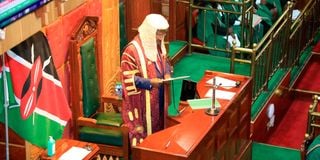
National Assembly speaker Moses Wetangula.
Photo credit: File | NMG
The legal contest started in May 2018 after Bloggers Association of Kenya (BAKE) challenged several provisions of the Act, citing constitutional rights including freedom of expression, privacy and media freedom.
The State said the law was enacted to provide a framework for detecting, preventing, investigating and prosecuting cybercrime, while facilitating international cooperation.
It said Parliament sought to address harms including online harassment, cyber-bullying and exploitation that older laws could not adequately cover.
In the fresh filings at the Supreme Court, Mr Weang'ula says those legislative objectives remain legitimate.
The High Court dismissed the petition in February 2020, holding that the Act and contested provisions were constitutional. BAKE appealed, leading to the March 2026 judgment that struck down only Sections 22 and 23 while upholding other challenged provisions.
The two invalidated provisions had outlawed the publication of false or misleading information likely to cause panic, chaos, or reputational harm.
Since enactment of the Act, dozens of individuals, particularly young social media users critical of government and political leaders, have faced arrests and prosecutions related to online speech.
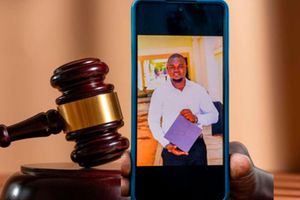
In some instances, enforcement of the Act led to deaths, such as the case of teacher Albert Ojwang, who died in June 2025 at Nairobi’s Central Police Station after being arrested over an alleged offensive social media post.
The appellate court said the legal sections were “so broad, wide, untargeted, akin to unguided missiles, and likely to net innocent citizens.”
It said they could catch people forwarding information without knowing it was false, as well as satire, opinions and journalistic inaccuracies.
The two offences carried penalties of up to Sh5 million, 10 years’ imprisonment, or both.
According to the National Assembly's petition of appeal, the Court of Appeal recognised that words such as “intentionally” and “knowingly” provide the guilty mental element required for criminal liability, but then failed to apply that reasoning consistently to Sections 22 and 23.
“Freedom of expression protects opinion, satire, and honest error. It does not protect a calculated, malicious intent to deceive and cause mass chaos,” the Speaker says in the petition.
In regard to the Court of Appeal’s finding that the State should rely on civil defamation or alternative laws, particularly the National Cohesion and Integration Act, the Speaker says civil defamation only protects personal reputation and cannot address public safety threats posed by large-scale online falsehoods.
He says civil lawsuits cannot effectively stop viral disinformation campaigns and that the National Cohesion and Integration Act does not cover computer-related offences, leaving criminal sanctions as the State’s remaining effective regulatory option.
It asks whether courts should presume laws are constitutional, whether they should first interpret disputed provisions to preserve them, and whether hypothetical unconstitutional effects justify striking down legislation.
Mr Wetang'ula says the appellate court substituted its policy preferences for Parliament’s legislative judgment.
National Assembly Speaker Moses Wetang’ula.
The Speaker also challenges the remedy chosen by the Court of Appeal. He argues that if parts of Sections 22 and 23 were defective, the court should have interpreted them narrowly, removed offending language, or temporarily suspended invalidity.
The petition says immediate invalidation created uncertainty for investigations, prosecutions and pending criminal matters.
The Speaker’s proposed interpretation would limit the offences to intentional or knowing false factual claims while excluding opinions, satire, parody, honest mistakes, innocent forwarding and journalistic inaccuracies where the required intent is absent.
The Court of Appeal upheld most of the Act, including provisions on cyber harassment, cybersquatting and investigative powers.
It also found safeguards in several investigative provisions, including specific warrants and judicial oversight.
The appeal seeks only to restore Sections 22 and 23. It says the Court of Appeal “failed to apply the same interpretive methodology” before invalidating the provisions.
"The Court of Appeal misconstrued the applicable constitutional and statutory framework, resulting in conclusions that are unsustainable upon a proper interpretation of the Constitution," reads the petition.
The respondents are BAKE, the Attorney-General, the Inspector-General of the National Police Service, the Director of Public Prosecutions, Article 19 East Africa, the Kenya Union of Journalists and the Law Society of Kenya.