The controversy over livestreaming of election results and whether to have a national tallying centre threatens preparations for the 2027 elections, with the opposition and the electoral agency staring at an impasse.
Yesterday (Wednesday), the opposition doubled down on their demands for livestreaming of election results, arguing that publicly broadcasting the results as they are transmitted from polling stations is a constitutional requirement that cannot be substituted by electronic transmission alone.
But at the heart of the contention is the understanding of live streaming, which the two parties interpret differently.
Independent Electoral and Boundaries Commission (IEBC) Chairperson Erastus Edung Ethekon.
Photo credit: Dennis Onsongo | Nation
For its part, the Independent Electoral and Boundaries Commission (IEBC) says live streaming of results is unattainable across over 55,000 polling stations to be used in the August 10 polls, explaining that it would significantly increase the cost of conducting the elections.
However, the opposition argues that livestreaming does not mean mounting 55,000+ video cameras in every polling station or streaming thousands of live video feeds but simply means integrating IEBC’s Results Transmission System with an open, online public portal featuring read-only application programming interface (API) nodes.
IEBC livestreaming Bill sparks backlash as leaders threaten court action and protests
The integration will allow simultaneous transmission of hourly voter turnout data, scanned Form 34A, the exact data and image to the constituency returning officer, the media, political parties, and the public through the online portal as soon as a presiding officer announces the same.
On the issue of the necessity of a national tallying centre, the opposition maintains there is no need for such a centre, while the electoral agency is adamant the same is a constitutional requirement.
The raging controversies come even as the opposition has given the IEBC a one-month ultimatum to address their grievances, failure to which they would resort to mass action.
Speaking on Tuesday in Nairobi, IEBC chairperson Erastus Ethekon observed that the commission is already grappling with the 2027 elections funding deficit and even though such a proposal is possible, it is impractical given the financial and logistical demands of providing live video coverage from over 55,000 polling stations.
Besides procuring the 55,000 cameras which would be very expensive, Mr Ethekon said it would require a centralised command centre to monitor what was happening across the polling stations, making it a complicated undertaking.
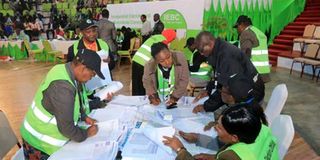
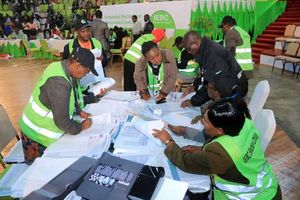
Bomas of Kenya, which was the Independent Electoral and Boundaries Commission's national tallying centre in the 2022 General Election.
Photo credit: File | Nation Media Group
But yesterday, the opposition maintained there must be real-time public broadcast of tabulated results and hourly voter turnout figures as transmitted from polling stations to the constituency tallying centre through an IEBC-maintained online public portal equipped with a read-only API.
Under the People’s Coalition on Electoral Reforms, the opposition said electronic transmission and livestreaming reinforce each other, but neither substitutes for the other, as results transmitted from polling stations are the foundation of the final result.
They accused the IEBC leadership of misrepresenting its proposal, insisting that livestreaming does not require installing video cameras in thousands of polling stations or broadcasting video feeds.
The opposition dismissed claims that livestreaming would require billions of shillings, explaining that the system could be integrated into the existing results transmission system through an online portal.
“For the clarity of the IEBC chairperson and the country, live streaming does not mean mounting 55,000+ video cameras in every polling station or streaming thousands of live video feeds,” read the statement by the opposition.
“It simply means integrating IEBC’s Results Transmission System with an open, online public portal featuring read-only API nodes so that as soon as a presiding officer transmits hourly turnout or a scanned Form 34A, the exact data and image appear simultaneously to the constituency returning officer, the media, political parties, and the public.”
This, the opposition said, will enable citizens, candidates, agents, election observers and the media to independently audit and reproduce the tally in real time rather than receiving delayed, unverifiable announcements.
They explained that livestreaming is an indispensable layer of verifiability enabling the public to scrutinise results at source instead of being asked by the IEBC to accept the final outcome on trust alone.
“The public must have a meaningful means of scrutinising the process through which those results are received, collated and declared. Therefore, live streaming is not a purposeless public relations exercise, or an optional technological burden. It is a critical means of verifying the accuracy of the election results and holding the IEBC accountable.”
On their side, the IEBC said they already have a results management framework which provides for display of electronic results at constituency, county and national tallying centres, access to election results through an IEBC public portal, and media access to results via dedicated API and media centres.
Independent Electoral and Boundaries Commission (IEBC) Chairperson Erastus Edung Ethekon (second left), Vice Chairperson Fahima Araphat Abdallah (second right), and Commissioners Ann Nderitu (right) and Hassan Noor Hassan during an engagement with political reporters at Iconic Plaza.
Photo credit: Dennis Onsongo | Nation
It further provides for finality of the polling station results, agents witnessing the count at polling stations, media capturing photo image of results, public display of the results at the polling station and electronic transmission and physical delivery of the results, as well as certification of results declared at constituency as final.
“We will make everything open, including the results. IEBC is not hiding anything and has not stopped anyone from accessing any polling station and so I do not understand the hullabaloo about the final results,” said the IEBC boss.
Mr Bobby Mkangi, a Constitutional expert and part of the team that delivered the 2010 Constitution, told the Nation that both the IEBC and the opposition have valid arguments, but the call for live streaming is to ensure the electoral agency is seen to be transparent due to trust deficit in the country.
“Both sides are right and what should be done is to marry the two by ensuring simultaneous broadcast and live uploading of the documents if modalities can be worked out on how that can be done,” he said.
At the same time, the opposition said they had proposed to the IEBC to abolish the national tallying centre, which it insists should be replaced with an open national results centre in Nairobi where commissioners would aggregate results declared across the 290 constituencies and the diaspora.
Has Parliament banned election results livestreaming?
They maintain that the chairperson and commissioners should not verify, tally or alter results already declared at polling stations and collated at constituency level and therefore their role should be limited to determining whether a presidential candidate has met the constitutional threshold for election.
According to Mr Mkangi, a national tallying center is not a constitutional requirement and does not feature in the Constitution.
“The phrase tallying is imagined. The national tallying centre was crafted out of imagination by the IEBC on how it would achieve that task and also informed by previous conduct of electoral bodies which eventually became a practice in the country,” said Mr Mkangi.
“It is just a facility for creating administrative efficiency around receipt and relaying of election results and providing semblance of transparency. Their work is just to confirm whether the presidential threshold of 50+1 and 25 percent in at least 24 counties have been met,” he added.
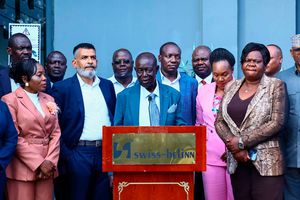
The joint press conference was attended by opposition leaders, including former Deputy President Rigathi Gachagua, Martha Karua, former Attorney-General Justin Muturi and Kiharu MP Ndindi Nyoro, among others.