A new poll shows public disapproval of potential presidential candidates, including Dr William Ruto , who polled less than a third in popularity rating, even as he maps a re-election strategy in the post–Raila Odinga era.
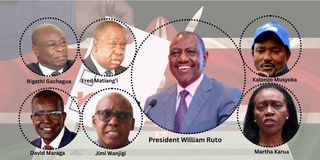
The new survey by Infotrak indicates that President Ruto commands a 28 per cent popularity rating, followed by former Interior Cabinet Secretary Fred Matiang’i (13 per cent), Wiper Patriotic Front’s Kalonzo Musyoka (12 per cent), Embakasi East MP Babu Owino (seven per cent), former Deputy President Rigathi Gachagua (five per cent), People's Liberation Party (PLP’s) Martha Karua (two per cent) and former Chief Justice David Maraga (two per cent), among others.
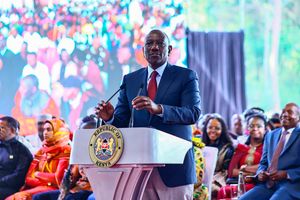
President William Ruto.
Photo credit: PCS
It means that if elections were held today, there would be no clear winner, as a first-round victory requires a 50 per cent plus one vote tally, hence a run-off vote is likely.
The report indicates that 27 per cent of Kenyans polled were undecided on whom to vote for as president, throwing the race wide open.
A united opposition force poses a huge threat to Dr Ruto, polling over 40 per cent, a clear path to a potential run-off if elections were called today.
Besides garnering more than half of all the votes cast, for one to be declared elected as president, he or she must also secure at least 25 per cent of the votes cast in each of more than half (24) of the counties.
According to the poll, President Ruto commanded a lead in six out of the eight regions, the highest being in North Eastern (76 per cent) with Dr Matiang’i beating him narrowly in Central Kenya after polling 17 per cent against the president’s 14 per cent, while Mr Musyoka also led the president in Eastern, polling 20 per cent against Dr Ruto’s 17 per cent.
Interestingly, both President Ruto and Dr Matiang’i of Jubilee Party — who is being fronted by former President Uhuru Kenyatta — beat Mr Gachagua in Central Kenya.
Former Interior and Coordination of National Government Cabinet Secretary Fred Matiangi.
Photo credit: File | Nation
The former DP managed 13 per cent in Central Kenya, his biggest support base, in the poll done between December 19 and 20, 2025.
The emergence of MP Babu to secure fourth position in the overall poll after Dr Ruto, Dr Matiang’i, and Mr Musyoka, even beating Mr Gachagua, has also elicited debate.
Dr Ruto’s win against Dr Matiang’i in the former Interior CS’s Nyanza backyard also suggests the Head of State’s growing support under the broad-based government, where he has received backing from a section of the Orange Democratic Movement (ODM) under Siaya Senator Dr Oburu Oginga.
According to the poll, in Nyanza, President Ruto polled 30 per cent against Dr Matiang’i’s 18 per cent.
On Saturday, President Ruto indicated that his administration may consider the political demands made by ODM ahead of the 2027 General Election. He added that the party should be ready to form the next government.
“You cannot lead the country when you have no agenda for the people, and whoever has no record should not be voted for. Some people have been in leadership positions for 40 years yet they cannot account for the time or tell people what their plans are,” the President said in Migori.
Dr Ruto’s United Democratic Alliance (UDA) also topped as the most popular party with 23 per cent, followed by ODM at 19 per cent, DCP (six per cent), Jubilee (five per cent) and Wiper (four per cent). It’s the first time that the ruling party has overtaken ODM in popularity rating.
The president said that the path to victory in the 2027 General Election is clear. He said that only Raila would have posed a serious challenge to his re-election bid.
According to the president, Raila was the only opposition figure with the political weight that would have threatened his hold on power.
Wiper party leader Kalonzo Musyoka addresses the congregation during a church service at Christian Dominion Ministries in Kasarani on December 7, 2025.
Photo credit: Billy Ogada | Nation Media Group
Political analysts have said that in the current political scenario, President Ruto’s strategy appears to rest on three pillars.
First is coalition expansion — sustaining the broad-based approach by pulling in opposition figures, regional blocs, and pragmatic power brokers willing to trade political certainty for proximity to power.
Second, is opposition engineering, including encouraging fragmentation by accommodating some actors while isolating others, ensuring no single bloc attains critical mass.
Third, is regional arithmetic, particularly in Mt Kenya as well as in what was Raila’s political bastions of Western, Coast, and Nyanza, where shifting loyalties could decisively shape turnout and margins.
Political analyst Dismas Mokua argues that in President Ruto entering into an MoU with Raila before his death, he hoped to strike a 2027 coalition deal to propel him to a second term.
“Ruto is not merely courting Raila’s bastions — he is attempting to dismantle the opposition’s emotional homeland and rebuild it into friendly territory,” Mr Mokua said.
He said that Dr Ruto’s 2027 arithmetic now hinges on absorbing orphaned vote blocs, suppressing turnout in hostile regions, and denying any successor the numbers needed to mount a credible national challenge.
Another political analyst, Mr Martin Oloo, said that President Ruto, knowing that Central Kenya may not overwhelmingly vote for him in the 2027 elections, like was the case in 2022, was looking to Western and Nyanza regions to shore up his support.
With Raila’s exit, the political equation has changed — and so has Dr Ruto’s strategy.
People's Liberation Party leader Martha Karua delivers her speech during the party's launch in Nairobi on February 27, 2025.
Photo credit: Boniface Bogita | Nation Media Group
“Raila’s absence removes the one opponent Ruto understood best. For years, Kenyan elections revolved around a predictable duel,” advocate Chris Omore said.
“At one level, Raila’s exit is an opportunity for Ruto. Without a towering opposition figure capable of national mobilisation, Ruto’s camp believes the path to re-election has widened. A divided opposition, split between succession battles, regional calculations, and generational shifts, reduces the risk of a single, formidable challenger emerging early. The State’s political machinery thrives best against multiple rivals rather than one unifying force,” he said.
ODM has largely remained divided, with leaders pulling from opposite sides. Some are backing the broad-based political union with President Ruto, while others like ODM Secretary-General Edwin Sifuna and MP Babu, are leading a rebellion against it.
Safina Deputy Party Leader Willis Otieno, who was part of Raila’s 2017 presidential campaign secretariat, described his death as “phenomenal”. He said that it would alter Kenya’s political fabric for years to come.
“We are talking of a giant who has shaped all our political conversations for the last 30 years,” said Mr Otieno. “Nobody discussed national politics without factoring in Raila Odinga, either for or against him. Many people owe their careers to debating about him—whether in adoration or criticism.”
Former Chief Justice David Maraga speaks during the declaration of his 2027 presidential bid on the United Green Movement Party ticket, at the party headquarters, Nairobi, on October 2, 2025.
Photo credit: Wilfred Nyangaresi | Nation Media Group
According to Mr Otieno, President Ruto could be one of the biggest casualties of Raila’s death.
“Raila was the guarantor of Ruto’s stability,” he said, referring to the political détente that followed the 2024 Gen Z-led anti-government protests. “He was able to hold at bay a generation that was pushing for Ruto’s ouster.”
Apart from winning Raila’s political bastions, Dr Ruto is also keen to retain the restive Mt Kenya vote bloc, a region that largely contributed to his 2022 election.
Democracy for the Citizens Party (DCP) leader and former Deputy President Rigathi Gachagua.
Photo credit: Dennis Onsongo | Nation Media Group
Political analysts said that Mr Gachagua is setting the stage as the Mt Kenya political supremo with his eyes set not only on the presidency, but also on other elective positions, especially in the Mountain.
“Gachagua is trying to consolidate the region under his DCP, and his strategy is to be the uncontested political gatekeeper of the Mountain. If he succeeds, many leaders risk being politically irrelevant, since access to the region’s vote would flow through him,” said Prof Gitile Naituli of Multi Media University of Kenya.
He added: “Fear is fuelling the rush by figures like Martha Karua, Jimi Wanjigi, Moses Kuria, Justin Muturi, Uhuru Kenyatta, Mwangi Kiunjuri, Peter Munya, and Prof Kithure Kindiki to stake their claim before the door is shut.”
Embakasi Central MP Benjamin Gathiru said DCP is the unifying factor of the Mountain under a single political identity— “one that would allow the region to negotiate with strength at the national table.”
Safina Party Leader Jimi Wanjigi during an interview at his Kwacha House offices in Nairobi on October 8, 2025.
Photo credit: Evans Habil | Nation Media Group
Safina leader Mr Wanjigi, who has promised to popularise his party across the country, told Nation that parties should be about ideologies, and not political capture.
He dismissed Mr Gachagua’s attempts to craft what he termed as a “region-based political bloc”, saying it represents “a dead ideology.”
“Mr Gachagua has chosen a tribal path. That’s not Safina’s politics,” he said. “If Mt Kenya believes its salvation lies in ethnic parties, good luck to them. We believe our unity is in shared economic pain.”
Safina, he added, will crisscross the country, and not Mt Kenya region alone, building issue-based networks from the coast to the highlands.
“I want to have representation in Pokomo land and Bungoma on the basis of issues, not tribe,” he said. “Gen Zs showed us that Kenyans have moved on. Don’t hijack their struggle and reduce it to tribal games.”
Stung by the dwindling fortunes of his UDA party in the Mt Kenya region, President Ruto has since unleashed DP Prof Kindiki to woo back the region, which overwhelmingly backed him in the last election.
Prof Kindiki has said that he will do everything to ensure that President Ruto retains his support in the region.
“I cannot be a DP, and, the president has no support here. I will do everything possible to make sure he is respected and supported because we have seen what he has done and what he will do,” the DP asserted.
Prof Kindiki has virtually remained Dr Ruto’s face in the region, crisscrossing the area to popularise economic empowerment programmes and development projects.
But Mr Wanjigi predicts that the 2027 contest will naturally narrow into two camps—but not along tribal or party lines.
“The Constitution already provides for a two-horse race in the runoff,” he noted. “I can’t see Ruto getting 50 plus one. If credible candidates run, he may not even make it to the second round.”
But it is the recent unveiling of former Nairobi Governor Mike Sonko’s National Economic Development Party (NEDP) that has further unsettled the United Opposition, with some leaders seeing it as a ploy by the government to divide the opposition.
The launch has set off political ripples across Ukambani, with Wiper Patriotic Front (WPF) led by Kalonzo Musyoka scrambling to contain fears that the flamboyant politician’s comeback could complicate their 2027 calculus.
“It’s my constitutional and democratic right to form and run a party,” Sonko says. “I have a lot of respect for Wiper leader Kalonzo Musyoka and this has got nothing to do with his party or influence.”
But Machakos Deputy Governor Francis Mwangangi argues that Sonko’s party fits into what he calls president Ruto’s broader strategy to weaken the opposition.
“Ruto will do a lot of games,” Mr Mwangangi warns. “Even within the United Opposition, he will use resources on leaders to divide and weaken us.”