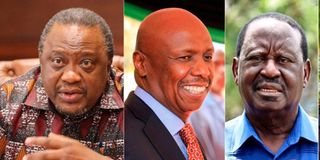
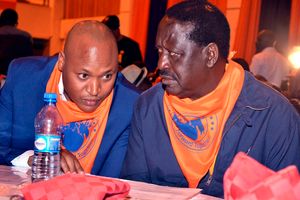
Kenya’s prominent political families— the Kenyattas, Mois and Odingas — are scrambling to reassert waning influence, their political survival threatened by shifting alliances in the lead-up to the 2027 elections.
Once unassailable, Moi’s dynasty is now a pale shadow of its former self—its name evoking history, not power. That is unfamiliar territory for a political empire led by the country’s second president, Daniel arap Moi, who ruled for 24 years.
The Kenyattas and the Odingas are also grappling with an uncertain future as a new political order led by President William Ruto and a vicious opposition steered by former Deputy President Rigathi Gachagua and Wiper leader Kalonzo Musyoka tightens its grip on the nation’s politics.
Retired President Uhuru Kenyatta has resisted efforts to dethrone him from the helm of Jubilee Party, while Orange Democratic Movement (ODM) leader Raila Odinga is at a crossroads, with his party divided over his deal to support President Ruto.
Analysts say this is not just a power struggle, but a battle for political survival.
“Political power comes with enormous influence and business leverage. What we are witnessing is dynastic self-preservation driven by the need to protect wealth and shield business empires from scrutiny,” said political analyst Javas Bigambo.
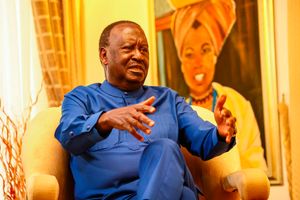
Former Prime Minister and ODM leader Raila Odinga during an interview at his home in Kare, Nairobi on July 19, 2025.
Photo credit: Wilfred Nyangaresi | Nation Media Group
Martin Oloo, another political analyst, said: “The Odingas and Kenyattas have mastered the colonial playbook—using political power not only to amass new wealth, but also to protect old riches.”
The family of Kenya’s third President Mwai Kibaki is the only one that has not had a scion dabble in active politics. Following Kibaki’s death in 2022, his son, Jimmy Kibaki, was touted as heir apparent. But seemingly, he did not seem to fit in.
In May 2024, he announced his resignation as the deputy leader of The New Democrats (TND) party. But in September, he made a comeback after he was gazetted as the deputy party leader by the Registrar of Political Parties.
“It seems these people don't want to let me go. I wrote them a letter of resignation last year. I should have forwarded the same to the Registrar of Political Parties. Let me do that now,” Jimmy told Nation yesterday.
TND Secretary-General Daniel Musembi said that as far as they are concerned, “we still recognise Jimmy as an official and a member of the party.”
Prof Gitile Naituli of the Multi-Media University of Kenya said that “political power in Kenya acts as a firewall for dynastic wealth.”
“Stepping away from politics is like walking away from your own security system. These dynasties don’t persist just because they’re powerful—they endure because the public sees no compelling alternative,” Prof Naituli added, as he explained the big families’ attempts to remain politically afloat.
“Without a decisive break from this cycle, Kenya risks remaining trapped in a revolving door of elite succession dressed up as democracy.”
For the Moi family, when the ex-president died on February 4, 2020, he left behind a family empire deeply rooted in politics and business. But the absence of his iron grip exposed cracks within the dynasty.
His son, Gideon Moi, attempted to carry the torch, but the political tide turned swiftly. His elder brother, Raymond, Moi, was beaten in the Rongai parliamentary seat race by Paul Chebor, who contested on Dr Ruto’s United Democratic Alliance (UDA) ticket.
Gideon lost his Baringo Senate seat in 2022 and his party, Kanu, is struggling to stay afloat. Even his long-time ally, Nick Salat, resigned as Kanu secretary-general.
“It was time,” Mr Salat told Nation on Monday. “Even as SG, I saw it—the party was failing to adapt.”
Salat’s departure marked more than just a resignation. It symbolised the slow unravelling of a political legacy once anchored by Mzee Moi. While the name Kanu still carried historical weight, it no longer commanded relevance.
“We were too content at the top,” he admitted. “The leadership was comfortable. But at the grassroots, nothing. The base was lifeless.”
“A party that doesn’t read the signs of the times becomes a spectator,” he said, adding that political parties should reflect current society—not cling to the past.
For Salat, the future lies in agile, responsive organisations—not personality cults.
“The 2010 Constitution gave us a chance to build parties beyond individuals. We can no longer afford to tie movements to names instead of ideas,” he said.
Gideon’s cautious style clashed with the aggressive, populist politics of the Kenya Kwanza era. The Moi family's silence has signalled retreat; both politically and publicly.
The dynasty that once ruled with a firm hand now finds itself as a spectator in a game they once dominated.
"Nobody owns Kenyans. Kenyans are nobody's slaves. Equally, nobody owns the people of Rongai, they can always decide on their own," Njiru said in an interview in the run-up to the last General Election held on August 9, 2022.
Uhuru, Kenya’s fourth president, and the son of the founding father of the nation Mzee Jomo Kenyatta, is facing a brutal political backlash, more than any former Head of State in the country's history.
After handing over power to President Ruto—albeit grudgingly following the defeat of his preferred candidate; Raila Odinga — scion of Kenya’s first vice president and the doyen of opposition politics Jaramogi Oginga Odinga — Uhuru has watched as his influence was systematically dismantled.
His allies were hounded by State agencies, family businesses faced raids and scrutiny, and his grip on the Mt Kenya vote bloc has loosened.
Uhuru’s silence, interrupted only occasionally by terse statements or symbolic appearances—speaks to a man under siege.
“Sina story mingi siku hizi, huwa naangalia tu TV.. .Let’s pray for peace, tuombee uwiano kati ya viongozi na wananchi, tuwache mambo ya ukabila na tupendane . We cannot succeed in division watu wakitupiana maneno ikiwa watu hawaheshimiani. To our leaders, respect citizens and they will return the same,” Uhuru said during the consecration and installation of Catholic Bishop Peter Kimani in Embu Diocese in November last year, an event that was attended by President Ruto.
Even though he has said that he was not bothered by the happenings in the country, analysts see his hold onto Jubilee Party leadership as a strategy to perhaps rebuild himself and keep the Kenyatta family candle burning.
Jubilee Secretary-General Jeremiah Kioni said Kenyatta’s power cannot wane. He said that the people of Mt Kenya region would definitely wait for his direction, having gone against his wishes in the last election.
“The public’s memory of his warnings against electing President Ruto might now be driving fresh interest in his views,” said Kioni.
On the other side of the battlefield is veteran opposition figure, Raila Odinga, whose political resilience is unmatched.
Despite losing five presidential elections, Odinga has remained a central figure in Kenya’s political fabric.
But the 2022 loss to Dr Ruto, despite having the backing of State machinery and then president Kenyatta’s support—was perhaps his most bitter defeat yet.
Now in his sunset years, the former prime minister is still fighting for political control, and is yet to decide whether to make a sixth stab at the top seat, back President Ruto with whom he admits they are in the broad-based government or front a different candidate.
“I have not said that I’m running (for president). I don’t have to run. I can support someone else, but I can also run if I want to. Right now, I’m focused on strengthening ODM,” Odinga told Nation during a recent interview.
He said the party will hold a National Delegates Convention (NDC) in October to chart its political course, including a decision on 2027, but declined to confirm whether he will be seeking re-election as party leader.
“It is a decision party members will make; if they give me the mantle, I will continue to serve the party,” Odinga said.
Insiders have said that the former PM is still keen on steering the party and re-inventing himself politically, even after the major loss to President Ruto in 2022.
As 2027 comes into the horizon, Uhuru is said to be supporting his former Interior Cabinet Secretary, Fred Matiang’i, for president while, at the same time, pushing Odinga to go for the same seat.
Former Interior Cabinet Secretary Fred Matiang'i.
Photo credit: Nation Media Group
Odinga is reported to be considering Uhuru’s advice, even as questions persist on how the ex-president will help when he failed while still in office.
There are also questions on who, between Odinga and Dr Matiang’i, Uhuru really supports. And with the emergence of Rigathi Gachagua , which constituency does he control?
In ODM, Odinga is under pressure as rival factions feud over his flip-flopping on support for the government.
Odinga on Tuesday presided over yet another Central Committee meeting barely two weeks after another in what insiders saw as a firefighting tactic.
“If Baba continues with his flip-flopping, I think we are simply going to sit back and watch. He cannot take us to this broad-based government and then appear to be throwing everyone under the bus. It is wrong,” a senior ODM member backing a working arrangement with Dr Ruto told Nation.
At the Coast, there is talk of a local party being fronted by Mining Cabinet Secretary Hassan Joho to take on ODM.
During a recent meeting with delegates from Busia, some members openly told the ODM leader that the party is dead in the region and is split between Eugene Wamalwa’s DAP-K and Dr Ruto’s UDA.
In Nyanza, Dr Matiang’i has yanked off the Gusii region, while Luo Nyanza is deeply torn between supporting President Ruto and joining Odinga should he decide to run.
As Mr Odinga scrambles to put the ODM house in order, Mr Kenyatta is equally struggling in Mt Kenya.
Prof Gitile Naituli says that “Kenya’s politics is sold as service but practised as inheritance.” “The Odinga, Kenyatta, and Kibaki families are not retreating—they are reloading.”