Orange Democratic Movement (ODM) leader Raila Odinga has, for the first time, ruled out an early political exit from the broad-based government, declaring that he is firmly aligned with President William Ruto at least until the 2027 General Election.
The former Prime Minister said he will continue working with President Ruto under the current arrangement until the next polls and will not engage in premature 2027 succession talk until the government has delivered on its promises.
However, Mr Odinga also dropped a political bombshell likely to stir debate—proposing sweeping electoral reforms, including the abolition of the voter register and a bold call to allow Kenyans to vote using only their national identification cards.
He urged the newly established Independent Electoral and Boundaries Commission (IEBC) to clean up the register urgently to restore public confidence ahead of the next elections.
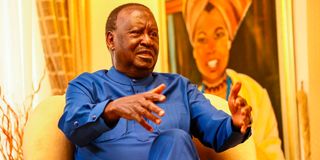
In an exclusive interview with NTV and the Daily Nation at his Karen residence in Nairobi on Saturday, Mr Odinga, who has contested the presidency five times, said the country is still navigating a national crisis.
He explained that ODM’s decision to cooperate with President Ruto’s administration was purely in the interest of national stability.
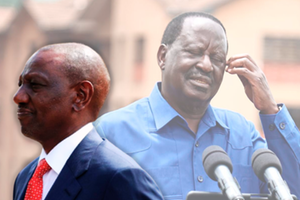
President William Ruto.
Photo credit: Pool
“We have said that we are in the broad-based government until 2027. We did not say that we are going to work with UDA beyond 2027. Those are issues that we will discuss at the appropriate time, and the decision will be made by party members, not Raila Odinga alone,” the ODM leader said.
Mr Odinga described the current political collaboration as a response to last year’s wave of youth-led anti-government protests, which pushed the country to the brink of civil unrest.
He disclosed that had they not intervened, Kenya risked plunging into a situation akin to Somalia, Haiti or Sudan.
“In 2023, we were in the streets raising very concrete issues about electoral justice, cost of living and corruption. The government responded with brutality, and we lost about 70 people. When we tried to honour them, no judge allowed us to hold a memorial. We eventually did it quietly,” he said.
He noted that the protests, followed by the Gen Z uprising in June 2024, exposed deep governance cracks, prompting international intervention, including mediation by Tanzanian President Samia Suluhu and Nigeria’s former President Olusegun Obasanjo.
The dialogue led to the formulation of the National Dialogue Committee (Nadco) report, which was later tabled in Parliament.
“Had the Nadco report been implemented earlier, we would not have had the Gen Z protests. The youth went further than we did. They stormed Parliament, the Judiciary and were heading to State House before being stopped,” he added.
The former prime minister revealed that former President Uhuru Kenyatta , who was in the US at the time, urged him to initiate dialogue with President Ruto to safeguard national peace.
“Although I had ruled out engaging Dr Ruto, the crisis forced my hand. I told him the Gen Z protests arose because Nadco was not implemented. We then agreed to broader consultations,” he said.
Azimio leader Raila Odinga holds a copy of a copy of Nadco report flanked by Wiper Party Leader Kalonzo Musyoka, Majority leader Kimani Ichung’wah and other leaders at Capital Hill.
Photo credit: File | Nation Media Group
He noted that allowing ODM members to join the government came after internal consultations within ODM and with Azimio principals.
“Initially, I was against it. But my colleagues felt we needed to steady the ship. So we allowed some of our experts to join the government. However, ODM as a party has not joined the government formally. That would require structured negotiations based on a clear agenda—which became our 10-point agreement ,” he said.
He insisted the 10-point agenda is a continuation of Nadco and that ODM has formed an internal task force to monitor its implementation.
Mr Odinga warned that if critical issues remain unaddressed, ODM will reconsider its involvement.
“There is a red line. If it is crossed, we will make a decision. Some things have been done, others have not, and we will evaluate and decide as a party,” he said in the interview.
To critics who accuse him of softening his opposition stance, Mr Odinga said his decision was driven by patriotism.
“I’m not worried about those who don’t understand. The cost of being Raila Odinga is high, but I have always acted in Kenya’s best interest,” he said.
On his 2027 presidential ambitions, Mr Odinga said he has not made a decision and cautioned that it’s too early to discuss the next election.
“I have not said that I’m running. I don’t have to run. I can support someone else, but I can also run if I want to. Right now, I’m focused on strengthening ODM,” he said.
ODM, he said, will complete party elections next month and hold a National Delegates Convention (NDC) in October to decide on the party’s political course.
Asked whether he would support Wiper leader Kalonzo Musyoka , who backed him in three consecutive elections, Mr. Odinga said: “Steve and I are friends. I respect him. But he has not asked for my support. When the time comes, we will evaluate who is best to carry the flag. The party—not I alone—will decide.”
He dismissed talk of a possible Ruto-Kalonzo alliance as “total rubbish,” saying any future coalitions would only come after consultations.
On claims that he has compromised his values by working with former political foes, Mr Odinga defended his legacy: “I have always stood for justice. We demanded change, and many lives were lost. We did not compromise, we acted for peace.”
He reiterated his opposition to extra-judicial killings, including President Ruto’s directive to "shoot the legs" of protesters.
“I condemned it publicly. That is lawlessness. Police should arrest, not kill,” he said.
“There is a contingency fund in the national budget. Compensation is going to happen soon, and we have a task force handling it,” he said.
On electoral reforms, the veteran Opposition leader proposed radical changes, starting with scrapping the voter register. He called out the IEBC’s procurement-heavy model, suggesting voter registration and digitisation have become cash cows.
Mr Odinga proposed using only national IDs for voting and eliminating the need for separate voter registration.
“Why are Kenyan elections among the most expensive in the world? It’s not rocket science. The system is bloated to enable looting. If you have an ID, you should vote. There are areas where people don’t have voter cards, and this skews the register,” he said.
He also called for staggered elections rather than holding six contests of presidential, gubernatorial, senatorial, MP, Woman Rep, and MCA on a single day, arguing that the current approach creates confusion and inflates costs.
“In many countries, not all elections are held on the same day. Staggering them makes it easier and cheaper,” he said.
He urged the new IEBC team led by Chairperson Erastus Ethekon to prioritise rebuilding public trust, saying years of disputed elections have undermined credibility and also condemned recent statements by politicians predicting vote rigging in 2027 as reckless.
“Kenyans are very skeptical because of past experience. But if the commission can show professionalism and neutrality, we can restore trust. I have seen some irresponsible remarks. People think I’ve lost so many times, but I only lost once in 1997. Kenyans know the truth. History will absolve us,” he said.
Mr Odinga reaffirmed his commitment to national unity and criticised ethnic-based political mobilisation.
“I’m from Nyanza, but my politics are national. I have relatives across Kenya. This talk of ‘Sisi watu wa Mlima’ is isolationist. Kenya is one country.”
He also criticised former Deputy President Rigathi Gachagua’s “shareholding” remarks, describing them as divisive.
He contrasted Gachagua’s style with that of current Deputy President Prof Kithure Kindiki , whom he described as “more intellectual and less ethnic.”
On his political future, Mr Odinga reiterated that he would preside over the ODM NDC, where a collective decision will be made.
“I have not made that decision, and I will consult with colleagues, and we will decide together.”