MPs have granted diplomatic immunities and tax exemptions to staff of the Ford Foundation, paving the way for the US-headquartered non-profit corporation to establish and strengthen the Foundation's Regional Office in Nairobi.
The National Assembly’s committee on Delegated Legislation has approved the draft Privileges and Immunities (Ford Foundation) Order, 2026.
If the House approves the report of the committee, MPs will hand tax exemptions to the Ford Foundation, which will constitute revenue forgone to be accounted for under Article 210 of the Constitution.
Article VI of the Agreement exempts the Foundation from taxation, including stamp duty, land rates and rents, and from customs duty, excise duty and value added tax on goods and services for official use.
In mid-July 2026, Dr Ruto claimed that the Foundation hired goons to cause mayhem during the Gen Z and anti-government protests, which led to the destruction of property and looting of businesses. The Foundation denied the accusations.
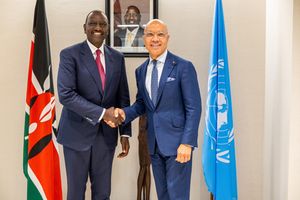
Months later, Dr Ruto met the then Ford Foundation President Darren Walker in New York and praised the organisation for its support of democracy in Kenya and its commitment to safeguarding democracy globally.
President Willia Ruto after talks with Ford Foundation president Darren Walker in New York.
Photo credit: PCS
The draft order was made by the Prime Cabinet Secretary and Cabinet Secretary for Foreign and Diaspora Affairs, Musalia Mudavadi, under section II of the Privileges and Immunities Act, Cap. 179.
“The purpose of the draft Order is to give the force of law in Kenya to the privileges and immunities agreed under the Host Country Agreement between the government of the Republic of Kenya and the Ford Foundation, signed on 13th March 2026, which provides for the establishment and strengthening of the Foundation's Regional Office in Nairobi,” Samuel Chepkonga, who chairs the committee on Delegated Legislation, said in a report.
“Having examined the draft Order against the Constitution, the Privileges and Immunities Act, Cap. 179, the Statutory Instruments Act, Cap. 2A and the Interpretation and General Provisions Act, Cap. 2, the committee recommends that the House approves the draft Order.”
The agreement authorises the Foundation to establish a Regional Office in Nairobi for purposes of carrying out its activities in Kenya and elsewhere in Eastern Africa.
It also defines the legal status, privileges, immunities and obligations of the Foundation and its officials in Kenya.
The committee said it raised concerns on accountability, the fiscal effect of the exemptions and the identification and number of beneficiaries.
“The committee found that the draft Order is within the powers conferred by section II of the Act and that the privileges conferred on the Foundation correspond to those agreed in the Host Country Agreement,” Mr Chepkonga said.
“The tax exemptions conferred constitute revenue forgone to be accounted for under Article 210 of the Constitution.”
Article 210(1) of the Constitution provides that no tax or licensing fee may be imposed, waived or varied except as provided by legislation.
Article 210(2) requires that where legislation permits the waiver of any tax or licensing fee, a public record of each waiver shall be maintained together with the reason for the waiver, and each waiver and the reason for it shall be reported to the Auditor-General.
The Privileges and Immunities Act provides immunities, privileges and capacities to international organisations and foundations with which Kenya partners.
“In furtherance of that objective, the Agreement seeks, subject to the laws of Kenya, to grant privileges, immunities and exemptions to the Ford Foundation, and grant exemptions and privileges to officials of the Ford Foundation in the performance of official work.
“The Ministry states that the Agreement will enhance Kenya's international profile, strengthen cooperation with global philanthropic stakeholders, create employment and capacity-building opportunities for Kenyan professionals, and increase support for projects in Kenya and Africa focused on democracy, inclusion and human rights.”
Article 11 of the Agreement authorises the Foundation to establish a Regional Office in Nairobi under a Regional Director appointed by the President of the Foundation.
Article Ill confers on the Foundation legal personality and the capacity to contract, to institute and defend legal proceedings, and to acquire, hold and dispose of property in accordance with the laws of Kenya.
Article V provides for the inviolability of the offices, premises, property, archives and communications of the Foundation, and grants it immunity from legal process except in commercial and labour disputes, traffic claims and where immunity is expressly waived. Rules applicable within the premises are subject to the laws of Kenya, and the premises may not be used as a refuge.
“Article VIII sets out the privileges of officials, namely exemption from income tax and social security contributions, the duty-free importation of household effects and motor vehicles on first arrival, exemption from national service, banking and the transfer of funds, repatriation in times of crisis, immunity for official acts, freedom of movement and exemption from export duty on departure,” the report states.
“Clauses I, 2, 3, 5 and 9 of Article VIII do not apply to Kenyan citizens and permanent residents. Article IX provides for diplomatic identity cards, exemption from work permits, facilitation of entry and transit, and notification to the government of officials and their dependents.”
The Agreement will be in force for ten years, renewable, and may be terminated by mutual consent, by 12 months' notice or upon closure of the Regional Office.
The Foundation is required to submit annual returns to the Ministry on all its activities in Kenya, including a summary of income and expenditure and particulars of its employees. The first return was due within three months of signing, by 1 30' June 2026, and thereafter annually by 31st December.