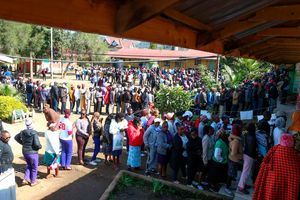
Kenya is heading towards the 2027 General Election with a cocktail of warning signs that security and electoral officials fear could undermine the credibility of the polls and plunge the country into a political, economic and humanitarian crisis.
From goons disrupting rallies to rising hate speech, allegations of planned election rigging, disputes over lucrative electoral tenders, disinformation, growing public distrust in electoral institutions and concerns over police conduct, the red flags are stark 342 days before Kenyans vote.
The concerns dominated a high-level national election security consultative forum convened in Nairobi yesterday to assess the country’s preparedness for the 2027 elections.
The Independent Electoral and Boundaries Commission (IEBC), National Cohesion and Integration Commission (NCIC), National Police Service (NPS), Office of the Director of Public Prosecutions (ODPP) and Judiciary warned that lessons from the 2007/08 post-election violence must not be forgotten.
The 2007 disputed presidential election plunged the country into violence that left more than 1,100 people dead, 3,500 injured and up to 600,000 displaced, and inflicted a heavy economic cost.
Officials at the forum warned that failure to confront the emerging threats early could expose the country to a repeat of that dark chapter.
Their concerns come against the backdrop of the Kofi Annan Foundation’s Electoral Vulnerability Index 2026–2027 released in July, which placed Kenya’s probability of experiencing some form of election-related violence at 81.6 per cent.
The report identified weak public trust in the IEBC, economic hardship, youth discontent and unemployment, ethnic mobilisation and concerns over police conduct during protests among the factors that could increase the risk of electoral violence.
Court of Appeal Judge and Vice-Chairperson of the Judiciary Committee on Elections Justice Daniel Musinga speaks during a High-Level National Election Security Roundtable Consultative Forum organised by the Independent Electoral and Boundaries Commission (IEBC) at Serena Hotel in Nairobi on August 2, 2026.
Photo credit: Bonface Bogita | Nation
“The political environment since 2022 has been marked by economic hardship, tax protests, opposition mobilisation, debates over the cost of living and public anger over corruption and police conduct. Youth-led protests and civic activism have shown that grievances can mobilise beyond traditional party structures. The 2027 cycle may therefore combine conventional presidential competition with broader accountability demands,” the report states.
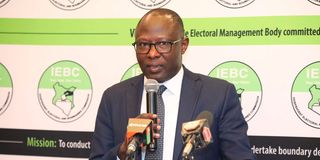
IEBC Chairperson Erastus Ethekon said the commission was increasingly being forced to respond to serious allegations by political leaders over the management of the 2027 elections. He warned that unsubstantiated claims about the electoral process risked undermining public confidence in the commission even before the election campaign had fully gathered pace.
“The events of 2007/8 were significant in making us learn that we are not immune to ethnic violence, to political violence. We are not immune to anything as crazy as what happened in our neighbouring country Rwanda,” Mr Ethekon said.
“We need to fact-check some of these wild allegations that are clearly calculated to create in the minds of ordinary Kenyans, who are our voters, that the elections are not going to be free and fair,” he said.
His remarks came against the backdrop of claims by Democracy for the Citizens Party Leader Rigathi Gachagua that the IEBC was planning to influence the 2027 election through a new election management system.
A company that has challenged the multi-billion shilling tender for technology to be used in next year’s General Election has claimed the commission designed the procurement process to favour a South Korean firm.
Galadirel Investment Limited told the Public Procurement Administrative Review Board that the requirements in the tender for the integrated elections management system (IES) and related hardware appear to mirror the experience, capacity and past achievements of Miru Systems, a South Korean company.
The Independent Electoral and Boundaries Commission Chairperson Erastus Edung Ethekon speaks during a High-Level National Election Security Roundtable Consultative Forum organised by the IEBC at Serena Hotel in Nairobi on August 2, 2026.
Photo credit: Boniface Bogita | Nation
The contested tender is one of two major international tenders floated by IEBC in preparation for the 2027 General Election. It covers the IES and associated hardware that will support the Kenya Integrated Elections Management System (Kiems) kits used for biometric voter registration, identification and transmission of election results.
“We shall call out those people, and institutions, whether in the media, in the political space or in the civic space, that without any justifiable reason whatsoever, try to undermine the institution of IEBC and the electoral processes in the Republic. We shall do that without fear or favour,” he said.
The IEBC chairperson, however, acknowledged that the commission could not deliver a credible election on its own and needed the support of security agencies, the Judiciary and other institutions.
Commissioner Hassan Noor Hassan said political parties and candidates would also have a critical role to play by accepting the outcome of the election.
“Political leaders who lose in the 2027 General Election must be ready to accept the outcome. Our appeal to the political class is to accept defeat graciously as and when it happens,” he said.
The threat posed by political goons was another major concern, with DPP Renson Ingonga warning that weak investigations and insufficient evidence were hampering efforts to prosecute perpetrators of political violence, hate speech and incitement.
Inspector-General of Police Douglas Kanja speaks during a High-Level National Election Security Roundtable Consultative Forum organised by the Independent Electoral and Boundaries Commission (IEBC) at Serena Hotel in Nairobi on August 2, 2026.
Photo credit: Bonface Bogita | Nation
Mr Ingonga challenged the police and the Directorate of Criminal Investigations (DCI) to gather evidence linking individual suspects to the offences they are accused of committing, including evidence identifying those who finance or coordinate goons.
“We use evidence to arrive at the truth. I would ask those of us who are here to help us in this. You can say this goon is doing so and so’s work. The goon is so and so, but when we ask you to give us evidence between this person and the goon, you don’t want to give us and yet you know,” Mr Ingonga said.
He said arresting the young people involved in violence without pursuing those who organise or finance them would not solve the problem.
The DPP added that he had engaged Parliament on proposed amendments to the Penal Code to address statutory gaps relating to public order offences, including incitement to violence and creating a disturbance likely to cause a breach of the peace.
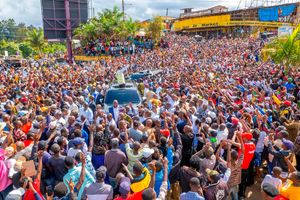
Goon attacks have recently been reported in Homa Bay, Migori, Ol Kalou, Nyeri and Kisumu, mostly during opposition rallies.
Bishop Kepha Omae, the NCIC chairperson, said the commission was concerned about rising cases of hate speech and incitement. He added that the commission would move swiftly against politicians and other Kenyans whose utterances breached the law.
“We have moved with speed to make sure that as soon as we receive any information, report or the public sends any clip content of any politician ... any Kenyan that breaches the law, we move with speed without any fear and without intimidation,” he said.
NCIC’s role in election security, Mr Omae said, included monitoring political speeches and messages circulating on social media platforms such as WhatsApp.
The commission also called on politicians to sign and abide by the electoral code of conduct, warning that no one would be spared if they used their platforms to incite hatred against other communities.
Politicians who have come under the commission’s spotlight include Mr Gachagua, Health Cabinet Secretary Aden Duale and his Public Service counterpart Geoffrey Ruku, Mukurwe-ini MP John Kaguchia, Sirisia MP John Waluke and Mandera Deputy Governor Ali Mohamud. Others are Busia Governor Paul Otuoma and Homa Bay Town MP Peter Kaluma.
Inspector-General of Police Douglas Kanja said the NPS had begun rolling out a security plan for the 2027 elections, drawing lessons from previous crises in which security agencies were caught off guard. He indicated that the plan would focus on protecting electoral personnel and infrastructure, while ensuring that police operations remained neutral.
“The risks posed by poor planning or inadequate coordination should not be given room. NPS has prepared a phased roadmap covering the vital period,” Mr Kanja said.
The police have, however, faced criticism over their handling of political rallies in recent months, particularly incidents involving groups of young men accused of disrupting political events.
Under Kanja’s watch, tens of protesters were killed during the 2024 youth-led demonstrations. Dozens more have been killed in subsequent protests in 2025 and this year. There have also been cases of enforced disappearances carried out by persons believed to be police officers.
Unresolved deaths in police custody have also sparked outrage. The Independent Medico Legal Unit documented 20 deaths in places of detention last year.
Justice Daniel Musinga, who was the chief guest, said emerging threats such as hate speech, misinformation and disinformation, political propaganda and technologically facilitated electoral gender-based violence required a coordinated response.
“For the Judiciary to do its work appropriately, there must be proper investigations, which would lead to good evidence being adduced,” he said.
He urged all institutions involved in election security to play their part, stressing that the country was bigger than any individual.