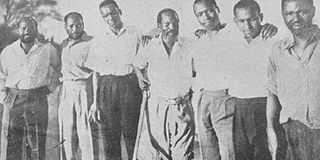
On this day 67 years ago, in the wee hours, Kenya African Union (Kau) leaders Jomo Kenyatta, Achieng Oneko, Kung’u Karumba, Paul Ngei, Bildad Kaggia and Fred Kubai were rounded up and detained for having connections with the Mau Mau.
Ten hours earlier, Governor Evelyn Baring had declared a State of Emergency, paving the way for the arrest of those the Colonial Office said were “behind chaos and lawlessness in the Colony”.
According to minutes of a secret meeting held at the Attorney-General’s chambers three days before the operation, it was agreed that “a plane should be standing by from 4am on October 21” to take Jomo Kenyatta to Lokitaung. “He should be brought on to the airfield through the civil entrance.”
At an earlier meeting held on October 17 at Government House chaired by the governor, it had been decided that at Lokitaung, Kenyatta should be kept in a cell occupied by trade unionist Makhan Singh, who was to be moved to Lodwar.
Although the emergency had been under planning for quite some time, it was hastened after the murder of senior chief Waruhiu at Gachie, on October 7, 1952.
The murder of one of the colonialist’s strongest loyalists in a brazen daylight attack had finally brought to the attention of the colonial officials how bold Mau Mau had become.
“The murder of Waruhiu and two murderous attacks on Europeans have produced a temper bound to lead to reprisal and then almost to civil war, unless leaders of the Mau Mau movement are removed during the next few days,” wrote Governor Baring in a telegram to the Colonial Secretary.
"I conclude therefore that we must remove Kenyatta and several of his henchmen during the next few weeks.”
In concluding that there existed a central body within Kau that directed and coordinated Mau Mau, the government did not only rely on police investigations, but also on some Kau officials who treacherously leaked information to colonial administrators.
Kau was formed in October 1944, with Harry Thuku as president, Francis Khamisi as secretary, and Albert Owino as treasurer.
It stated its aims as “to unite African people towards an African nation, and to foster the social economic and political interests of the Africans”.
However, in January 1945 , Thuku was considered too moderate and forced to resign by former members of the proscribed Kikuyu Central Association (KCA), who now had great influence in the party. James Gichuru became the new president and H. Nangurai vice president.
In 1946, Kenyatta returned from his prolonged sojourn in Britain but found himself without a political vehicle through which he could further his goals, since the KCA, where he was the acknowledged leader, had been banned by the government.
He at once took charge of Kau, which had the advantage of being legal, widespread and dominated by his former associates in the KCA.
Under Kenyatta’s leadership, Kau became increasingly critical of the government, and European occupation.
By 1948, Kau had absorbed most of the members of the banned KCA and had also adopted the technique of oath-taking in order to bind members to secrecy.
In 1950, the colonialists began taking a keen interest in Kau activities after they became convinced that its oath was similar to that of Mau Mau.
In August 1950, the colonial Governor outlawed Mau Mau and declared heavy punishment for anybody caught taking ritual oaths.
He further challenged Kau leaders to come out openly to condemn Mau Mau to prove that the two groups were not associated.
But despite Kenyatta’s public statements disassociating Kau from the Mau Mau, the colonialist felt he was not genuine.
“Kenyatta has induced the Kikuyu to obey him. Yet his condemnation of Mau Mau crimes has been ineffective and has often, I am told by Kikuyus, been accompanied by sayings and gestures making it clear to his audience that he did not mean what he said,” wrote Governor Baring.
Apparently, Kenyatta’s reluctance was because of a warning he had received from members of a committee which coordinated the activities of Mau Mau in Nairobi after he began to condemn the group.
This account was given by the leader of Kau Nairobi branch Fred Kubai, who was a member of the committee and was present when Kenyatta was summoned.
However, moderate Kau leaders such as vice president Tom Mbotela and treasurer Ambrose Ofafa strongly and openly condemned Mau Mau.
Despite being Kau’s second-most senior leader, in September 1950, Mbotela secretly reported to the colonial government that the union’s office bearers were administering oaths.
The following month, he again reported that at Nyeri, Kenyatta had advised Kau branches to support Mau Mau.
In May 1951, London-based Colonial Secretary James Griffith arrived in Kenya to assess the situation.
He held a two-hour meeting with Kau leaders, among them Kenyatta, and Mbotela, who demanded the return of land to Africans and equal representation in the LegCo.
Griffith would later write to the Governor, revealing: “It was notable that after that meeting, I had a private letter from Kenyatta’s chief lieutenant (Tom Mbotela, an honest if rather weak little man) expressly disassociating himself from some of the more extreme sentiments uttered by Kenyatta at the meeting, but making it clear that he dare not do this in public.”
At Kau’s 6th annual conference held in November 1951, Mbotela and Ofafa, who were also councillors in the Nairobi City Council, were removed from office and relegated to mere members.
Ofafa was replaced by Nangurai but Mbotela’s position remained vacant. This, however, did very little to stop the two from collaborating with the government.
According to a letter sent to “The Hon. Member for Law & Order” by Nairobi District Commissioner, Mbotela, Ofafa and Mohamed Mudhiri visited him on Aug 7, 1952 and told to him that Kau had become practically synonymous with Mau Mau and therefore should be proscribed.
The DC went on to reveal, “Tom Mbotela states that he is aware that Bildad Kaggia is deeply implicated in the Mau Mau organisation, and he thinks he is Treasurer of it.”
On November 27, 1952, a month after the declaration of emergency, Mbotela was murdered in Shauri Moyo market by suspected Mau Mau.
That same night the police, acting on a tip off, raided Burma Market and arrested everybody.
Two hours later, the market was burnt to the ground by the Nairobi Municipal Council.
The police cordoned off the area and thoroughly searched the ground for two days. One revolver, a rifle and a huge roll of copper wire were found.
Almost a year later, in November 1953, Ofafa died of gunshot wounds after he was ambushed by an assailant in Ziwani location at night.
The colonialist tried to use his death to incite Luos against the Kikuyus but Jaramogi Oginga Odinga and Tom Mboya held meetings throughout Nairobi warning Luos not fall victim to the colonialist’s tactic of divide and rule.
In his book Not Yet Uhuru , Jaramogi wrote that it was Ofafa who introduced him to Kenyatta in Kisumu.
Ofafa’s funeral in Alego, Siaya, was attended by senior colonial administrators and prominent African leaders. Two African housing estates were later named after Ofafa and Mbotela by the colonial administration.
Following the arrest of all Kau leaders, Walter Odede became the new president while WWW Awori became the vice president.
Odede’s leadership was however short-lived for he was arrested five months later after being snitched on by Chief Gideon Magak of Kasipul.
He was on a tour of South Nyanza when Magak informed the police that Mau Mau agents were in his home.
In March 1953, Odede was detained for seven years after the Governor became satisfied that he was trying to “spread in Nyanza the violent methods adopted by Mau Mau”.
With Odede also in detention, WWW Awori, the brother of President Mwai Kibaki’s Vice President Moody Awori, was entrusted with the leadership of Kau.
But he would later betray the trust bestowed upon him when he made a secret visit to Government House (the equivalent of State House) on June 6, 1953, and informed the colonial Governor that he was not happy with his position in Kau.
According to a confidential telegram “Number 700”, he further recommended to the Governor that the political outfit should be banned since it was hindering efforts to restore law and order.
He however requested the Governor not to make his views public. Two days later, the Governor banned Kau, therefore making continued membership a serious offence.
He subsequently vested all the party’s property in MN Evans, who was an African Court Officer. The Emergency would eventually end, and the leaders released, with Kau changing to Kanu ahead of independence.