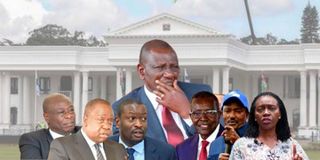
Behind the alignments shaping up ahead of the 2027 General Election is the question of why there is so much jostling to preside over a country facing serious economic, political and social upheavals that promise to make 2027–2032 like governing in hell.
Beyond the raging ‘Wantam’ and ‘Tutam’ political rhetoric (the former term for those backing the removal of President William Ruto in 2017 and the latter for his re-election for a second term) lies a deeper worry about whose hands the country will be safer in.
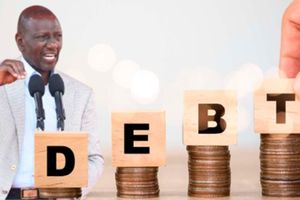
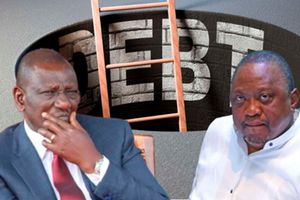
Whoever wins the 2027 General Election will inherit Sh13 trillion in debt , Sh700 billion in pending bills and angry youth. That is why political analysts are calling it “the hell presidency.”
“If it is hard enough today to circumvent debt, it will be a nightmare in the next governance term. This year alone, Sh1.3 trillion to Sh1.5 trillion is supposed to go to debt repayment and pensions. That is nearly half of all the money the government collects. This means there will be less left for development after we set aside the recurrent expenditure budget,” said Mr Wanjumbi Mwangi, an economic consultant.
Mr Mwangi noted that while the law demands that the development budget remain above 30 per cent, it is no longer possible, with estimates that by 2029 the percentage will have shrunk to about 15 per cent.
Mr Wanjumbi said the economic situation is dire and the 2027–2032 regime will have to get the country out of deficit-financed and borrowing-dependent national budgets, where, for now, the 2026/27 fiscal budget has a Sh1.1 trillion deficit that calls for borrowing.
With the Bretton Woods institutions growing weary of the local economic out-look, the incoming government — be it President William Ruto’s or the opposition’s — is expected to contend with stagnant employment opportunities, a heavy debt portfolio, unequal wealth creation and limited development projects.
Deputy President Kithure Kindiki.
Photo credit: DPCS
“We have, for instance, paid Sh177 billion debt to road contractors. We are undertaking the building of 6,000 kilometres of roads and we will employ more teachers… President Ruto has got it right and the best Kenyans can do is to re-elect him to steady the ship,” Prof Kindiki said in Murang’a last Sunday.
President Ruto has already launched Economic Vision 2060 to consolidate economic gains , with a promise of making the country a replica of the Asian Tigers. He has also offered a warning that his administration must get back to power, issuing a thinly veiled warning that “those planning to inherit me are clueless… and they represent what no one can fathom”.
Democracy for Citizens Party (DCP) presidential hopeful Mr Rigathi Gachagua said President Ruto is giving a rosy picture where gloom exists.
He said the economic hardships Kenyans are undergoing have everything to do with state capture, where taxes are raised for tokenism instead of expanding the economy and government projects are transformed into private gain by a government full of wheeler-dealers.
Democracy for Citizens Party (DCP) Party Leader Rigathi Gachagua during a media briefing at the party's offices in Nairobi on August 11, 2026.
Photo credit: Francis Nderitu | Nation Media Group
“The International Monetary Fund has since issued a warning that our public debt is climbing dangerously and might hit 72.4 per cent by 2028. President Ruto can only take us deeper into a crisis since even the tax he gets goes to other uses not committed to fixing the national economy,” he said.
He said an alternative government is needed so that it can immediately bring down taxation levels to increase disposable incomes and spur a private sector-driven economy, rather than the current situation where the government is doing business.
“The three things that President Ruto has lacked and cannot be relied upon to recover from are borrowing discipline, commitment to clearing pending bills and his appetite for revenues from earnings,” he said.
He said it will not be hard for the incoming government if it comes from the current opposition side, but all efforts must be made to save the country.
Jubilee Party presidential hopeful Dr Fred Matiang’i said the country needs shock therapy to get back to economic reprieve, especially for the less well-off.
“It is urgent to realise that we cannot grow this country through this harsh taxation choking every income stream. We cannot borrow because we are living under a dangerous debt burden. The only way out is to live within our means, revise some of our ambitions and, above all, get the stolen loot and jail the thieves,” he said.
Jubilee Presidential hopeful Dr Fred Matiang'i in Borabu, Nyamira County on April 24, 2026.
Photo credit: Ruth Mbula | Nation Media Group
While some of the proposals sound good and populist, pundits warn that relying on stolen wealth to be channelled back into the mainstream economy is a naive ambition.
Laikipia East MP Mr Mwangi Kiunjuri says “there is no money buried in a public cemetery such that all that you will need is a court order to go and exhume it”.
He said, “thieves of Kenya’s economy date back to 1963 and making them surrender the loot will take painstaking court battles that might end after the world has since been folded”.
Mr Kiunjuri said, “what we need are practical efforts like the ones we are seeing President Ruto articulate… issues like the infrastructure fund, Vision 2060 that seeks to make manufacturing a key pillar… the Bottom-Up Economic Transformation Agenda and a commitment to expanding the economy for all 47 counties”.
Mr Kiunjuri said the economic story in the next six years will be written by whether Kenya can grow faster than it borrows — and whether those pending bills finally get paid, or just become another loan.
“We need to remain very awake in the ongoing political discourse. If we all reasoned, you will find that Kenyans will stand to gain a lot if they voted for continuity rather than severance… But democracy being the freedom to choose the ropes to hang you… Let us wait,” he said.
Mr George Natembeya, who is also eyeing the presidency, warns that the mother of all youth uprisings might be lying in wait for the country.
“The youths revolted in 2024. The government promised to deal with the issues that they raised. Instead, what happened was a cruel crackdown that made the youths retreat,” he said.
He said the demands the youths raised remain pending and will come back to haunt the next government.
“The youths now have high hopes that if the opposition gets into power, their concerns will be addressed. Those concerns are a debt. The sinister angle about it is that, if this same government gets back to power, it might incense the youths to a point of no return… If the opposition bags it and dithers with them, it will be another minefield to navigate,” he said.
He added that the youths will justifiably demand to know who was abducting and murdering them and demand that they be brought to book, as well as those who looted their resources.
“That will be a tough call but one which we must do if we win power. The targeted will talk of witch-hunt, and the corrupt will fight back, but we must get it right and pay the accountability debt we owe the youths,” he said.
Mr Natembeya said the issue of youths and their inclusion in the running of the affairs of the country will define the stability of the nation for the 2027–2032 term.
“When joblessness is the order of the day, do not get worried about insecurity. We must agree that the next government better abandon all other engagements and first address the issue of idle education and dormant talents. We cannot afford this culture we have built over time of making the youths’ minds be the devil’s workshop and expecting bullets, jail terms and lynch mobs to provide us security,” he said.
The winning side will also face a tricky legislative composition in the National Assembly, Senate and counties.
According to political analyst Mr Herman Manyora, both Houses and the county assemblies will be like the Tower of Babel.
“We are seeing regional parties and tribal mobilisation. Every region wants to get to 2027 riding on its political party. What this means is that 2027–2032 will be a daily negotiation exercise. President Ruto has taught us that with numbers, you can do anything. I foresee a situation whereby the winning president will have a minority in the Houses, and that is risky,” he said.
He said Presidents Uhuru Kenyatta and William Ruto have perfected the politics of impeachments, and if the winning president is without them, impeachment will be real.
“This means that the greatest challenge facing us as we approach 2027 is about uniting ethnic numbers in the Houses and the signing of both pre- and post-election coalition pacts. Much as we would love to pretend, we are now approaching a government of shareholding in its most vicious form,” he said.
Busia Senator Mr Okiya Omtatah said the next government after Dr Ruto’s — be it in 2027–2032 or beyond — will have to spare a constitutional moment to fix serious gaps that the broad-based government has caused.
“President Ruto’s rule has made it urgent for us to seal constitutional gaps that he utilised and nearly felled the nation. We must strengthen our institutions to rid them of the capture we are witnessing. By manipulating the constitutional gaps, we have witnessed senseless impeachments, sale of state assets, cold-blooded and blasphemous crackdowns on dissent, as well as utilisation of strange budgets to dish out money to citizens,” he said.
He said the country also needs to tame government officials from campaigning using state resources, as was witnessed in by-elections, so that the country can start discarding the culture of politicking immediately after a new government is installed.