Former Deputy President Rigathi Gachagua’s bold campaign to brand Mt Kenya as a stronghold of the Democracy for the Citizen’s Party (DCP) has thrown the region’s politics into disarray, triggering a wave of activity as over a dozen political outfits jostle for dominance in what remains Kenya’s ultimate electoral battleground.
Others include The Service Party (TSP) led by Laikipia East MP Mwangi Kiunjuri, Chama Cha Kazi (CCK) of former Minister Moses Kuria, Devolution Empowerment Party (DEP) under Lenny Kivuti, Usawa Kwa Wote Party of former Murang’a Governor Mwangi wa Iria, Ferdinand Waititu’s Farmers’ Party, and The National Party (TNP) linked to former Thika Town MP Patrick Wainaina Wa Jungle.
A wave of political anxiety is sweeping through central Kenya as Mr Gachagua intensifies efforts to cement DCP as the region’s dominant force ahead of the 2027 General Election. Insiders say the campaign seeks to give him a political vehicle to consolidate influence and bargaining power, unsettling rivals who fear being locked out.
The jostling is influenced by fears that Mr Gachagua’s quest for a DCP monolith could hinder their chances of election if the region identified with only one outfit.
Political analysts believe Mr Gachagua is positioning himself as Mt Kenya’s political supremo, with ambitions beyond the deputy presidency.
“Gachagua is trying to consolidate the region under his DCP, and his strategy is to be the uncontested political gatekeeper of the mountain. If he succeeds, many leaders risk being politically irrelevant, as access to the region’s vote would flow through him,” says Prof Gitile Naituli of the Multi Media University of Kenya. “That fear is fuelling the rush by figures like Karua, Wanjigi, Kuria, Muturi, Uhuru, Kiunjuri, Munya, and Kindiki to stake their claim before the door is shut.”
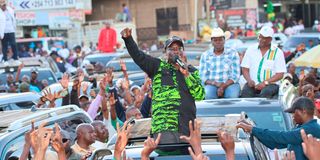
Democracy for Citizens Party (DCP) leader Rigathi Gachagua speaks at Kiritiri town in Embu County on October 11, 2025.
Photo credit: George Munene | Nation
He adds that the contest is driven by “fear of exclusion, ambition for succession, and the exploitation of economic discontent”.
According to Prof Naituli, “If Gachagua’s DCP push succeeds, he will monopolise Mt Kenya’s bargaining power for years. The stakes are high—not just for 2027, but for the next decade of Kenyan politics.”
In recent weeks, central Kenya has witnessed a flurry of activity as ex-ministers, governors, and MPs revive or register parties to secure a foothold in the evolving power structure. The rush highlights fear that DCP could sideline traditional power brokers reliant on national parties for survival.
Embakasi Central MP Benjamin Gathiru defends the movement, saying DCP is meant to unify the region under a single identity “that allows Mt Kenya to negotiate with strength at the national table”.
But Safina Party leader Wanjigi dismisses Mr Gachagua’s approach as outdated. “Mr Gachagua has chosen a tribal path. That’s not Safina’s politics,” he told the Nation. “If Mt Kenya believes its salvation lies in ethnic parties, good luck to them. We believe our unity is in shared economic pain.”
He added that Safina will crisscross the country—from the Coast to Bungoma—building issues-based networks. “I want to have representation in Pokomo land and Bungoma on the basis of issues, not tribe,” he said. “The Gen Z showed us that Kenyans have moved on. Don’t hijack their struggle and reduce it to tribal games.”
Political analyst Dismas Mokua observes that Mr Gachagua’s growing assertiveness mirrors earlier political realignments.
“It is not lost on observers that Mr Gachagua lost his cool when Dr [Fred] Matiang’i attended the Jubilee NDC. Jubilee can upset the political environment created by Gachagua, who wants to prefect both Mt Kenya and the opposition,” he said.
“He wants unchecked powers. This explains why other politicians are invigorating their political parties because Mr Gachagua can lock them out of the 2027 race if they don’t dance to his drumbeats. Gachagua simply wants to suffocate multiparty politics in Mt Kenya and make DCP the de facto party.”
Mr Gachagua insists his mission is to “restore Mt Kenya’s political dignity”, arguing the region has long been reduced to a mere voting bloc for external power centres.
But not everyone agrees. Githunguri MP Gathoni Wamuchomba maintains that former President Kenyatta remains “the undisputed kingpin of Mt Kenya”.
“He didn’t force it on us,” she says. “In his 10 years, despite flaws, he was never impeached, and never impeached his deputy. He unified the country. He’s free to bless whoever takes over. No one has the monopoly of Mt Kenya’s eight million votes.”
In a thinly veiled jab at Gachagua, she warned against “entitlement politics”, saying, “It’s disheartening to see mountain people attacking each other for political competition; this entitlement is too much! Before DCP, there were Jubilee, UDA, DP and others. Nobody owns the mountain. We said before, hatupangwingwi (We can’t be controlled) Uhuru is the undisputed kingpin of the mountain, and he didn’t force it on us,” she said.
TSP leader Mwangi Kiunjuri accuses Mr Gachagua of pursuing “personal vendetta and divisive rhetoric instead of offering solutions for Kenyans”.
Sensing DCP’s rise, Dr Ruto has deployed his deputy, Prof Kindiki, to reclaim the region’s loyalty. “I cannot be a DP and the President lacks support here,” Prof Kindiki said. “I’ll do everything to ensure he is respected and supported. We have seen what he has done and what he will do.”
Prof Kindiki has urged locals to reject leaders he described as “clueless politicians with no development agenda” and “power-hungry busybodies” who failed to deliver development while in office but now seek to turn voters against government projects.
Deputy President Kithure Kindiki waves to a crowd in Maara, Tharaka Nithi County on October 11, 2025.
Photo credit: DPCS
He said such leaders are urging residents not to support the government. He termed such moves retrogressive and political miscalculation. “When they were in power, they never bothered to push for any development for the people. After losing their seats, they are lecturing us and telling us to abandon government for uncertainty and the unknown. We can’t and will not allow that to happen.”
Prof Kindiki has virtually remained the face of UDA and Dr Ruto in the region, traversing it with his economic empowerment programmes and development projects to woo locals. But Mr Wanjigi predicts that the 2027 contest will narrow down to a two-horse race, “but not along tribal or party lines.” He adds: “The Constitution already provides for a two-horse race in the runoff. I can’t see Ruto getting 50 [per cent] plus one. If credible candidates run, Ruto may not even make it to the second round.”
Analysts say the current jostling mirrors historical Mt Kenya realignments—from the splinter parties that supported President Mwai Kibaki under PNU in 2007, to the formations like TNA, APK, and GNU that were part of the Jubilee coalition in 2013 under Mr Kenyatta.
“Whenever one leader appears to consolidate too much control, others respond with counter-movements. What we are seeing is a pre-emptive reaction to Gachagua’s perceived dominance,” Mr Mokua explains.
While Gachagua’s allies insist DCP will strengthen regional unity and bargaining power, his critics fear it could rekindle the divisive politics reminiscent of the 2022 succession wars that fractured their political unity. The former deputy president’s growing assertiveness—symbolised by frequent grassroots tours—has further deepened suspicion that he is laying the foundation for a post-Ruto political path.
As 2027 draws closer, Mt Kenya seems headed for another bruising internal battle—over who truly speaks for the mountain.