Democracy for Citizens Party (DCP) leader Rigathi Gachagua is a man confronting tricky political battlefronts that could either cement or cripple his influence ahead of the 2027 General Election.
Since his impeachment as Deputy President in October 2024, Mr Gachagua has reinvented himself as a central mobiliser within the United Opposition. According to Jubilee Party Chairman in Kiambu County, George Maara, the impeachment inadvertently strengthened the opposition.
“We thank President William Ruto for the blessing of Gachagua’s impeachment. The move donated to us a polished mobiliser and orator who amplified the voice of the opposition,” Mr Maara told the Nation on February 3, 2026.
Yet even as he consolidates his base, Mr Gachagua faces resistance in nearly all the pre-2010 constitutional regions from his Mt Kenya backyard to Coast, Rift Valley, Western, Nyanza and North Eastern.
In Nairobi, Mr Gachagua has faced backlash over remarks suggesting that senior county positions be zoned in favour of DCP under an arrangement with Wiper Patriotic Front leader Kalonzo Musyoka.
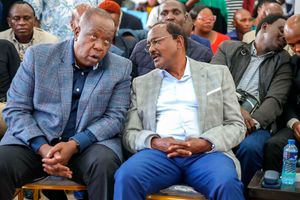
From right: Trade CS Lee Kinyanjui and United Opposition leaders Justin Muturi, Martha Karua, Fred Matiangi and Rigathi Gachagua during a funeral service in Muranga County on February 6, 2026.
Photo credit: Mwangi Muiruri | Nation Media Group
“We are in agreement with Mr Musyoka that all the senior county positions be left to DCP,” Mr Gachagua said, comments political critics suggested were evidence of tribal zoning.
Orange Democratic Movement (ODM) Nairobi chairman George Aladwa dismissed the move, saying the capital cannot be controlled along ethnic political lines.
Mr Musyoka later clarified that while discussions had taken place, Nairobi remains “an international city that belongs to all Kenyans in their diversity.”
In his Mt Kenya stronghold, Mr Gachagua is locked in a three-way contest involving President Ruto’s United Democratic Alliance (UDA) and loyalists of former President Uhuru Kenyatta under Jubilee Party.
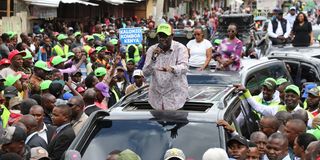
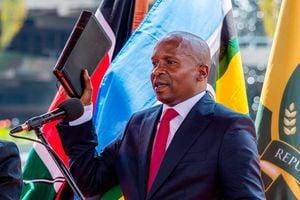
Former Deputy President and Democracy for Citizens Party leader Rigathi Gachagua.
Photo credit: Boniface Mwangi | Nation Media Group
Meanwhile, tensions have occasionally turned violent with disruptions reported at political events in Nyandarua, Murang’a, Kiambu, Kirinyaga and Nyeri counties, including an incident at Witima Anglican Church in Othaya on January 25, 2026.
In the Mt Kenya East, particularly Embu, Meru and Tharaka Nithi Mr Gachagua faces resistance from leaders allied to President Ruto who advocate for greater autonomy from the larger Mt Kenya bloc.
Public Service CS Geoffrey Ruku has declared that Mt Kenya East should not be used as a bargaining chip in national negotiations. He is backed by Embu Governor Cecily Mbarire, who also chairs UDA.
Complicating matters further is Deputy President Kithure Kindiki, who hails from the region and is seen as a contender for Mt Kenya kingpin status, a title Mr Gachagua claims, but some elders argue still belongs to Mr Kenyatta.
Mr Gachagua has sought to counter this by broadening the Mt Kenya bloc to include the Akamba community, strengthening ties with Mr Musyoka to create a larger Central-Eastern negotiating bloc.
At the Coast, Mr Gachagua and Mr Musyoka are reportedly competing over political alignment with Nyali MP Mohammed Ali, who is eyeing the Mombasa gubernatorial seat.
“We are looking into options on who, between Mr Musyoka and I will field Mr Ali,” Mr Gachagua admitted.
UDA Secretary-General Omar Hassan has criticised what he terms “gatekeeping politics,” warning against importing ethnic bloc strategies into the Coast region.
In Rift Valley, which is President Ruto’s political backyard, Gachagua has vowed to chip away at the incumbent’s support base by rallying opposition-aligned communities.
Former Deputy President Rigathi Gachagua and his legal counsel Paul Muite before the Senate in Nairobi during the second day of his impeachment trial on October 17, 2024.
Photo credit: Dennis Onsongo | Nation Media Group
Analysts say President Ruto’s outreach to Baringo Senator Gideon Moi may be aimed at consolidating support amid fears of fragmentation.
In North Eastern Kenya, Mr Gachagua ignited controversy by accusing local leaders of mismanaging public resources and failing their constituents.
He claimed the region has received over Sh1 trillion in public funds without visible development gains and criticised insecurity and professional flight.
Mandera Governor Mohamed Adan Khalif dismissed the remarks as politically motivated, labelling Mr Gachagua “confused and loose-tongued.”
In Western Kenya, DCP faces rivalry from the Democratic Action Party–Kenya (DAP-K), associated with Eugene Wamalwa and Trans Nzoia Governor George Natembeya.
The rivalry surfaced during the Malava by-election with disputes over which party should field a candidate.
Mr Natembeya has argued that only public participation, not backroom negotiations, should determine the opposition’s presidential flagbearer.
In Nyanza, where leaders played a key role in his impeachment, Mr Gachagua faces entrenched resistance.
ODM figures such as Homa Bay Governor Gladys Wanga and MP Peter Kaluma have publicly ruled out alliances with him.
Tensions also extend to Jubilee deputy party leader Fred Matiang'i, with DCP allies arguing that Dr Matiang’i must first consolidate Nyanza before seeking a broader national appeal.