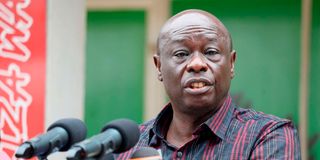
Rigathi Gachagua’s United States tour is increasingly exposing the tensions within Kenya’s opposition, with the former deputy president seeking to project unity while openly warning allies against undermining a joint 2027 presidential bid.
Mr Gachagua , who is the leader of the Democracy for the Citizens Party (DCP), has repeatedly told Kenyans in the diaspora that opposition parties will settle on one candidate to challenge President William Ruto .
But his remarks have also revealed disagreements with retired President Uhuru Kenyatta’s Jubilee Party and Kiharu MP Ndindi Nyoro, whose People’s Party of Kenya is building its own political base.
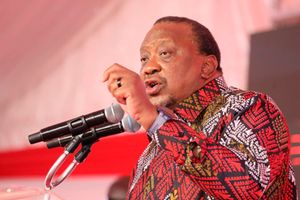
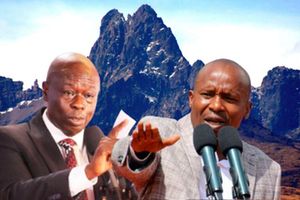
Retired President Uhuru Kenyatta during the 23rd memorial of the late Vice President Michael Kijana Wamalwa in Kitale, Trans Nzoia County on August 23, 2026.
Photo credit: Jared Nyataya | Nation Media Group
“We were in a meeting where two women attached to one of the principals leaked our discussions even before we had concluded our deliberations. I have repeatedly stated that there are many spoilers among us, some of whom helped bring me down," he said.
In Portland, Mr Gachagua urged opposition principals to publicly commit to accepting the outcome of a joint nomination process, saying Jubilee should disown claims that opposition parties need not unite.
Mr Kenyatta has endorsed former Cabinet secretary Fred Matiang’i as his preferred presidential candidate.
Mr Gachagua has also alleged that meetings involving opposition leaders have been compromised by people he described as “spies”, claiming discussions were leaked before they ended. He did not identify those he accused.
The remarks underline a central contradiction in his US campaign: he is selling opposition unity while positioning himself as an influential broker in determining who gets what in the alliance.
In Oregon, Mr Gachagua said his time in the US would allow him to develop a “winning formula” for the opposition, including proposals on who should occupy which position and which leaders should work together.
That posture has coincided with growing competition for influence in Mt Kenya. Mr Gachagua has sought to present himself as the region’s political leader, while Mr Nyoro has emerged as an increasingly assertive rival.
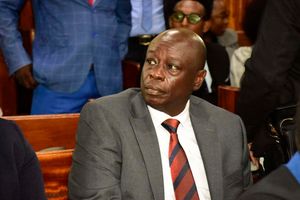
Kiharu MP Ndindi Nyoro.
Photo credit: File | Nation Media Group
Their camps have traded accusations since Mr Gachagua suggested an unnamed politician had received Sh200 million to establish a party intended to divide the Mt Kenya vote.
Mr Nyoro challenged him to name the person and threatened to respond with information about him. Neither allegation has been independently established.
The rivalry also feeds into the wider question of whether the opposition can reconcile competing ambitions before choosing a presidential candidate.
On the economic front, Mr Gachagua has framed a possible change of government around debt constraints and what he describes as corruption and state capture.
He has proposed prioritising merit-based appointments, investigations into alleged abuses during Gen Z protests, free primary education and removal of the Housing Levy and Social Health Authority contribution. Mr Nyoro has defended retaining the Housing Levy, arguing that it would provide funds for education and infrastructure.
Mr Gachagua has also used the US tour to question the electoral commission’s conduct and warn of possible post-election violence, urging international observers to watch Kenya closely.
Mr Gachagua left the country on August 2026 and first took 10 days off before he commenced on public and private engagements in Spokane and Pullman. Thereafter he proceeded to Portland, Oregon and is now in Kansas up to September 24, 2026.
His tour, scheduled to continue through Dallas and Boston, therefore serves two purposes: courting diaspora support and testing how far he can shape an opposition alliance whose internal competition remains unresolved.