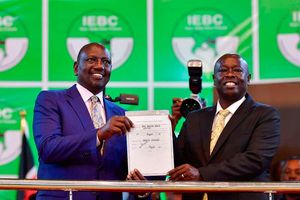
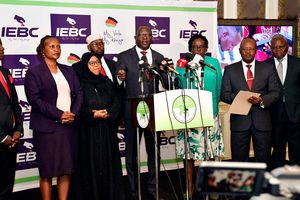
Independent Electoral and Boundaries Commission (IEBC) Vice Chairperson Fahima Abdalla said the country will have no choice but to procure new election technology every five-year election cycle, according to a State agency audit.
Ms Abdalla told the National Assembly’s Justice and Legal Affairs Committee (JLAC) that an ICT Authority technical audit found the 15,000 Kenya Integrated Election Management System (Kiems) kits procured in 2021 for the 2022 polls have already hit their five-year end-of-life limit.
This means that the kits cannot be used in any other election, forcing the IEBC to seek at least Sh10 billion to replace its entire fleet of 60,000 obsolete devices ahead of 2027.
The findings effectively lock the taxpayers into a perpetual cycle of buying single-use election hardware every five years.
“The ICT Authority came to IEBC to audit the Kiems kits and told us that the technology has an end life of five years,” said Ms Abdalla, noting. “This was from the expert report that we were told to undertake because they will not operate perfectly for the 2027 General Election.”
Deputy Chairperson of the Independent Electoral and Boundaries Commission, Fahima Abdallah, at a past event. She said the commission has developed proposals aimed at implementing the two-thirds gender principle through political party nomination rules ahead of the 2027 election.
Photo credit: Wilfred Nyangaresi I Nation Media Group
The revelation came after Rarieda MP Otiende Amollo demanded to know how many of the IEBC kits are reusable in the 2027 General Election.
Ms Abdalla revealed that the commission was encouraged to seek the opinion of other experts as opposed to relying on its directorate of ICT for advice.
This means that every billion diverted to replace the kits is money taken away from healthcare, infrastructure or clearing the commission's own Sh1.71 billion in pending bills.
While the commission has previously suggested wiping and donating old kits to schools or other government agencies, custom biometric hardware, proprietary vendor locks and strict rules requiring election devices to be preserved as evidence for potential court petitions often leave the old hardware gathering dust until it is completely worthless.
Governance expert Barasa Nyukuri notes that buying an entire fleet from scratch every five years creates tight procurement timelines.
“Late tenders inevitably trigger court battles, single-sourcing accusations and urgency premiums where vendors charge higher prices to manufacture and ship tens of thousands of custom kits on short notice,” Mr Nyukuri says.
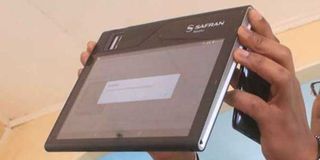
When Kenya introduced the Kiems kits in 2017, buying 45,000 kits from French firm Safran, now Idemia, for about Sh4.3 billion, the hardware was pitched as a long-term capital investment.
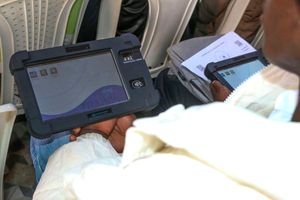
A polling clerk uses a Kiems kit to identify a voter.
Photo credit: File | Nation Media Group
In 2022, the IEBC reused about 41,000 of those 2017 kits and only bought 14,100 new ones from another vendor – Smartmatic, a Venezuelan firm – for Sh3.2 billion to cover the new polling stations.
City lawyer and electoral expert David Ochami told Nation that because a Kenyan electoral cycle is five years, a five-year hardware lifespan means devices bought for one election are officially obsolete before the next.
“This entrenches one of the costliest elections in the world,” said Mr Ochami.
Kenya already spends about Sh2,000 to Sh2,500, which is $15 to $25 per voter, far above the global average of $4 to $5 in established democracies.
“Treating multi-billion-shilling hardware as a five-year disposable item permanently bakes a massive capital expenditure into every national budget cycle,” Mr Ochami noted.
Kiems kits are Android tablets fitted with biometric fingerprint scanners and barcode readers. They comprise an integration of the Biometric Voter Registration (BVR), Electronic Voter Identification Devices (EVIDs) and the Results Transmission System (RTS). The kits are also used in the registration of voters.
Like smartphones, their lithium-ion batteries degrade, especially when left sitting in IEBC warehouses for four years between elections, and their processors struggle to run newer, heavier security software five years later.
Experts from ICTA argue that even if a tablet turns on, operating systems like older versions of Android stop receiving security patches after three to five years.
“In a high-stakes election environment where hacking allegations can overturn a presidency, using devices running unsupported software is a legal and cybersecurity liability,” the ICTA experts say.
They noted that most commercial tablets are used daily and replaced after three to four years and that “Kiems kits are used intensely for about two weeks during voter verification and election day and then locked away for 59 months”.
“Because technology ages by calendar years rather than hours of active use, the kits effectively expire on the shelf,” they said.
Said Mr Ochami: “Unlike countries where technology replaces paper, Kenyan law, shaped by court decisions and deep political mistrust, requires electronic systems to run alongside full manual backups.”
“Taxpayers pay billions for biometric kits and servers, while simultaneously paying billions more for printed registers, security-printed ballot papers and over 600,000 temporary polling clerks,” he added.
The Venezuelan firm supplied IEBC with over 14,000 new Kiems kits and upgraded the software for the other 41,000 existing kits to power the 46,229 polling stations across the country during the 2022 general election.
The technology provider for the 2017 elections was the French firm OT-Morpho that later rebranded to IDEMIA.
The common denominator for the 2017, 2022 and 2027 elections is the employment of an integrated system.
This is unlike the 2013 General Election, the inaugural elections under the 2010 constitution, which relied on separate, non-integrated pieces of technology sourced from different vendors.
For instance, the Biometric Voter Registration (BVR) kits were provided by Morpho Safran through a government-to-government deal with Canada.
This led to the Canadian Commercial Corporation (CCC) being contracted to source 15,000 BVR kits that were manufactured by Morpho.
The Electronic Voter Identification Devices (EVIDs) were sourced from Face Technologies, a South African IT firm that supplied the electronic poll books used to verify voters' biometrics on voting day.
The Results Transmission System (RTS) was developed and managed with software support from the International Foundation for Electoral Systems (IFES) alongside local telecommunication firms like Safaricom to transmit scanned election result forms.