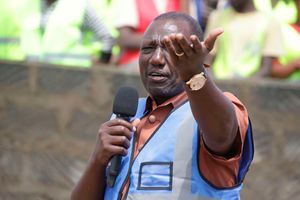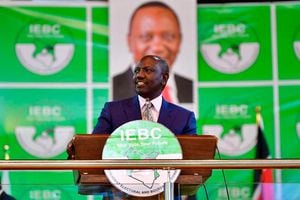
Hustlers Women Brigade members celebrate Dr Ruto's win in Nairobi on August 27, 2022,

Few campaign slogans in Kenya have been as powerful as the one by President William Ruto in the 2022 elections: “Hustlers versus dynasties”.
By casting himself as the champion of ordinary Kenyans (hustlers) against powerful political families (dynasties) – the Kenyattas, Odingas and Mois – Dr Ruto tapped into frustrations over inequality, ultimately turning a slogan into a winning movement.
For months, the then-deputy president framed the race as a struggle between the hoi polloi fighting for economic empowerment and families that had dominated Kenya’s leadership since independence.
On the opposite side stood Mr Odinga, backed by outgoing president Uhuru Kenyatta, Mr Gideon Moi and a coalition of other established political figures.
Mr Kenyatta is the son of the country’s first president Jomo Kenyatta while Mr Moi is the son of the second president Daniel arap Moi. Odinga’s father, Jaramogi Oginga Odinga, was Kenya’s first vice-president.
By the time Kenyans went to the polls on August 9, 2022, the “hustler” message had transformed from a campaign slogan into a political juggernaut.
Dr Ruto had been cultivating the image of a self-made politician long before 2022.
Born in Sugoi, Uasin Gishu County, he often recounted his humble beginnings, loudly recalling selling chickens by the roadside.

President William Ruto (then deputy president) pushes a wheelbarrow, the symbol of hustlers. His campaign massage for the 2022 elections was that of “dynasties versus hustlers.”
“I’m not the son of a chief or politician. I am the son of a peasant,” he frequently said during the rallies.
The message resonated strongly with the youth, boda bodas, mama mbogas, cart pushers and other informal workers.
Years of rivalry
Dr Ruto portrayed his rivals as beneficiaries of entrenched privilege. The narrative gained traction after the March 9, 2018, handshake between Mr Kenyatta and Mr Odinga.
The deal ended years of rivalry between the two leaders but sidelined Dr Ruto, who had been widely expected to inherit Mr Kenyatta’s support in 2022.
President Kenyatta abandoned his deputy and threw his weight behind Odinga instead.
“I know Raila since I have worked with him. He is the right person to take this country forward,” Mr Kenyatta said.
Dr Ruto went on the offensive, saying powerful political families had united to block the rise of a leader from humble origins.
He promised to improve the lot of small traders, boda bodas and other informal workers through “bottom-up” economics.
“The choice is between dynasties who have ruled this country for decades and the hustlers who wake up early every morning to earn a living,” he said.

President William Ruto takes breakfast at a kiosk in Mandera Town during a past campaign trip.
Mr Kenyatta, Odinga and their supporters dismissed the hustler versus dynasties narrative, saying Dr Ruto had been part of the political establishment for many years.
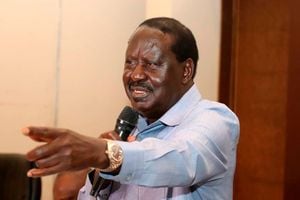
“Ruto cannot talk of being an outsider. He has been in government for almost 30 years,” Odinga, who died last year, said.
“The hustlers and dynasties talk is meant to divide Kenyans. Leadership is not about where you come from but what you can do for the people. We should focus on policies that uplift the country.”
The Kenyatta-Odinga-led Azimio la Umoja coalition campaigned on promises of social protection.
In the end, Dr Ruto garnered 7,176,141 votes against Mr Odinga’s 6,942,930 in the election.
Legal challenges
The results triggered legal challenges and protests from the opposition, but the Supreme Court upheld Dr Ruto’s victory. He was sworn in as Kenya’s fifth president on September 13, 2022.
Analysts now say the hustler versus dynasty narrative reshaped the political discourse.
Mr Mutahi Ngunyi once described it as a “class narrative” that appealed to people who felt locked out of power. Others say the slogan simplified complex political realities.
Despite portraying himself as an outsider, Dr Ruto had spent much of his career in government, serving as an assistant minister at just 33. He was elected Eldoret North MP in the 1997 election aged 31.
Long after the 2022 elections, the hustler-dynasty debate continues to shape discussions.
The President’s supporters say his victory marked the rise of a new political order driven by grassroots mobilisation.
Critics, on the other hand, say it was largely rhetorical and masked the realities of Kenya’s entrenched political networks.
For millions who identified with the message, the win showed that the highest office on land could be won by anyone, including those from ordinary households.
Follow our WhatsApp channel for breaking news updates and more stories like this.