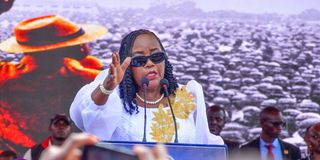
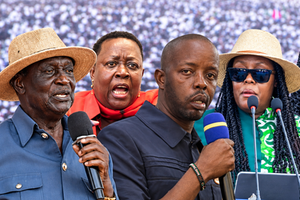
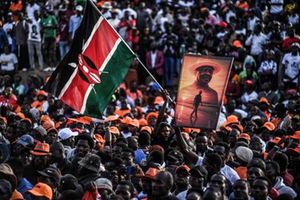
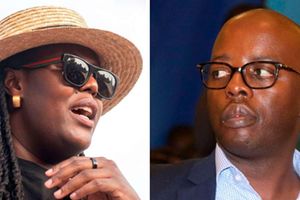
This became even more apparent after she invited opposition leaders to Raila's first death anniversary, unsettling sections of ODM and the government.
Her subsequent declaration of loyalty to the broad-based government now offers a clearer picture of her political thinking, but it also raises a deeper question: can the Odinga family's position and the party's increasingly divided political establishment remain aligned as the 2027 election approaches?
Ida has since declared that she remains in ODM and supports the broad-based government under President William Ruto.
President William Ruto and Mama Ida Odinga during the commissioning of the Raila Amolo Odinga Mausoleum at Kang’o Ka Jaramogi in Bondo, Siaya County, on October 7, 2026.
Photo credit: PCS
Her declaration, made in Homa Bay on Tuesday, November 10, is her clearest public statement yet on where she stands in the political arrangement her husband helped shape before his death.
It comes weeks after the family's decision to welcome politicians from across the political divide to the first anniversary of Raila's death triggered criticism from sections of ODM supporters and revived questions about the family's political loyalties.
“Where he left me is where I am still standing,” Ida said, invoking the late former Prime Minister's political position as she addressed residents during the launch of the Gembe Hills Participatory Management Plan in Suba North.
“For me, he left me in ODM. That is where I still stand. He left me in broad-based. That is where I stand,” she said.
Ida added that Raila had told her that President Ruto was the leader of the country and that this was where she should stand.
Her message was also directed at his supporters, whom she urged not to abandon the political positions in which he had left them.
“I know he left a lot of people. Where he left you is where you should stand. You don't move,” she said.
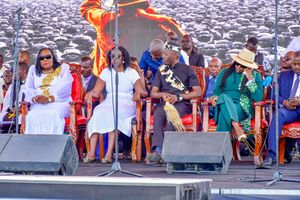
The remarks also clarify questions that had lingered since October 15, when the family held a commemoration at Migwena Grounds in Bondo, Siaya County, to mark one year since Raila's death.
The event, intended to honour a figure whose career crossed decades and political divides, became a flashpoint over the guest list and the future direction of his party.
The family's decision to invite former Deputy President Rigathi Gachagua, one of the late Raila's fiercest critics, alongside other opposition leaders, appeared to anger a section of ODM supporters and leaders. They questioned Ida's loyalty to the party, particularly given her appointment as the country's Permanent Representative to the United Nations Environment Programme (UNEP) under President Ruto's broad-based government.
Former Deputy President Rigathi Gachagua.
Photo credit: Francis Nderitu | Nation Media Group
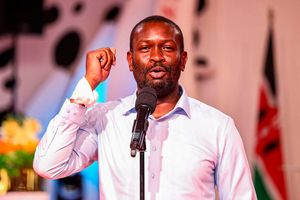
While Mr Gachagua did not attend the anniversary, opposition chiefs Kalonzo Musyoka (Wiper), Edwin Sifuna (Linda Mwananchi Movement), Martha Karua (People's Liberation Party) and Jimi Wanjigi (Safina), among others, graced the occasion. The event was marred by chaos, while several top ODM leaders gave it a wide berth.
Their presence drew attention because many have been critical of Dr Ruto and the broad-based government.
The invitation to Mr Gachagua was particularly contentious among some ODM figures. The former Deputy President had been a political opponent of Raila and is now among the leaders seeking to challenge Dr Ruto in 2027.
National Assembly Minority Leader Junet Mohamed said he skipped the commemoration after seeing Mr Gachagua's name on the guest list.
“I did not attend because when I saw the list, I saw the name of Gachagua and decided I could not sit in the same forum with him. Baba's spirit cannot sit with such a person,” said Mr Mohamed, the Suna East MP.
Junet Mohamed: Why I skipped Raila Odinga's memorial
The disagreement was not merely about protocol at a family event. It exposed the strain between ODM leaders who support continued cooperation with President Ruto and those who want the party to maintain a clearer opposition identity.
It also raised the question of who has the authority to interpret Raila's political legacy: his family, the party leadership or the wider movement that supported him.
Ida defended the invitations soon after the anniversary, arguing that they reflected relationships Raila had built throughout his political life rather than an endorsement of every guest's politics.
“Throughout his life, Raila built friendships, encountered disagreements and found reconciliation with people across the political divide. Our invitations to the memorial reflected that lifetime of relationships,” she said in a statement on October 17, two days after the ceremony.
“Every guest we invited was welcome. The Odinga family does not quarrel with any of them,” she added.
President William Ruto greets Raila Odinga Junior during the handover and dedication of the Raila Amolo Odinga Mausoleum in Bondo, Siaya County. Looking on is Mama Ida Odinga and Rosemary Odinga.
Photo credit: PCS
She also cautioned against reading political meaning into attendance or absence, saying an invitation to a family commemoration was an expression of fellowship, not a summons.
Former President Uhuru Kenyatta, who was expected to attend as the chief guest, also failed to turn up, citing “security concerns” at the event.
Ida's defence was consistent with her insistence that Raila's relationships extended beyond party boundaries. But it did not settle the political question of where the family stood in the broad-based arrangement, especially after her daughter Winnie, who used the occasion to declare her interest in the Nairobi senatorial seat, appeared to pledge loyalty to Mr Sifuna's camp.
Ida's latest remarks provide that clarification. By explicitly stating that Raila left her in ODM and the broad-based government, observers say she has publicly aligned herself with the camp that favours continued cooperation with the President.
“The declaration is especially consequential because she is not simply defending a family guest list; she is invoking her husband's final political position as the basis for her own,” says Geoffrey Mboya.
Raila died on October 15, 2025, after entering a broad-based political arrangement with Dr Ruto following the 2024 national dialogue. The arrangement brought ODM figures into government and changed the party's relationship with an administration it had previously opposed.
President William Ruto and Raila Odinga at State House, Nairobi, where Odinga was officially unveiled as Kenya’s candidate for the chairperson of the African Union Commission on August 27, 2024. Odinga passed away on October 15, 2025.
Photo credit: Photo | PCS
Raila defended the cooperation as a way to address national challenges, while critics questioned whether it diluted ODM's role as an accountability force outside government.
Since his death, that question has become more difficult for the party to manage. His elder brother, Oburu Oginga, who assumed the party leadership, has defended the arrangement, saying ODM should continue working with Dr Ruto because that was where Raila left it.
ODM party leader Dr Oburu Oginga.
Photo credit: Pool
“Raila left us in the broad-based government, and we will continue to work with the President to the end,” Dr Oginga has consistently affirmed.
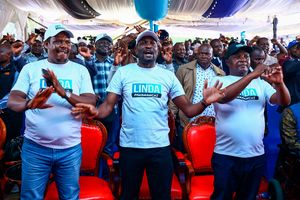
But the position has faced resistance from politicians including Mr Sifuna, Siaya Governor James Orengo and Embakasi East MP Babu Owino, among others. Most have since gravitated towards Linda Mwananchi, criticising aspects of the broad-based arrangement and arguing for ODM's independence.
The Linda Mwananchi grouping has become a platform for some of those opposed to the direction taken by the party's pro-government faction.
Their differences extend beyond the relationship with Dr Ruto to include party discipline, leadership and who should speak for ODM's grassroots support.
“Ida's declaration is therefore a setback for those who had interpreted the anniversary guest list as evidence that the family might be moving closer to the opposition. Her remarks make clear that inviting opposition politicians to remember Raila should not be confused with abandoning the political arrangement he supported,” adds Mr Mboya.
The distinction, he says, matters because the anniversary controversy had become a proxy for a larger struggle.
For the opposition-leaning faction, he says, the family's openness to their presence demonstrated that Raila's legacy could not be confined to the broad-based government.
“For pro-government ODM leaders, the presence of Ruto's critics at the commemoration was uncomfortable because it risked blurring the political line the party had taken after Raila's engagement with the President,” Mr Mboya notes.
Ida's position, he adds, now appears to separate the two questions: the family can maintain relationships with people across the political divide while remaining committed to the political arrangement Raila left behind.
Advocate Chris Omore argues, however, that Ida's statement is neither an endorsement of every government action nor an explicit declaration that she will campaign for President Ruto's re-election.
“What it establishes is her stated commitment to ODM and the broad-based government. There is also a personal dimension to her explanation. Raila's death was sudden and left many followers uncertain about where to go politically. By urging them to remain where he left them, Ida is presenting continuity as a matter of loyalty to his choices rather than an invitation to negotiate a new direction.”
Ida's intervention now strengthens Dr Oginga's argument that the party should remain within the broad-based arrangement.