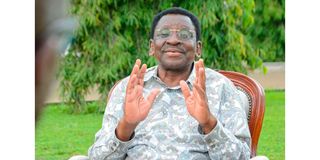
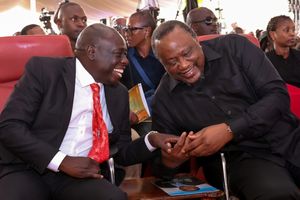
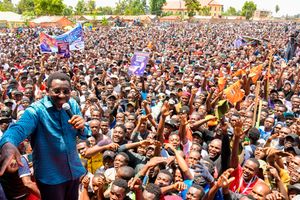
His loyalty has rarely been in doubt, but his independence has often raised eyebrows.
Over the years, Siaya Governor James Aggrey Bob Orengo has walked a delicate tightrope in his relationship with the wider Odinga family—embracing their political vision while occasionally pushing back against its direction.
Mr Orengo was born on February 22, 1951, into a generation of Kenyans who came of age as the one-party state was unravelling and multiparty politics surged to the fore.
A lawyer by training, a fearless human rights advocate by choice, and a politician by destiny, the Siaya Governor would go on to shape — and be shaped by — his complex relationship with the Odinga political dynasty: starting as staunch allies, tearing apart in political rivalry, pressing back together in pragmatic reconciliation, then fracturing again in ideological bitterness.
This was not just personal politics — it was the politics of the Luo community, the politics of the Kenyan opposition, and often the politics of succession, identity, and leadership struggle itself.
Mr Orengo’s political roots were deeply intertwined with Kenya’s first vice president, Jaramogi Oginga Odinga, who later became the doyen of Kenya’s opposition and an enduring champion of multiparty democracy.
When the Forum for the Restoration of Democracy (Ford) was born in the early 1990s as a broad coalition to challenge the Daniel Arap Moi-led Kenya African National Union (KANU), it represented the hopes of many disenfranchised leaders.
Azimio La Umoja leader Raila Odinga (right), accompanied by Siaya Governor James Orengo, during a relief food distribution exercise to flood victims at Muhondo grounds in Alego-Usonga in Siaya.
Photo credit: File| Nation Media Group
Mr Orengo, the late former Prime Minister Raila Odinga, and others shared a seat at the table under the umbrella of this united front.
However, the opposition fractured soon after, splitting into Ford–Kenya and Ford–Asili and shaping decades of factional politics.
In Ford–Kenya, Jaramogi’s followers found a home, with Mr Orengo emerging as a key strategist and loyal ally of the Odinga political family.
At this point, Raila — Jaramogi’s son was a rising star, fully in political activism.
When Jaramogi passed on in 1994, the question immediately became: Who would succeed him as the Luo community’s foremost political torchbearer?
The mantle should have passed smoothly to Mr Orengo, whom many believed was the late Jaramogi’s heir apparent.
Inside Ford–Kenya, a leadership struggle erupted between Raila and the late Michael Kijana Wamalwa, described by many as a charismatic lawyer who also wielded his own national ambitions.
The bruising and protracted contest between Raila and Wamalwa for control of Ford–Kenya ended with Wamalwa emerging victorious—a result that triggered Raila’s dramatic exit from the party.
In that defining moment, Mr Orengo shifted his political allegiance toward Wamalwa — a move that estranged him from Raila and was experienced by some as a betrayal of the Odinga family.
Mr Orengo and Wamalwa worked to wrest the leadership of Ford–Kenya from Raila and to reshape the party’s direction — a decision that would define Orengo’s next few years.
Raila Odinga and President Daniel arap Moi at Kasarani stadium during the Kanu-NDP merger.
Photo credit: File | Nation Media Group
Meanwhile, Raila formed and took the helm of the National Development Party (NDP) as his new political vehicle.
He became its standard-bearer in the 1997 presidential election and, riding a personalised wave of support among Luo voters and other opposition sympathisers, garnered 667,886 votes (10.79 percent of the total) in that race — trouncing Wamalwa who had denied him Ford Kenya leadership.
Moi of Kanu won by garnering 2,500,865 (40.4 percent), followed by Mwai Kibaki who secured 1,911,742 (30.89 percent) on Democratic Party ticket, Raila came third while Wamalwa managed 505,704 (8.17 percent) and Charity Ngilu of Social Democratic Party got 488,600 (7.89 percent).
Mr Orengo himself retained his Ugenya parliamentary seat in 1997 on a Ford–Kenya ticket, defeating a Raila-aligned candidate, Bishop Stephen Ondiek.
This kept him in visible national politics, but it was clear the Odinga split had cut deep — both personally and politically.
According to Prof Gitile Naituli of Multimedia University of Kenya, Mr Orengo’s actions are best understood through an ideological lens rather than personal rivalry.
“Orengo is definitely ideological. His opposition is not personal but rooted in principle,” Prof Naituli says.
As the 2002 general elections approached, Kenya’s political climate was boiling over years of frustration under Kanu rule.
However, the evolving coalition movements found a rare, if uneasy, unity in rallying behind Kibaki and the National Rainbow Coalition (Narc) to defeat Kanu.
Raila famously endorsed Kibaki under the slogan “Kibaki Tosha!” (Kibaki is the choice!) and committed his political machinery, including the crucial Luo vote, to the coalition.
Siaya Governor James Orengo addresses journalists at Sarova Panafric hotel in Nairobi on February 12, 2026.
Photo credit: Billy Ogada | Nation Media Group
Instead, driven by ambition and perhaps by chagrin at being outmanoeuvred by Raila, Mr Orengo remained outside the Kibaki-Raila coalition.
“He believed he could rally the Luo community to reject Kibaki’s presidency — even when key leaders including Raila were united behind it. It was a strategic miscalculation,” argues advocate Chris Omore.
Mr Orengo’s own bid for the presidency under the Social Democratic Party (SDP) flag in 2002 met with meagre support at the polls, managing only 24,524 (0.42 percent of the total vote) and losing his Ugenya Parliamentary seat to Raila’s candidate Bishop Stephen Ondiek.
Backed by a united opposition front led by Raila and Wamalwa in a fresh unity bid, Kibaki cruised to victory in a historic political convergence, polling 3,646,277 votes (62.2 per cent).
His main challenger, Uhuru Kenyatta of Kanu, trailed with 1,835,890 votes (31.32 per cent), while Simeon Nyachae of Ford People finished a distant third with 345,152 votes (5.89 per cent).
For Mr Orengo, this moment marked both personal political loss and a deeper realization: he could not ascend to national leadership completely on his own, without the Odinga base and without a coalition.
Between 2002 and 2005, he watched as Raila consolidated his position as the Luo community’s political center of gravity, as Kibaki took office, and as the landscape reshaped around constitutional reform.
Rather than abandon politics altogether, Mr Orengo once again began a quiet and strategic rapprochement with Raila.
When the 2005 constitutional referendum came around — a divisive national issue — Mr Orengo didn’t just sit on the sidelines.
Siaya Governor James Orengo addresses a Linda Mwananchi political rally at Amalemba Grounds in Kakamega on February 21, 2026.
Photo credit: Alex Odhiambo | Nation Media Group
He joined Raila’s bandwagon and helped mobilise support, even offering pro bono legal services that enhanced his relevance and made sure Raila would notice and remember him.
“This was Mr Orengo at his most pragmatic: love kept apart, but politics brought them near.”
With Raila leading the newly formed Orange Democratic Movement (ODM), Mr Orengo eyed a return to parliament in 2007. But he faced a stiff challenge from within his own community.
Stephen Mwanga.
Photo credit: Pool
Mr Mwanga’s energy, local support, and organisational reach made him a formidable contender.
In the hotly contested ODM primaries, Mr Mwanga apparently defeated Mr Orengo, taking the party’s nomination for the constituency.
This was seen by many as a dramatic rejection of an established leader in favour of a new generation.
ODM Leader Dr Oburu Oginga — Raila’s brother — later publicly acknowledged that Mr Mwanga had genuinely beaten Mr Orengo in the primaries, and that it was only Raila’s intervention that secured him the ODM nomination and kept him in the race.
But Raila’s influence was decisive. The ODM leadership — unified behind his vision — stepped in to ensure Mr Orengo remained the party’s candidate, eclipsing Mr Mwanga and sending him to political oblivion.
This rescue for Mr Orengo was both political and symbolic: the Odinga family was no longer dismissive of Mr Orengo, and he, for his part, realigned firmly with Raila’s political orbit.
As a result, Mr Orengo regained his parliamentary seat and served in the National Assembly once again.
“I paid the ultimate price after what I consider a clear win in Ugenya Constituency. That is the cost of standing against entrenched interests,” Mr Mwanga told Nation.
He also argues that he was the first leader to introduce President William Ruto to Luo Nyanza in 2007, as he then served as the MP for Eldoret North.
“Today, the same ethnic gatekeepers who could not see what I saw 19 years ago are now all over him. That tells you everything about how politics in this country works.”
Mr Mwanga quipped: “When I take a stand, I do so firmly and without fear. I have always believed in following conviction, not convenience.”
After the 2007 elections — notably contentious and marred by widespread violence — a grand coalition government was formed between Raila as Prime Minister and Kibaki as President.
Azimio la Umoja One Kenya Coalition party leader Raila Odinga confers with Siaya Governor James Orengo in Naivasha. The opposition should serve as a government in waiting. It should check government excesses by raising questions about policies, offering choices and alternatives and criticising the government for its failures.
Photo credit: John Njoroge | Nation Media Group
In this new government, Raila seconded Mr Orengo for appointment as Minister for Lands, giving him significant influence and a platform for national impact.
Fast forward to 2018, and Kenya's political landscape changed once again when Raila and President Uhuru Kenyatta publicly reconciled in an event that became known as the 'Handshake'.
This was an unexpected development for many, as it bridged the intense electoral rivalry that had existed previously. It also shifted the focus of national politics towards stability rather than confrontation.
Mr Orengo — known for his strong personality and independence of thought — was initially opposed to this rapprochement.
But as before, reality and power politics prevailed: when it became clear this unity would endure, Mr Orengo swallowed his pride and backed the handshake, aligning himself with the broad movement for peace and stability.
The result? A smoother path to the Siaya gubernatorial seat in 2022, which he won and began to occupy as governor.
This was a restoration of prestige, enabled by a reconciled alliance with the Odinga machine.
By 2024, the Kenyan political landscape was once more in flux.
ODM leader Raila Odinga (left) with Siaya Senator James Orengo during a past national function.
Photo credit: File | Nation Media Group
Raila had joined President William Ruto’s broad-based government, something that irked many in the opposition and within ODM ranks.
Mr Orengo — ever the independent critic — became one of the fiercest opponents of this alignment, challenging the coalition’s ideology and the direction of ODM’s support.
Then came October 15, 2025, when Raila passed on in India at the age of 80 — an event that shook Kenyan politics to its core and left the fate of the opposition in question.
Following his death, a leadership transition occurred within ODM: Oburu Oginga, Raila’s elder brother, took over the reins of the party.
Far from being a smooth continuation, this shift exacerbated tensions.
Mr Orengo — still ambitious, still opinionated, and no longer constrained by personal loyalty to Raila’s decisions — came out guns blazing against Dr Oginga’s leadership, voicing strong disagreement with ODM’s emerging relationship with UDA and critiques of its strategic direction.
Mr Omore says that “Mr Orengo’s political odyssey with the Odinga family is neither linear nor predictable. It is a love-hate relationship marked by: early alliance and shared activism, born in the struggle against authoritarianism, bitter rivalry and party splits, as leadership ambitions collided and strategic reconciliation and mutual rescue, especially around the ODM era.”
He says that it is also marked by periodic ideological divergence, particularly when national strategy or personal principle was at stake.
“Reassertion of independence after Raila’s death, signaling a complex future for Luo politics and ODM itself.”
He adds that: “Through triumphs and defeats, alliances and disillusionment, Mr Orengo has remained true to a defining feature of his career: political courage — even when it puts him at odds with allies, friends, or old companions.