From fiery exchanges to calls for unity, Deputy President Kithure Kindiki is changing tack in Mt Kenya, signalling a strategic retreat from political confrontation as the battle for the region—and its decisive role in President William Ruto’s 2027 re-election bid—intensifies.
Prof Kindiki appears to have ditched his hardline rhetoric against rivals — led by his predecessor Rigathi Gachagua, toning down attacks against the Democracy for the Citizen’s Party (DCP) leader and pivoting towards a strategy anchored on unity and development as the Kenya Kwanza administration intensifies its 2027 vote hunt.
The shift, unfolding through a series of carefully choreographed meetings and rallies, signals a recognition within President Ruto’s camp that the political ground in Mt Kenya is rapidly shifting, with rival factions coalescing and the region increasingly asserting itself as a decisive national kingmaker.
PHOTO 47
Photo credit: File | Nation Nation Media Group
In recent weeks, Prof Kindiki has adopted a markedly conciliatory tone, a departure from the sharp exchanges that characterised the fallout between allies of the President and those aligned to Mr Gachagua.
Speaking in Embu and later in Tigania West, Meru County, the Deputy President framed his message around restraint and coexistence, avoiding direct confrontation even when addressing sustained criticism from his predecessor’s camp.
“I’m a leader and there’s today and tomorrow. Even after leadership we shall remain as one community. I don’t have any problem with any leader, even those who insult me. I have forgiven them unconditionally,” he said.
In what was widely interpreted as a direct reference to Mr Gachagua, Prof Kindiki added: “I have forgiven my brother… I will not answer him because as an elder of Njuri Ncheke, you cannot insult your brother.”
The remarks marked a notable shift from earlier months when allies of the two leaders engaged in open political hostilities, deepening divisions within the region.
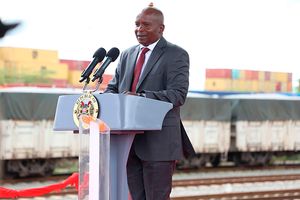
Deputy President Kithure Kindiki speaks during the Broad-Based Parliamentary Group meeting at Kenyatta International Convention Centre in Nairobi on March 10, 2026.
Photo credit: Wilfred Nyangaresi | Nation Media Group
According to Prof Gitile Naituli, a lecturer at Multimedia University, the Deputy President is responding to emerging realities on the ground.
“Gachagua is taking command of the public in Mt Kenya, so Kindiki’s move is wise and intelligent. If Kindiki recognises that his position could be at threat, you start creating a space to land,” Prof Naituli said.
Prof Naituli argues that while the deputy president’s shift is tactically sound, it may not be sufficient to reverse entrenched political sentiments.
“It’s not easy to replace a Deputy President mid-term, and we know the President will likely go into the next election with Kindiki. But it won’t get them votes. I don’t think they can even get 10 percent. The people of the Mountain have already decided,” he said.
At the heart of Prof Kindiki’s new approach is a series of structured engagements at his rural home in Irunduni, Tharaka Nithi County, in what appears to be a move to build a grassroot machine.
Insiders say such meetings mirror the political playbook President Ruto deployed in the run-up to the 2022 elections at his Karen residence to win the election.
Over the past month, the DP has hosted at least five high-level delegations, each carefully curated to consolidate influence across different strata of Mt Kenya society.
The meetings have brought together grassroots leaders, professionals, clergy and opinion shapers from across the region.
Among the notable recent delegations include; leaders and professionals from Maara Constituency, grassroots mobilisers from Meru and Tharaka Nithi, youth representatives from Embu and Kirinyaga, business community figures from Nyeri and Murang’a and clergy and elders drawn from the larger Mt Kenya East bloc.
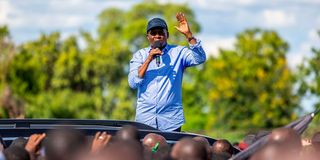
Deputy President Kithure Kindiki addresses residents during a public sensitisation event in Karurumo Town, Runyenjes Constituency, Embu County, accompanied by Governor Cecily Mbarire among other leaders.
Photo credit: DPCS
Sources familiar with the meetings say the discussions revolve around three central themes: securing President Ruto’s re-election, negotiating the region’s political future, and countering the growing influence of rival camps aligned to Mr Gachagua and former President Uhuru Kenyatta.
During these sessions, Prof Kindiki has consistently advanced a strategic argument—that backing President Ruto in 2027 is the fastest route to a Mt Kenya presidency in 2032.
The DP said the region will be in a better position to front a presidential candidate in 2032 which will only be five years away after the next polls.
“We have no option next year but to re-elect President Ruto. A cow that is heavy with a calf cannot be slaughtered. After the re-election of President Ruto next year, we will only wait for five years. Then in 2032, the calf will be born,” DP declared.
The Deputy President spoke on Monday when he hosted a delegation of grassroots leaders and professionals from Maara Constituency at home in Irunduni, Tharaka Nithi County.
He frames the choice before Mt Kenya voters as a binary political calculation—either support President Ruto’s second term and wait five years for a shot at the presidency, or back an opposition candidate and potentially delay that ambition by a decade.
“Is it not easier and more strategic for our people to wait for five years than to wait for 10 years? We are sharp people. We know how to make political calculations,” he said.
The pitch seeks to tap into a long-standing sentiment within the region: the desire to retain proximity to power and influence national leadership transitions.
But critics argue that the message may be losing traction in a region increasingly disillusioned with the Kenya Kwanza administration.
Mr Gachagua has been among those pushing back, questioning both the credibility and intent of the government’s overtures.
“I heard him speak in Embu, saying he doesn’t have a problem with Riggy G and our community. We thank you for that… but as a community, we have a problem with some of your actions,” Mr Gachagua said.
He cited concerns over the handling of Gen Z protests, corruption allegations and what he described as attempts to divide the region through financial inducements.
Alongside messaging, Prof Kindiki has intensified his presence on the ground, pitching camp in Mt Kenya East where he has presided over or launched a string of development projects.
The strategy is aimed at reinforcing the administration’s development credentials while countering claims that the region has been sidelined.
Among the flagship projects he has highlighted is the long-awaited Nithi Bridge, which he says will be one of the largest in the country once completed.
“We have the money. We have a contractor… The bridge will be done. It will be the second largest and longest bridge in Kenya only second to Dongo Kundu in Mombasa,” he said.
The DP has also pointed to road upgrades, market construction, water projects and education infrastructure as evidence of the government’s commitment to the region.
Design of the new Nithi bridge released by Kenha.
Photo credit: Pool
Political observers note that the focus on Mt Kenya East is deliberate, reflecting an attempt to consolidate a base that could offset losses in other parts of the larger Mt Kenya region.
The Independent Electoral and Boundaries Commission (IEBC) has projected a total of 1,720,016 voters in the three Mt Kenya East Counties by 2027 election time, spread across Meru (992,317), Embu (429,629) and Tharaka-Nithi (298,070).
Prof Kindiki’s recent rallies across Mt Kenya have also reflected his evolving strategy, blending development messaging with calls for unity and restrained political rhetoric.
At these rallies, the DP has avoided direct attacks on rivals, instead framing his campaign as one of continuity and stability.
Gone are the fiery exchanges that once dominated political gatherings in the region. In their place is a carefully measured message designed to appeal to a broader audience.
Another key dimension of Prof Kindiki’s strategy is internal coalition management, particularly in the face of an assertive Oburu Oginga-led ODM, which is UDA party’s broad based partner.
Within the Kenya Kwanza coalition, there is growing pressure to balance regional interests, especially as ODM seeks to expand its influence.
Prof Kindiki is said to be leveraging key allies, including Cabinet Secretary Geoffrey Ruku, to strengthen his bargaining position within government and secure the region’s stake in future power arrangements.
Insiders say the deputy president’s outreach is as much about external mobilisation as it is about internal negotiations—ensuring Mt Kenya retains leverage in the event of shifting political alliances, to ring-fence his DP post.
The re-emergence of an Uhuru Kenyatta-Gachagua axis has injected new energy into the region, with calls for unity resonating across counties.
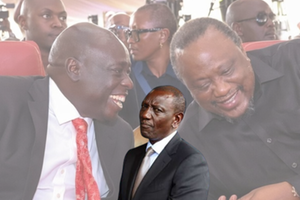
Former President Uhuru Kenyatta (right) shares a light moment with the former Deputy President Rigathi Gachagua during the burial of Daniel Karaba in Kirinyaga on Wednesday, April 1, 2026.
Photo credit: Pool
Analysts say this consolidation could significantly alter the national political equation, enhancing the region’s bargaining power and positioning it as a decisive bloc in 2027.
For President Ruto’s camp, this presents both a challenge and an opportunity.
On one hand, a unified Mt Kenya could swing decisively against the government. On the other, strategic engagement—such as the approach now being adopted by Prof Kindiki—could help retain a critical mass of support.
But despite the change in tact, scepticism remains about the effectiveness of Prof Kindiki’s approach.
Prof Naituli argues that while the DP’s shift is tactically sound, it may not be sufficient to reverse entrenched political sentiments.
“…it won’t get them votes. I don’t think they can even get 10 percent. The people of the Mountain have already decided,” he said.
Such assessments underscore the uphill task facing the DP as he seeks to reconfigure political alliances in a region that has historically voted as a bloc but is now showing signs of fragmentation.
With just a year to the 2027 General Election, time is becoming an increasingly critical factor.
The Deputy President’s strategy—anchored on reconciliation, development and long-term political promises, analysts say, represents a calculated attempt to stabilise the region and secure its support.
But the window for influence is narrowing, and rival camps are equally active, consolidating their bases and shaping the narrative.