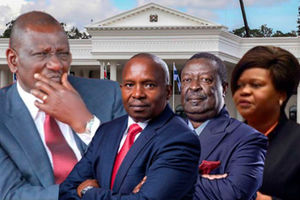
The United Opposition is working to broaden the coalition, name a compromise presidential candidate early, challenge unpopular government decisions in court, and sharpen anti-government messaging by presenting credible alternative policies as part of a strategy to win over support this year.
Acknowledging there’s more to elections than mere voting, and given persistent attacks by President William Ruto that his opponents have nothing other than empty sloganeering, the United Opposition appears to be adjusting its campaign maps accordingly.
For opposition leaders, 2026 — not 2027 — is shaping up as the make-or-break year, when unity, credibility and strategy will determine whether President Ruto faces a genuine threat or another fragmented challenge in next year’s poll.
President William Ruto speaks during the World Minority Rights Day celebrations at State House, Nairobi, on December 18, 2025.
Photo credit: Wilfred Nyangaresi | Nation Media Group
While Dr Ruto insists this year will be defined by delivery and implementation, the opposition argues it will instead expose what it calls a hollow presidency built on impunity, inflated projects and weakened institutions.
For an opposition seeking to mount a credible challenge, political analysts say, strategy — not slogans — will determine relevance.
President Ruto has repeatedly dismissed his critics as being obsessed with Wantam rhetoric without an agenda.
But interviews with leading opposition leaders, political analysts and insiders suggest a more deliberate, multi-layered pushback plan is quietly taking shape — one aimed at undermining the government’s delivery narrative while positioning the opposition as a credible alternative ahead of 2027.
The opposition’s 2026 plan hinges on early unity, disciplined messaging, institutional battles and the ability to translate public frustration into a credible alternative vision of government.
Sunday Nation established that the opposition has lined up key action areas including; robust legal challenges in courts against what they refer to as executive overreach, a nationwide, ward-to-ward grassroots mobilisation, systematic exposure of government excesses by dissecting corruption flagged by the Auditor-General and the Controller of Budget.
Above all, will be the early unveiling of a single presidential candidate followed by a coordinated national campaign behind the flag bearer.
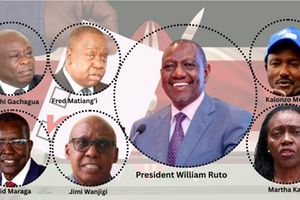
Some opposition strategists have floated the idea of a high-level opposition leadership retreat early in 2026, bringing together key opposition figures, including those outside the United Opposition like former Chief Justice David Maraga, Busia Senator Okiya Omtatah- who has filed court petitions seeking to block the sale of State enterprises- and Safina leader Jimi Wanjigi.
Safina Party Leader Jimi Wanjigi during an interview at his Kwacha House offices in Nairobi on October 8, 2025.
Photo credit: Evans Habil | Nation Media Group
The aim would be singular; forge unity early, agree on rules of engagement and project seriousness.
“This is not an extravagant idea,” one insider said. “It is a necessary one to bring the entire opposition under one umbrella.”
Former Deputy President Rigathi Gachagua — now touted as the defacto opposition chief, and the Democracy for the Citizen’s Party (DCP) leader- insists that the United Opposition will not allow president Ruto to set for it an agenda.
United Opposition flag bearer
“William Ruto cannot advise us on how to remove him from power and we cannot allow him to set an agenda for us. He should be very happy if we have no agenda, we are clueless and with no brains,” Mr Gachagua told Sunday Nation in an interview on Friday.
He went on: “Such characters (clueless) pose no threat to him and one wonders why he is preoccupied with their uselessness.”
Democratic Party Leader Justin Muturi, one of the principals of the United Opposition, told Sunday Nation: “We shall unveil our flag bearer very soon.”
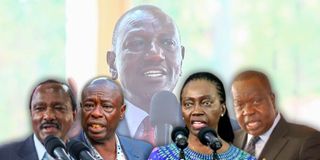
United Opposition leaders, led Rigathi Gachagua (centre), address the media in Nairobi on December 11, 2025.
Photo credit: Dennis Onsongo | Nation Media Group
This followed an assertion by Wiper Patriotic Front (WPF) leader Kalonzo Musyoka that the United Opposition shall unveil its flag bearer by March this year.
Mr Musyoka framed the early declaration as a show of unity and readiness against what he called “an oppressive and morally bankrupt regime.”
On Saturday, Mr Muturi was more explicit on the United Opposition’s presidential candidacy. The former Attorney General and ex-National Assembly Speaker said the matter of their flag bearer is an issue being canvassed at the highest level of the coalition.
“I can tell you without fear of contradiction that our candidate will come very soon. It’s an issue we have been discussing. We may not yet have agreed on the date for the unveiling but we are on course,” Mr Muturi said.
He went on: “The interest of the country must come first and we must all be ready to sacrifice our individual ambitions to rescue this country.”
“We are only left with the Auditor-General, the Controller of Budget and to a very large extent the Judiciary,” he said. “But even then, court orders are routinely ignored.”
At the heart of the opposition’s 2026 strategy is a conscious shift from protest politics to policy contrast.
Opposition leaders acknowledge that public anger alone is insufficient and that sustained relevance will depend on presenting a coherent alternative to Dr Ruto’s economic and governance model.
Their focus areas are; cost of living, taxation, debt management and job creation.
“The government keeps telling us about macroeconomic stability, but wananchi are not feeling it,” said one of the United Opposition’s strategists. “Our task in 2026 is to show that the pain is not accidental — it is a product of bad choices.”
Opposition’s pushback plan
The opposition is working on what insiders describe as a unified policy framework — not yet a manifesto, but a shared narrative that frames Dr Ruto’s presidency as “economically harsh, fiscally reckless and institutionally corrosive.”
This approach is designed to neutralise the President’s argument that the opposition has no agenda beyond sloganeering about removing him from office.
Perhaps the most consequential pillar of the opposition’s pushback plan is early consolidation around a single political vehicle.
Kenya’s electoral history offers a cautionary tale of fragmented opposition formations which have repeatedly handed incumbents victory despite widespread dissatisfaction. United Opposition leaders say this mistake will not be repeated.
United Opposition leaders after meeting in Nairobi to chart the way forward for opposition unity.
Photo credit: Pool
“We cannot wait until the last minute,” Mr Muturi said. “The country is at a crossroads and our individual ambitions cannot be greater than the interests of the nation. We are called now at this time, more than ever before to put the country first.”
“If unity talks drag into late 2026, the damage will already be done,” warned Multi-Media University don Prof Gitile Naituli. “Oppositions rarely lose elections because they lack numbers. They lose because they lack coherence.”
Prof Naituli argues that history — both Kenyan and global — is unforgiving to fragmented dissent. “Power thrives not merely on strength but on the inability of its challengers to organise themselves into a single, believable alternative,” he said.
Beyond unity, the opposition’s pushback plan is anchored in localising economic pain. Rather than debating GDP growth or fiscal consolidation, opposition leaders plan to take the fight to counties, markets, hospitals and schools.
The argument is that macroeconomic indicators mean little if households remain under budgetary strain.
“Effective opposition politics in 2026 will not be done from Nairobi boardrooms,” said a senior Wiper official. “It will be done in villages where food prices are high, hospitals lack supplies and youth have no jobs.”
Kitui Senator Enoch Wambua of Wiper Patriotic Front dismissed the President’s claims that the opposition lacks direction.
“If things were improving, Kenyans would feel it,” he said. “We don’t need to be told that microeconomics are looking up.”
Mr Wambua said crucial announcements — including the unveiling of a presidential candidate and a grand agenda — would come “at the fullness of time”.
“For the opposition to get a chance to roll out its plan for Kenya from 2027, Ruto must serve one term. That mantra is not idle talk.”
In a year President Ruto has framed as decisive, the opposition’s response may ultimately determine whether 2027 is a genuine contest — or a foregone conclusion.
Kirinyaga Governor Anne Waiguru however, dismisses the opposition’s plans.
Kirinyaga Governor Anne Waiguru during an interview at her official residence in Kutus on December 17, 2025.
Photo credit: Evans Habil | Nation Media Group
“There doesn’t seem to be a considered and well-thought-out program by the united opposition beyond criticism and the desire to replace the current government. On the other hand, the Kenya Kwanza Government appears more defined programmatically on the economy, on health, on agriculture, on infrastructure and on education, the issues that matter most to Kenyan voters,” she says.
Former Interior Cabinet Secretary and Jubilee deputy party leader Fred Matiang’i emphasised on collaboration and mutual respect, saying it will be a key cog in the race to the 2027 elections.
“We must focus on what brings us together. There is no reason why we should fight, nor any reason why we should hate each other, disorganise, or divide our people. Speaking arrogantly against our people is not why we are seeking leadership,” Dr Matiang’i said in Nyamira on Saturday.
He added: “When we seek leadership, let us choose our words carefully and consider how we address our people. Even when campaigning for votes, let’s weigh our words; they mean a lot. Reckless tongues can burn a country.”