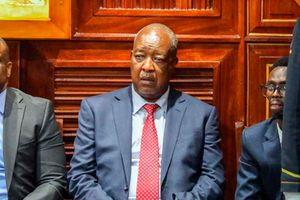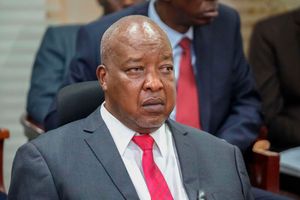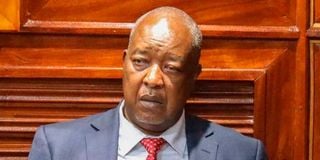
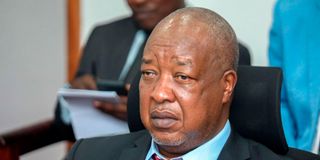
Nyamira Governor Amos Nyaribo before the Senate on December 3, 2025 during his impeachment hearing.

When the Senate overturned the Nyamira County Assembly’s decision to impeach Governor Amos Nyaribo on Wednesday, it marked the third time he had faced “political death” and emerged unscathed.
Mr Nyaribo ascended to the governorship following the death of his predecessor John Nyagarama and secured a fresh term in the 2022 General Election. He has had a consistently frosty relationship with members of the county assembly (MCAs), prompting three attempts to remove him from office.
The first attempt to impeach Mr Nyaribo failed due to insufficient votes, the second by a single vote.
Nyamira Governor Amos Nyaribo before the Senate on December 3, 2025 during his impeachment hearing.
The latest attempt, widely regarded as the most coordinated and politically charged, appeared on the brink of success but collapsed in the Senate.
Twenty-three MCAs voted to impeach Mr Nyaribo. The matter was then forwarded to the Senate. Here, through his legal team, the governor argued that the impeachment did not meet the constitutional threshold.
Lawyer Elias Mutuma raised a preliminary objection citing grave procedural gaps in the assembly’s case. Central to this was the claim by Speaker Thaddeus Nyabaro that three MCAs had voted through proxies—a charge that Nyaribo’s team successfully dismantled by proving no such proxy votes occurred. Once this threshold was disproved, the entire impeachment effort collapsed.
After the Senate verdict, Mr Nyaribo issued told his critics: “I ask my fellow leaders to let us solve our issues back at home instead of bringing them here (at the Senate).”
He called for a focus on development rather than political gossip.
Allegations also circulated that State House and politicians from the Gusii region aligned to the government had helped Mr Nyaribo avoid impeachment, but he denied the claims.
Prior to the Senate hearing, some United Democratic Alliance (UDA) voices, including State House official Denis Itumbi, suggested Mr Nyaribo had crossed the floor and aligned with the broad-based government. But Mr Nyaribo maintained his independence and denied support for the broad-based arrangement.
Sources close to the governor indicate that the impeachment effort aimed less at removing him from office and more at pressuring him to embrace the broad-based government led by President William Ruto.
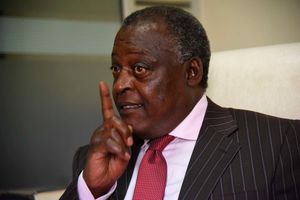
Nyamira County Governor Amos Nyaribo.
Before the Senate session, Mr Nyaribo was photographed at his Lavington home with Kisii Governor Simba Arati, South Mugirango MP and National Assembly Chief Whip Silvanus Osoro and UDM National Treasurer Japheth Nyakundi.
The images sparked speculation that Mr Nyaribo had succumbed to pressure. His supporters, however, argued the meeting was a political manoeuvre by Mr Arati to appear as a rescuer and boost his own political standing.
“In my experience, impeachment is more political than legal. It involves lobbying loyalists, perceived loyalists and possible opponents behind the scenes. When they want to save someone, they even point out weak lines of attack. Bottom line: this is politics, not court or law,” one ally explained.
But Mr Nyaribo’s survival was not welcomed by all, with former county health executive, Dr Ombati Mokua, saying: “The real losers are the people of Nyamira. I wish we had the same energy for serving our people as we do when protecting personal interests.”
The Senate’s ruling not only kept the governor in office but also reset the political chessboard, raising the question: will he continue aligning with Jubilee Deputy Party Leader Fred Matiang’i’s camp, or shift towards the broad-based government?
The latest impeachment was largely framed around allegations that Mr Nyaribo supported a breakaway faction of MCAs known as Bunge Mashinani.
While accusations of constitutional violations were broad and politically charged, he successfully demonstrated procedural failures, which became his saving grace.