The broad-based government formed through President William Ruto's political truce with the late opposition leader Raila Odinga and the subsequent partnership between UDA and ODM parties has no constitutional foundation and breaches Kenya's multiparty democracy.
In dissenting opinion delivered in consolidated petitions regarding the constitution of President Ruto’s Cabinet, High Court Judge Jairus Ngaah also found that the Head of State could not lawfully reappoint Cabinet secretaries he had dismissed in July 2024 because the dismissal rendered them ineligible for immediate reappointment.
Justice Ngaah said that bringing members of opposition party into Cabinet outside constitutionally recognised coalition or merger arrangements blurred the line between government and opposition, weakening the checks and balances envisaged by the Constitution.
In a dissenting judgment to a three-judge bench that otherwise upheld the appointments, Mr Ngaah said the broad-based government departed from the constitutional framework.
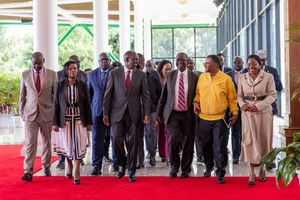
ODM Party leader Dr Oburu Oginga (left), President William Ruto and ODM Chairperson Gladys Wanga share a cake during ODM@20 celebrations at Sarova Whitesands in Mombasa on November 16, 2025
The dissent formed part of the court's judgment dismissing four consolidated petitions challenging the legality of the Cabinet reconstituted after the June 2024 anti-Finance Bill protests.
While the majority –Justices Eric Ogolla and Stephen Githinji- rejected the challenges, Justice Ngaah set out a competing constitutional interpretation explaining why he believed the appointments breached the constitutional order.
The petitions had been filed by lawyer Saitabao Ole Kanchory, Katiba Institute, the Centre for Rights Education and Awareness, the Institute for Social Accountability, the Community Advocacy and Awareness Trust, World March of Women-Kenya, the Kenya Human Rights Commission, Wanjiru Gikonyo, Eliud Matindi, Dr Magare Gikenyi and Busia Senator Okiya Omtatah.
They challenged the appointments of Cabinet secretaries following President Ruto's dismissal of almost the entire Cabinet after nationwide protests against the Finance Bill, 2024.
The reconstituted Cabinet included four senior ODM politicians, among them John Mbadi, Opiyo Wandayi, Hassan Joho and Wycliffe Oparanya, under what became known as the broad-based government.
Mr Mbadi was appointed Cabinet Secretary National Treasury; Mr Wandayi Cabinet Secretary Energy and Petroleum, Mr Joho (Mining, Blue Economy and Maritime Affairs) and Mr Oparanya (Co-operatives and Micro, Small and Medium Enterprises (MSME) Development).
From left: Cabinet Secretaries John Mbadi (National Treasury), Wycliffe Oparanya (Cooperatives), Beatrice Askul (EAC), Hassan Joho (Mining) and Opiyo Wandayi (Energy).
Photo credit: Nation Media Group
Also appointed was Ms Beatrice Askul Moe as Cabinet Secretary for East African Community (EAC), The Arid and Semi-Arid Lands (ASALs) & Regional Development.
A host of key ODM-allied appointees also jointed President Ruto’s administration as Principal Secretaries and Presidential advisers.
Justice Ngaah said the legal dispute was not about the President's power to appoint Cabinet Secretaries.
Instead, he said it turned on whether the Constitution recognized a political arrangement that brought leaders from the opposition into government without following procedures established under the Constitution and the Political Parties Act.
“I would make the declaration that the nomination for appointment and the subsequent appointment of members of political parties other than the ruling party in the absence of any merger or coalition agreements under sections 10 and 11 of the Political Parties Act was not only contrary to those provisions of the law but it is an assault on identification of the Republic of Kenya as a multi-party democracy under article 4 of the Constitution," he said.
He explained that where political parties intended to govern together, the Constitution and legislation already provided clear mechanisms through coalition or merger agreements.
“The appointments were in violation of Article 4 of the Constitution and the broad-based government that ensued has neither constitutional nor legal basis,” Ngaah said.
"Political accommodation"
According to the judge, allowing opposition leaders to join Cabinet outside those legal mechanisms fundamentally altered the constitutional design that separates the Executive from the opposition.
He also rejected arguments that political accommodation or national unity could justify departures from constitutional procedures.
He held constitutional governance required public power to be exercised strictly within the framework established by the Constitution rather than through political consensus alone.
The judge further dissented on the reappointment of several Cabinet Secretaries who had been dismissed during the July 2024 Cabinet shake-up before being returned to office weeks later.
The judge said the President publicly justified dissolving the Cabinet by citing concerns over governance, accountability and responsiveness to Kenyans.
In those circumstances, he said, reappointing the same individuals without explaining the change raised constitutional questions on accountability and transparency.
“I would also be inclined to make a declaration that the President’s nomination for reappointment of Cabinet Secretaries he had dismissed on 11 July 2024 was in violation of article 259(10) of the Constitution,” said Justice Ngaah.
The judge relied on the President's own public statement dismissing the Cabinet. Ngaah noted that the President said he had reflected on the Cabinet's "performance", "achievements and challenges" before dismissing all Cabinet Secretaries except the Prime Cabinet Secretary.
Second, the judge said those reasons mattered constitutionally. He reasoned that if the President found the Cabinet's performance wanting to the extent of dismissing it, then those same Cabinet Secretaries could not immediately be regarded as qualified for reappointment.
"When dismissing his Cabinet, the President found its performance wanting in some respect and if the Cabinet was deficient in its performance to the extent that it had to be dismissed, the same Cabinet members cannot be said to have been qualified for reappointment under Article 259(10) of the Constitution,” said Justice Ngaah.
President William Ruto chairs a past Cabinet meeting.
Photo credit: PCS
He rejected any suggestion that the dismissals were merely part of a Cabinet reshuffle. He drew a sharp distinction between dismissal under Article 152(5)(b) and reassignment under Article 152(5)(a), saying the two constitutional powers were different and could not be treated as interchangeable.
The majority of the bench, however, rejected the constitutional challenges and upheld the appointments, meaning Justice Ngaah's conclusions did not become the court's binding decision.
The judge concurred with his colleagues that the Cabinet, as constituted, did not satisfy the constitutional requirement that no more than two-thirds of members of an appointive body be of the same gender.
He said the gender principle under Article 27 imposed a binding constitutional obligation and could not be treated as an optional political objective when constituting Cabinet.