As Kenya's opposition races against time to forge a united front for the August 10, 2027 General Election, the biggest battle is no longer whether to face President William Ruto as one coalition, but who should lead that charge.
Behind the scenes, an intricate web of negotiations, power plays and political calculations is shaping what many insiders describe as the most consequential decision the alliance will make.
With nearly every principal convinced they bring unmatched political capital to the table, coalition talks have increasingly revolved around balancing party strength, regional influence, financial muscle and personal ambition without fracturing the fragile unity that has kept the movement together.
The high-stakes bargaining has also exposed a delicate reality: while everyone agrees on the need for a single presidential ticket, few are willing to concede the top seat without securing significant political guarantees.
The outcome of the negotiations is expected to determine not only who faces President Ruto in the poll but also which party emerges as the dominant force within the opposition for years to come.
Away from public rallies and declarations of unity, intense negotiations are underway as opposition leaders attempt to craft what they believe is the only viable formula for defeating an incumbent enjoying the advantages of State power.
Former Deputy President Rigathi Gachagua, Wiper Patriotic Front leader Kalonzo Musyoka , People's Liberation Party leader Martha Karua , Jubilee candidate Fred Matiang'i, Democratic Action Party-Kenya leader Eugene Wamalwa, Democratic Party leader Justin Muturi , Party of National Unity leader Peter Munya and other political formations are all pursuing the same goal of building a united opposition capable of mounting a serious challenge against President Ruto.
Yet beneath the public display of solidarity lie difficult questions that have historically broken Kenyan opposition alliances.
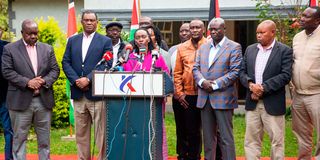
From left: DCP leader Rigathi Gachagua, Wiper party leader Kalonzo Musyoka and PLP leader Martha Karua, alongside other United Opposition leaders head to Vigilance House in Nairobi on January 30, 2026.
Photo credit: Bonface Bogita | Nation Media Group
Who should carry the presidential flag? How should the candidate be selected? Can the coalition raise sufficient resources to compete with an incumbent? How should regional interests be accommodated? Above all, can leaders with presidential ambitions subordinate personal interests for the sake of unity?
The latest realignment is perhaps Kenya's most significant political reorganisation since the contested aftermath of the 2022 General Election.
President Ruto assumed office promising to transform the economy through his Bottom-Up Economic Transformation Agenda. However, rising taxes , the high cost of living, mounting public debt and growing economic dissatisfaction have gradually strengthened calls for a united opposition.
The June 25, 2024, Gen Z protests became a defining moment.
Initially triggered by opposition to the Finance Bill 2024, the demonstrations evolved into a broader national conversation about governance, accountability, corruption, police conduct and public participation. The protests forced President Ruto to withdraw the Finance Bill , dissolve his Cabinet and reorganise his administration.
Soon afterwards, the late former Prime Minister Raila Odinga entered into a broad-based political arrangement with President Ruto, weakening Azimio as the country's principal opposition outfit while creating political space for a new coalition.
Leaders uncomfortable with the arrangement gradually gravitated towards a fresh alliance positioning itself as Kenya's genuine opposition, now christened the United Alternative Government.
That coalition has expanded beyond former Azimio affiliates to include former Kenya Kwanza insiders led by Mr Gachagua, whose fallout with President Ruto transformed him into one of the administration's fiercest critics.
For the first time since 2022, politicians from different ideological and regional backgrounds are attempting to build one opposition machine.
Perhaps no issue better illustrates the coalition's delicate balancing act than selecting its presidential candidate.
Nearly every principal commands a substantial political constituency and harbours presidential ambitions.
Mr Musyoka sees 2027 as his best opportunity after past unsuccessful attempts. Dr Matiang'i has emerged as a favourite among those seeking a technocratic candidate. Ms Karua remains one of the country's leading reform voices, while Mr Gachagua commands considerable influence in Mt Kenya. Mr Wamalwa and Mr Munya also retain important regional support.
Yet coalition leaders increasingly insist that the contest should not be about personalities but about process.
Ms Karua and Dr Matiang'i have become the strongest advocates of a transparent, scientific nomination model, arguing that opposition alliances have repeatedly failed because candidates were imposed through elite negotiations rather than objective processes.
Ms Karua has ruled out zoning or backroom deals, insisting that the coalition's flag bearer must emerge through a credible process acceptable to all partners.
"We should not choose a presidential candidate through boardroom negotiations. The candidate must emerge through a scientifically proven process that is transparent and acceptable to all Kenyans," Ms Karua disclosed.
She has also opposed zoning, arguing that leadership should be determined by merit and acceptability.
Dr Matiang'i has taken a similar position, maintaining that the coalition must prioritise fairness over personalities in selecting its flag bearer.
"Our responsibility is to build institutions and processes that inspire confidence. Whoever emerges should do so through a process that every Kenyan considers fair and credible," Dr Matiang'i has said.
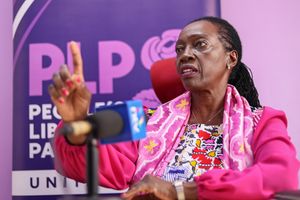
People’s Liberation Party leader Martha Karua.
Photo credit: Wilfred Nyangaresi | Nation Media Group
Their proposal centres on scientific polling, measurable public support and transparent criteria capable of producing a nominee acceptable to all coalition partners.
Opposition unity almost collapsed in 2002 when Ford People presidential candidate Simeon Nyachae refused to join the National Rainbow Coalition behind Mwai Kibaki.
Five years later, Kalonzo Musyoka broke ranks with Raila Odinga-William Ruto-led ODM over leadership disagreements and mounted his own presidential campaign.
Even Azimio experienced internal tensions over the choice of Raila Odinga's running mate in 2022, with Mr Musyoka threatening to go it alone once again, even though he was later implored to back the late Odinga.
If multiple principals compete for the nomination, they say, those who lose must leave the process convinced—not coerced—that the winner genuinely enjoys broader national support.
Political analyst Dismas Mokua argues that the credibility of the nomination process may ultimately prove more important than the nominee.
"The process determines whether supporters accept the outcome. Without legitimacy, unity becomes impossible," he says.
Even as coalition leaders debate nomination rules, another development has complicated opposition calculations.
Before the ruling, the former Deputy President had positioned himself as the undisputed political voice of Mt Kenya through his Democracy for the Citizens Party (DCP), hoping to consolidate the region before negotiating within the opposition.
The court decision introduced uncertainty over his future and transformed him from a potential presidential contender into a possible kingmaker.
For decades, Mt Kenya has preferred direct representation at the apex of government, backing leaders such as Kenneth Matiba, Mwai Kibaki, Uhuru Kenyatta and later Mr Gachagua as Deputy President.
Should the opposition eventually settle on a ticket led by Kalonzo Musyoka or another leader without a Mt Kenya running mate, analysts say, Mr Gachagua would face the difficult task of persuading the region to support a ticket lacking direct representation.
The political observers describe that as one of the coalition's biggest strategic challenges, as it could benefit President Ruto if he retains Prof Kithure Kindiki as his running mate, or further still, profit Safina party candidate Jimi Wanjigi, should he go all the way to the wire.
Alongside Siaya Governor James Orengo and Embakasi East MP Babu Owino, Mr Sifuna has become one of the leading faces of the Linda Mwananchi movement, which seeks to occupy the opposition space created after ODM entered the broad-based arrangement with President Ruto.
From left: Suba South MP Caroli Omondi, Embakasi East MP Babu Owino, Nairobi Senator Edwin Sifuna, Siaya Governor James Orengo and Vihiga Senator Godfrey Osotsi during the People’s Delegate Convention organized by the Linda Mwananchi faction of the ODM at Ufungamano House in Nairobi on March 27, 2026.
Photo credit: Wilfred Nyangaresi | Nation Media Group
Although coalition leaders dismiss suggestions of rivalry, discussions between Linda Mwananchi and the broader opposition have fuelled speculation about possible cooperation.
Kitui Senator Enoch Wambua insists both formations share the same objective of making President Ruto a one-term president, while Eugene Wamalwa says communication between the two sides remains active.
“A closer look at the Linda Mwananchi team will answer your question. It has members drawn from all parties in the united alternative government. The two teams are focused on a single mission; to make President Ruto a one term president. And they will do it together,” Mr Wambua told Nation.
Political analyst Prof Gitile Naituli believes Mr Sifuna's growing profile has significantly altered coalition arithmetic.
By positioning himself as an articulate advocate for governance and constitutionalism, the Nairobi senator has broadened his appeal beyond Nairobi while attracting younger urban voters.
For coalition strategists, his emergence represents both an opportunity and a challenge, expanding the opposition's appeal while complicating efforts to balance competing regional and generational interests.
Even if coalition principals eventually agree on a candidate, another hurdle remains: Campaign financing.
Coalition strategists increasingly acknowledge that resources may determine whether the opposition becomes a credible electoral machine.
Unlike previous elections, the coalition is exploring grassroots fundraising, digital mobilisation and contributions from supporters.
A Technical Committee for the United Opposition is already working on coalition registration, a common manifesto, dispute resolution mechanisms and campaign financing structures.
Yet presidential campaigns require enormous resources, from logistics and advertising to polling, legal teams and nationwide mobilisation.
But Ms Karua argues that elections should not become contests of financial muscle, insisting leadership should be judged on integrity and competence rather than campaign spending.
"Leadership is not about who has the deepest pockets. Kenyans should elect leaders based on integrity, competence and their commitment to public service—not on how much money they spend during campaigns," she says.
She has also accused the Kenya Kwanza administration of exploiting State resources for political mobilisation, insisting the opposition intends to finance its activities transparently and within the law.
Dr Matiang'i has similarly criticised the use of State resources during by-elections, warning that excessive incumbency advantages undermine democratic competition.
"When State resources are deployed to influence elections, the democratic playing field becomes uneven. We must protect the integrity of the electoral process," he has said.
Political analyst Mark Bichachi believes the opposition should rely more heavily on technology, volunteer mobilisation and the organisational lessons demonstrated during the Gen Z protests.
Mr Mokua, however, argues fundraising alone will not succeed unless accompanied by a compelling national message.
Making President Ruto a one-term president, he says, is insufficient. “The coalition must present a clear alternative on jobs, taxation, governance and economic management.”
Prof Naituli agrees that while campaign resources matter, elections are ultimately shaped by public mood, organisation and voter turnout.
Perhaps the coalition's greatest challenge lies not in selecting candidates or raising money but in managing competing ambitions.
Reconciling those aspirations while maintaining unity will require exceptional political discipline.
Publicly, coalition leaders insist there is no rivalry.
Ms Karua describes the current situation as "friendly competition," while Dr Matiang'i dismisses reports of tension with Mr Gachagua, and Mr Wamalwa says integrity must guide coalition decisions.
Privately, however, negotiations continue over power-sharing, regional balance, campaign strategy and future government positions.
Analysts say that the coalition must satisfy competing regional interests while avoiding the ethnic bargaining that has characterised previous elections.
Instead, leaders insist they want to build a coalition based on competence, governance and public participation.
Political commentator Herman Manyora says defeating an incumbent requires more than criticising government failures. “The coalition must present a coherent governing philosophy capable of inspiring confidence among undecided voters.”
Governance expert Javas Bigambo agrees, arguing that public frustration alone will not guarantee victory.
He says: “Organisation, unity, credible leadership and sufficient resources remain essential.”
Advocate Chris Omore similarly believes the coalition must convince Kenyans that supporting it represents an investment in a different future rather than merely a protest vote.
History is filled with opposition alliances that generated excitement only to collapse under the weight of competing ambitions.
Current coalition leaders insist they have learnt from those failures, with some embracing scientific nominations, issue-based politics, grassroots fundraising and collective leadership.
Analysts say that opposition leaders must first resolve the delicate questions of leadership, regional balance, financing and ideology before asking Kenyans to entrust them with power.
Only after navigating those internal intrigues can the coalition hope to transform itself from a loose collection of anti-Ruto politicians into a disciplined, united and electable alternative government.