Wiper leader Kalonzo Musyoka and Jubilee Party presidential hopeful Fred Matiang’i have offered contrasting but revealing accounts of the difficult road facing Kenya’s opposition as it seeks to settle on a single candidate to challenge President William Ruto in the 2027 General Election.
While both leaders said they were ready to participate in the search for a joint presidential candidate, their remarks exposed the fault lines already emerging within the opposition, from competing ambitions and questions over who qualifies as a principal to distrust over opinion polls and disagreements on how the eventual flag bearer should be chosen.
Speaking separately yesterday, Mr Musyoka accused unnamed State agents of working with pollsters to manipulate perceptions of popularity within opposition strongholds, while Dr Matiang’i warned that the emerging alliance risked being undermined by hypocrisy, insults and internal rivalry.
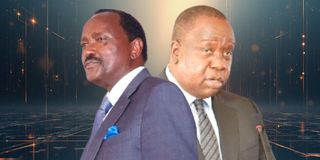
Jubilee Party Presidential candidate Fred Matiang'i (left) and Wiper Patriotic Front leader Kalonzo Musyoka during a church service at PCEA Utawala in Nairobi on February 22, 2026.
Photo credit: Dennis Onsongo | Nation Media Group
Mr Musyoka spoke on NTV’s Fixing the Nation programme, while Dr Matiang’i appeared on Kameme TV .
Both leaders agreed that selecting a single candidate would require painstaking negotiations and consensus, but differed in their emphasis on what should determine the choice.
For Mr Musyoka, his four decades in national politics, experience in government and familiarity with Kenya’s political and international landscape give him an advantage in a contest that will require a candidate capable of remaining steady in moments of crisis.
He entered Parliament in 1983 and has since been at the centre of some of the country’s defining political contests, serving as Vice-President and holding several senior government positions.
Mr Musyoka said this experience, combined with what he described as a credible anti-corruption record and freedom from the greed associated with younger politicians, makes him a strong contender for the opposition ticket.
He nevertheless insisted that the final decision must be based on a careful assessment of the political dynamics across the country.
“God willing, I will be on the ballot next year… just like the way I was in 2007,” he said.
The Wiper leader also warned against what he described as manufactured opinion polls designed to create a false impression of support for particular opposition politicians.
“We will not fall to those tricks. We must be very meticulous in coming up with the method and moment of deciding who the flag bearer will be. We must take into consideration the many dynamics that apply in the more than 42 communities we have around and ensure we front the best we can to give us a crashing win against this government,” he said.
He argued that the process must take into account Kenya’s ethnic and regional diversity and produce a candidate capable of assembling the broadest possible coalition.
The former Vice-President was also asked whether he would accept becoming a running mate to Linda Mwananchi leader Edwin Sifuna if the latter were selected as the opposition presidential candidate.
Nairobi Senator Edwin Sifuna acknowledges supporters during the Linda Mwananchi rally in Butula, Busia County, on August 7, 2026.
Photo credit: Alex Odhiambo | Nation
Mr Musyoka avoided giving a categorical yes or no, saying the question could only be answered after all the factors surrounding the eventual coalition were considered.
“I wouldn’t have a problem… not only about him, but about anyone else. I have been very clear on that. But this issue is not exactly that of a yes or no answer. There are many factors to be considered, and we will explore all of them so that our pick will have that inclusivity and thoroughness,” he said.
On the other hand, Dr Matiang’i appeared more concerned about the internal culture of the op-position and the manner in which its leaders are relating to one another.
He accused some members of the emerging alliance of resorting to insults and suspicion instead of building trust.
“Those among us calling me a mole are the very ones who the other day were helping this president fight and insult us. They were there when former President Uhuru Kenyatta ’s Northland Estate was raided in 2024, and my house was broken into. They are now back to their old habits of insults,” he said.
The former Interior Cabinet Secretary appeared to direct some of his criticism at Democracy for Citizens Party leader Rigathi Gachagua and his allies, who have increasingly sought to define who should be regarded as the principal figures in the opposition.
Former deputy president Rigathi Gachagua.
Photo credit: File I Nation Media Group
Dr Matiang’i said the opposition should first build a team before choosing its captain, warning against the emergence of a dominant figure who dictates the direction of the alliance.
“In the opposition that we are building, it is not like a seminary where we have the mother superior. We are leaders who have come together. We are in the process of turning the group into a team, and then this team will have a captain. You first form a team, then pick the captain, but you cannot pick the captain then form the team. We are a grouping of equals with diverse but complementing strengths,” he said.
The Jubilee leader cited the July 16 Ol Kalou parliamentary by-election as evidence of what he described as the opposition’s failure to honour agreements and work collectively.
He said Jubilee had supported the Democratic Party in the Mbeere North by-election after agreeing that the parties would back one another where necessary, but that the arrangement was not reciprocated in Ol Kalou.
“There is hypocrisy in the united opposition. In Ol Kalou, we were to field our Jubilee candidate to defend our seat. We had honoured that agreement in the Mbeere North by-election where we withdrew our candidate to help the Democratic Party to defend its seat. But in supporting us in Ol Kalou, they started saying DCP is the popular party. If we do not do away with that hypocrisy, we risk bungling 2027,” he warned.
Dr Matiang’i dismissed suggestions that he was seeking acceptance or political popularity from his colleagues, adding that he preferred negotiations and policy discussions to public political theatrics.