For months, the opposition's greatest challenge was forging unity against President William Ruto.
Today, a more difficult task confronts its leaders—deciding who’d bell the cat as it were.
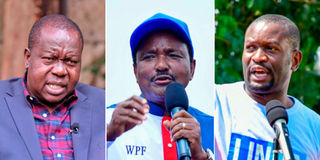
With former Deputy President Rigathi Gachagua effectively out of the presidential equation at the moment following his impeachment, attention has shifted to four possible pairings involving Wiper leader Kalonzo Musyoka, Jubilee candidate Fred Matiang'i and Nairobi Senator Edwin Sifuna.
Insiders now speak of a possible Kalonzo-Matiang’i, Matiang’i-Kalonzo, Kalonzo-Sifuna or a Sifuna-Kalonzo ticket.
Until recently, Mr Musyoka and Dr Matiang’i appeared the undisputed favourites to fly the opposition's presidential flag in 2027.
Today, however, Mr Sifuna has upended that assumption after emerging as the opposition's most popular presidential hopeful in the latest TIFA poll, overtaking Mr Musyoka and Dr Matiang’i for the first time.
Yet despite the shifting numbers, one constant cuts across every serious power-sharing formula under discussion— Mr Musyoka himself.
Whether as presidential candidate or running mate to Dr Matiang'i or Mr Sifuna, the veteran opposition leader has become the coalition's indispensable factor, leaving the alliance grappling with its biggest dilemma yet: who pairs with whom?
The rapid emergence of Mr Sifuna and the Linda Mwananchi movement has introduced a new centre of gravity within the opposition, forcing leaders who until recently believed they had a clear path to the presidential ticket to rethink their calculations.
Today, virtually every opposition leader agrees on one thing that unity is the only realistic path to defeating President Ruto in 2027.
Yet agreeing on unity has proved far easier than agreeing on who should carry the presidential flag—and perhaps even more importantly, who should deputise them.
From left: United Opposition leaders Justin Muturi, Kalonzo Musyoka, Rigathi Gachagua and Eugene Wamalwa address on March 5, 2026.
Photo credit: Dennis Onsongo | Nation Media Group
Regional arithmetic, ethnic balancing, coalition management and perceptions of inclusivity often matter just as much as personal appeal.
It is this reality that has thrown the opposition into one of its most delicate negotiations since coalition talks began.
The three leading contenders— Mr Musyoka, Dr Matiang'i and Mr Sifuna—all possess compelling arguments.
Opposition strategists say Mr Musyoka brings decades of political experience and has patiently waited for what many of his allies describe as "his turn."
He served as Vice President, has contested the presidency before and remains one of the country's most recognisable opposition figures after Raila Odinga’s death.
Dr Matiang'i on the other hand, offers a technocratic image and enjoys considerable goodwill among “reform-minded voters.”
His entry into active opposition politics, they say, injected fresh momentum into coalition talks.
Only months ago, few considered him a serious presidential contender. Today, he is perhaps the fastest-rising politician in opposition politics.
Opinion polls now place him among the country's leading presidential hopefuls, fundamentally changing coalition negotiations.
An Infotrak survey ranked a Kalonzo-Sifuna combination as the opposition's most preferred presidential pairing at 23 percent, suggesting that the two leaders together may offer the coalition its strongest electoral formula.
According to the latest TIFA poll, Mr Sifuna has overtaken Mr Musyoka in presidential popularity, polling 15 percent against the Wiper leader's 13 percent, while Dr Matiang'i follows closely with 14 percent.
Combined, opposition candidates command more than half of voter preference compared to President William Ruto's 24 percent.
Nairobi Senator Edwin Sifuna during a women empowerment program on July 3, 2026.
Photo credit: Alex Odhiambo | Nation Media Group
If Mr Sifuna has become the opposition's most popular individual candidate, should he accept the deputy president's slot?
Conversely, if Mr Musyoka once again steps aside despite years of waiting, would his supporters remain united behind another candidate?
Political analyst Eric Muli argues that Mr Musyoka has remained in opposition through multiple election cycles and has patiently built alliances across the country.
"Coalition politics is built on trust and relationships developed over time. Kalonzo has spent years nurturing political partnerships across different regions, which explains why his name features in almost every opposition formula being discussed," says Mr Muli.
That endurance, Mr Muli says, gives him credibility as a unifying figure in any coalition negotiations.
Kitui senator Enoch Wambua insists that the United Opposition and the Linda Mwananchi will work together despite any challenges.
“The two teams are focused on a single mission; to make President Ruto a one term president. And they will do it together,” says Mr Wambua.
For Dr Matiang'i, his allies say he represents competence and administrative experience, having served in some of the country's most influential ministries.
Dr Matiang'i has consistently argued that the coalition should rely on a transparent and scientifically tested process to settle on its presidential ticket, warning that the real test will come after the decision
"It will not be an easy task to convince your supporters that despite your popularity, you cannot fly the flag," he says.
Mr Sifuna, meanwhile, represents political energy.
His appeal appears strongest among younger voters and those seeking a fresh generation of leadership.
The challenge for coalition negotiators is determining whether elections are won by rewarding political seniority or embracing changing voter preferences.
If the presidential contest presents one dilemma, the running mate debate presents another.
DCP party leader Rigathi Gachagua, Jubilee deputy party leader Fred Matiang’i, Wiper Party leader Kalonzo Musyoka and DAP-Kenya’s Eugene Wamalwa during a press briefing at the SKM Centre, Nairobi, on the opposition’s alternative budget proposals and key economic priorities.
Photo credit: File | Nation Media Group
For decades, the region has insisted on having direct representation at the highest levels of government, either through the presidency or deputy presidency.
Political analysts warn that excluding the region from the opposition ticket could suppress voter enthusiasm in one of Kenya's most influential voting blocs.
That concern has become even more pronounced following the High Court's decision upholding former Deputy President Rigathi Gachagua's impeachment.
While the verdict did not erase Mr Gachagua's influence, it fundamentally altered the opposition's calculations.
The former deputy president can still mobilise voters, but uncertainty over his own political future complicates coalition planning.
“One of the opposition's greatest challenges lies in persuading Mt Kenya voters to rally behind a ticket lacking one of their own,” argues advocate Nelson Osiemo.
Among leaders associated with the region, only Safina Party leader Jimi Wanjigi and People's Liberation Party leader Martha Karua have openly declared presidential ambitions.
However, Ms Karua remains part of the broader opposition coalition, where discussions increasingly revolve around combinations involving Mr Musyoka, Mr Sifuna and Dr Matiang’i.
Mr Osiemo argues that this creates an opportunity for Mr Wanjigi to emerge as the principal presidential choice for voters seeking a home-grown candidate.
Mr Wanjigi has held two private meetings with Mr Gachagua at his Wamunyoro residence, fuelling intense speculation over their political strategy as Mt Kenya grapples with growing uncertainty ahead of the 2027 General Election.
Should the opposition settle on a ticket without a Mt Kenya leader, some analysts say, Mr Wanjigi may become an attractive alternative for sections of the region's electorate, particularly if Mr Gachagua declines to endorse one specific candidate.
Despite his impeachment, Mr Gachagua remains one of the opposition's most influential mobilisers.
Multi-Media University don Prof Gitile Naituli says the impeachment verdict “creates opportunities for alternative leaders,” while cautioning against reducing Mt Kenya politics solely to Mr Gachagua's legal status.
Politics, he argues, ultimately revolves around influence, legitimacy and public trust.
Political analyst Dismas Mokua similarly believes that while the ruling narrowed Mr Gachagua's options, it did not eliminate his influence.
“Instead, it forces him to rethink how to convert regional popularity into sustainable national political leverage,” he says.
Can it fully harness Mr Gachagua's mobilisation machinery without giving Mt Kenya a place on the presidential ticket?
As the opposition debates internal formulas, President Ruto's camp is moving aggressively to secure Mt Kenya.
Deputy President Kithure Kindiki has emerged as the administration's principal campaigner in the region, arguing that Mt Kenya's future lies within Kenya Kwanza.
Support President Ruto's re-election and the region remains firmly within the national leadership structure.
United Opposition leaders, from left: Fred Matiang'i of the Jubilee Party, Stephen Kalonzo Musyoka of the Wiper Patriotic Front, Rigathi Gachagua of the Democracy for Citizens Party (DCP), and Eugene Wamalwa of the Democratic Action Party–Kenya, during a church service at PCEA Utawala in Nairobi on Sunday, February 22, 2026.
Photo credit: Dennis Onsongo | Nation Media Group
Support the opposition, and Mt Kenya risks relegation.
In one of his strongest political appeals last Sunday, Prof Kindiki claimed that within the opposition hierarchy, the region occupies "number 20," while under Kenya Kwanza it remains central to national leadership.
But political analyst Steve Ngari says “it undoubtedly increases pressure on opposition negotiators to produce a ticket capable of reassuring Mt Kenya voters.”
United Opposition spokesperson Dr Mukhisa Kituyi says that with the emergence of Linda Mwananchi movement; they now have to consider Mr Sifuna in their winning formula.
“There is the new kid on the bloc—Sifuna and his team. We have to talk to them and see the next steps they are making,” Dr Kituyi told Nation.
Mr Sifuna has said he's willing to work with Mr Gachagua and his camp despite having voted to impeach the former deputy president, arguing that the opposition's shared goal of removing President Ruto from office outweighs their past political differences.
Speaking during an interview on Citizen TV on Tuesday night, Mr Sifuna said the Linda Mwananchi movement is prepared to work with anyone committed to upholding the Constitution, the rule of law and unseating President Ruto.
"We will work with everyone who believes in these things, the Constitution and the rule of law. We will work with anyone who believes that Ruto does not deserve an extra day in office and, for as long as that's our cause, we will work together," the Nairobi senator said.
Opposition coalition leaders insist no final decision has been reached on its ticket and have cautioned against speculation, emphasising that negotiations remain ongoing.
The opposition intends to require unsuccessful aspirants to formally endorse whoever eventually emerges as the coalition's flag bearer.
“Such commitments may reduce public divisions, but history suggests written agreements alone cannot eliminate political resentment,” Dismas Mokua.
He added: “Kenya's coalition politics has repeatedly shown that losing internal nominations often produces defections, parallel campaigns or diminished enthusiasm during the general election.”
Preventing that outcome, analysts, he says, will require more than signatures, but genuine trust.
“Ultimately, the opposition's dilemma extends beyond personalities. The coalition must answer broader questions; should experience outweigh popularity? should regional balancing override opinion polls or should coalition loyalty take precedence over public demand?” political analyst Geoffrey Mboya poses.
The opposition has pledged to unveil its presidential candidate and power-sharing formula by March next year.
Between now and then, negotiations will likely intensify behind closed doors.
“Opinion polls will continue to reshape perceptions while regional interests will compete with national calculations and individual ambitions will collide with coalition discipline,” adds Mr Mboya.
Advocate cum political analyst Chris Omore observes, defeating an incumbent “President Ruto will require far more than anti-government sentiment.”
“It will demand careful management of egos, regional interests and competing ambitions before the campaign truly begins,” he says.