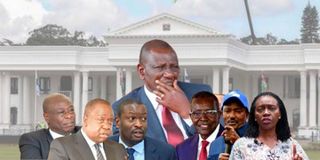
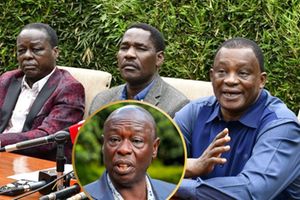
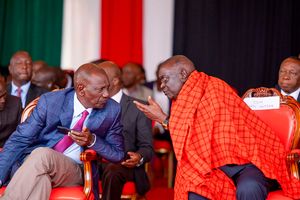
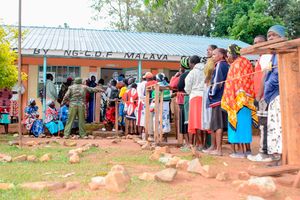
One year from today, Kenyans will troop to polling stations to deliver a verdict on who governs them until 2032.
They will choose whether to hand President William Ruto another five-year contract or clear the way for someone else.
In the same election already framed as ‘Tutam’ versus ‘Wantam’, the voters will elect 290 members of the National Assembly, 47 governors and their deputies, 47 woman representatives, 47 senators, and 1,450 members of county assemblies.
Notably, it will be the second election since 1997 in which Raila Amolo Odinga's name will not appear on a presidential ballot paper. Mr Odinga died last October. “There will never be another Raila. But the ideals he stood for live,” his daughter Winnie says.
In 2022 there were 46,229 polling stations. For 2027, the Independent Electoral and Boundaries Commission (IEBC) is expected to add more stations.
The IEBC register had at least 22.1 million voters in 2022, and it is projected that at least 6.3 million will be added to the register, making it approximately 28.5 million.
The commission is planning a mass voter registration exercise for January next year, which will run for 30 days from January 11 to February 9, 2027.
The political landscape is expected to keep changing ahead of D-Day, largely on the opposition side.
Photo credit: Nation Media Group
Even President Ruto, who already has a working arrangement with the Orange Democratic Movement (ODM) led by Siaya Senator Dr Oburu Oginga under the broad-based government, is still courting more parties, with some from the opposition expected to join him, particularly in the event of a fallout over who should fly the presidential flag.
To put its house in order, on August 3 the Azimio coalition council, chaired by former President Uhuru Kenyatta , ratified a restructuring.
It admitted Dr Fred Matiang'i, Mr Peter Munya and Mr Lenny Kivuti as council members. It also brought in Mr Justin Muturi's Democratic Party, the People's Democratic Party and the Umoja na Maendeleo Party. Further, the council resolved to rebrand and to settle on one candidate to face the President.
It also opened talks with Mr Rigathi Gachagua's Democracy for the Citizens Party (DCP) and with Linda Mwananchi, the movement fronted by Nairobi Senator Edwin Sifuna.
Before this, Mr Kenyatta named Wiper leader Kalonzo Musyoka the Azimio party leader, a position hitherto occupied by Mr Odinga.
The convener of all this is a man who cannot himself stand. Mr Kenyatta is term-limited, holds no party office of consequence in the new arrangement, and works almost entirely off-camera.
The People's Liberation Party leader Martha Karua and DAP’s Eugene Wamalwa are also principals in the united opposition.
While the opposition negotiates, the President is also assembling a ground network in full public view.
In the first week of August alone, State House hosted village elders on Tuesday, Muslim leaders on Wednesday and more than 5,000 private security guards on Thursday.
“Are you ready?” the President asked one of the gatherings. He appreciates the weight of the task at hand. “Will you help me spread this word to the people in the villages?” he added.
The most recent TIFA Research wave — fielded between June 13 and 22 among 2,048 respondents across nine regions, released on 24 July — puts the President at 24 per cent, unchanged from May.
That is a weak number for an incumbent. It is also, at present, a winning one, because of how the rest distributes.
Senator Sifuna is second at 15 per cent, up from 10 in May and from effectively nothing in late 2025. Mr Musyoka has fallen to 13 per cent from a peak of 25 per cent in November 2025. One respondent in five is undecided.
The regional breakdown is the real finding. TIFA recorded Mr Sifuna leading in Western , Dr Matiang'i in Nyanza, Mr Musyoka in Lower Eastern, Mr Gachagua in Mt Kenya and the President holding the Rift Valley and the north. Five leaders, five bases, no aggregation.
Among those opposed to the President's re-election, 62 per cent said Mr Gachagua should back the strongest opposition candidate rather than run himself.
“The 2027 presidential race remains highly fluid, with no single candidate commanding dominant national support. While President William Ruto leads at 24 per cent, the findings show growing competition from other opposition figures. The data also points to a fragmented opposition landscape, with support spread across multiple leaders rather than consolidating around a single challenger,” Tifa noted.
Based on previous cases, the risk of violence increases when elections are approaching, and the incumbent is seeking re-election. The 2007 and 2017 elections are examples of this, especially when the incumbent appears to be facing a strong challenger. In both of these elections, the challenger was Odinga.
The same applies to the prospect of a united opposition fielding a single, strong candidate to compete with Dr Ruto.
The Kofi Annan Foundation's Electoral Vulnerability Index 2026–2027, released on July 13, warns of a high risk of electoral violence next year. It puts the probability at 81.6 per cent.
"Economic hardship, tax protests, opposition mobilisation, debates over the cost of living, and public anger over corruption and police conduct have marked the political environment since 2022. Youth-led protests and civic activism have shown that grievances can mobilise beyond traditional party structures. The 2027 cycle may therefore combine conventional presidential competition with broader accountability demands," the foundation notes.
Although the stakes remain high, the risks are lower when an incumbent is retiring, as happened in 2013 and 2022 when Mwai Kibaki and Uhuru Kenyatta retired, respectively.
Compared to her neighbours, Kenya has a paradox of strong institutions, such as the Judiciary and electoral body, but suffers low public trust.
The Kenya Private Sector Alliance (Kepsa) says that general elections significantly disrupt national economic growth every five years. Investors tend to hide their money and adopt a wait-and-see attitude, which has a devastating ripple effect. Even agricultural production is affected.
There is also a growing fear of hired gangs, commonly referred to as 'goons', and of how they will be used in campaigns. Politicians are already using them to subdue opponents.
“These goons are innocent children who are being used by bankrupt politicians. They cause chaos, assault people and wreak destruction," President Ruto acknowledged at a previous event. “All the goons should be dealt with firmly, and those paying these young people should be tracked down too,' he added.
The President is also expected to reorganise his Cabinet for the last time in his first term early next year, particularly after resignations by those keen to stand for election.
At least four Cabinet Secretaries have confided in their aides about their intention to run for governor next August. The IEBC has set a deadline of February 2027 for public servants keen to run for elective office to quit.
In the meantime, each camp is faced with weighty decisions that will determine whether they succeed or fail in their respective bids to either usher in a new order or guarantee continuity.
Action has already shifted to the ground, with a busy itinerary for aspirants starting on Thursday and continuing until Sunday. If they are not addressing congregations in churches, they are attending funerals or weddings, or hosting delegations at home.
It has become commonplace to find Cabinet Secretaries and other senior government officials working in Nairobi from Thursday onwards, in what we have learned is a verbal instruction to bring 'government services closer to the people'.
The Independent Electoral and Boundaries Commission (IEBC) is expected to officially publish the limits for expenditure, contributions and donations in the Kenya Gazette today (Monday), with the aim of instilling discipline at the polls. This is intended to prevent voters from succumbing to undue influence from wealthy candidates.
The electoral agency has proposed a campaign spending limit of Sh4.44 billion for presidential candidates. Among the proposals contained in the campaign limits, candidates contesting for governor, senator and woman representative seats in remote counties such as Turkana will be permitted to spend the highest amounts, capped at Sh123 million.
Candidates contesting similar positions in Nairobi will have a spending limit of up to sh117.3 million, while those in Marsabit and Wajir will be allowed to spend up to Sh114 million and sh113.8 million respectively.
Keen to secure a second term in office, President Ruto will decide whether to retain Prof Kithure Kindiki as his running mate or succumb to pressure from his newfound partners in the ODM to award them the position. With ODM on board, a rebranding exercise could also result in the formation of a new alliance to replace Kenya Kwanza.
The ongoing realignment in the political chess game will have a significant impact on this. For example, depending on the pairing chosen by the united opposition — assuming they present a single candidate — Dr Ruto may need to adjust his strategy in the hope of guaranteeing victory.
The urgency of the moment is not lost on the leading parties, who are either keen to retain power or to wrest it from the incumbent.
It is a moment of reckoning, not just for the president, but also for MPs, governors, and ward representatives, who have returned to basics in an attempt to shore up their chances of re-election. This has already resulted in the traditional quorum issues that the August House is all too familiar with in an election year. County Assemblies are not spared either.
Based on past elections, the approximate turnover rate for lawmakers is 56 per cent.
The General Election, which both sides are billing as a matter of life and death, will, as in previous elections, see some careers terminated, and others begin.
Mr Gachagua, Dr Ruto’s former deputy president (DP), who was impeached in 2024 and has since become one of his foremost critics, admits that the task facing the united opposition is not an easy one.
“Removing a sitting president from office is not easy. That’s the truth, and it’s the reason I work so hard — it’s a tough job. Let's stop these workshops and hotel meetings. First, let's lock Ruto out of Kenya. I am not a rogue, just strategic,” he said last Thursday.
All of Dr Ruto’s predecessors served at least two terms. Jomo Kenyatta, the founding president, served for 15 years and died in office, while his successor Daniel Moi served for 24 years, as the constitutional limit of two five-year terms had not yet been put in place. Dr Ruto’s predecessor, Kenyatta, served for 10 years, as did the late Kibaki.
However, with the clock ticking towards 10 August, the electoral body is not inspiring much confidence in terms of preparations.
Of particular concern is the underperforming electoral agency. The IEBC faces a funding deficit of at least 335 billion Kenyan shillings in its quest to prepare adequately for the 2027 general election, with critical logistical and infrastructural changes driving up the costs.
The commission warns that unless Parliament approves a supplementary budget, the shortfall will adversely affect its preparedness for the elections.
The IEBC has sounded the alarm, warning that enacting electoral laws too close to an election year 'severely compromises' the commission's operational planning and procurement within strict statutory timeframes.
These much-needed changes stem from proposals in the National Dialogue Committee (Nadco) report on the Elections Act, the Election Offences Act and the Political Parties Act.
Additionally, there is the draft Election Campaign Financing (Amendment) Bill 2020 and the draft Election Campaign Financing Regulations 2020. The passage and implementation of these bills are designed to ensure a level playing field in election campaigns.
The bills were published last year, passed in the Senate, and sent to the National Assembly for approval.
The IEBC Act, which expanded the selection panel responsible for recruiting the current IEBC commissioners, is the only success story highlighted in the Nadco report.