Siaya Governor James Orengo had a more than 50-year friendship with the late Raila Odinga before the veteran politician. In this exclusive interview, Mr Orengo shares with our writer Rushdie Oudia why he believes Raila was going to make one final bid for the presidency in 2027, and how his death left unfinished political business. Mr Orengo reflects on his last conversation with the former ODM leader, the circumstances surrounding his death and burial, and the ideals he believes defined their decades-long political struggle. He accuses President William Ruto’s broad-based government of failing to honour the 10-point agenda agreed with Raila, faults ODM’s current leadership for abandoning its founding principles, and argues that Raila’s political spirit now resonates most strongly with the Linda Mwananchi movement today.
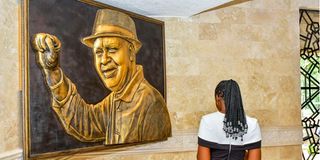
Historical photographs documenting the political journey of the late former Prime Minister Raila Odinga adorn the walls inside his mausoleum at Kang’o ka Jaramogi in Bondo on October 11, 2026. The displays chronicle his decades-long contribution to Kenya’s political and democratic development.
Photo credit: Alex Odhiambo | Nation Media Group
I was in Siaya the week that Raila Odinga died . Before he left for Dubai and India, I met him and spoke to him. We had the Siaya International Trade and Investment Conference, which he was expected to close. I was able to talk to him on October 13th but he informed me about difficulties in making it to the conference and that he would make arrangements for someone to represent him in case he was not able to attend. On the 15th, we had invited Ida Odinga to attend the conference as a special guest. She kept telling me something was not right, almost as though she had a premonition, and doubted whether she would make it to Siaya. Just as we were about to begin the conference, we received news that he had passed away. The country was plunged into shock. Before the news spread widely, we deliberated on what to do and decided that the conference could not continue.
Raila was a giant not only in Kenya, but across the continent, if not the world. More time should have been provided for Kenyans and people across the continent to mourn him. But of course, we were told there was a Will, which also took the family by surprise. There are one or two things I believe could have been handled better, particularly the manner in which his body was brought back to the country. Although there was a delegation, I thought a special plane should have been sent to bring his body home. We witnessed unfortunate scenes at the Jomo Kenyatta International Airport. There was no order, no little sense of dignity throughout the period, particularly upon his arrival and when mourners gathered at the Moi Kasarani International Sports Centre.
I was not prepared for it. I was shocked and lost for words and feeling. Unfortunately, we had come to believe that Raila would never die. His death was almost as sudden as his father's, because Jaramogi Oginga Odinga also died to me in similar circumstances, in a hospital, but without any signs that he was going to pass on. For me, it was a great loss, a great tragedy, particularly when we thought, you know, there was still more to come for him, to participate and drive the country in the right direction. One thought that kept coming to mind was that Raila should have been given one final opportunity to seek the presidency. In our conversations, he never ruled out another presidential bid.
I remember that on the eve of the delivery of the presidential election petition of 2017 by David Maraga, Raila was uncertain; he was in doubt, but I told him my instincts suggested he should be present in court and wear his best suit. We celebrated major political milestones in the country together, including when President Daniel Moi announced an end to one-party rule, giving way to a multi-party system. I also remember when he was to be sworn in as the People’s President; many people were warning him not to proceed with it, including some of his close friends saying it would be treasonous. We were in a hotel room with his son Raila Junior and daughter Winnie. I would not disclose what they said, but ultimately, we left for Uhuru Park.
Raila loved football, and particularly when Arsenal was playing, he would walk out of a meeting to go and watch it. He also loved athletics and music. He had a gift for singing and could remember song lyrics. On the other hand, he detested forms of government that rendered people without freedom and dictatorship; he would fight against them. He also hated tribalism and fought hard against it. That is why he tried creating a platform for the Luo-Kikuyu alliance to heal the wounds that existed over the years. He did not like people retreating to their tribal cocoons during elections because he had support across the country.
The political space is empty without him. Raila pushed the country not aimlessly, not on the basis of what he wanted politically, but all the time he had an agenda for the country. For instance, last year he signed a 10-point agenda with President Ruto, and I think, if he was alive, those issues would have been pushed to their logical conclusion. His death has left unfinished work, which if he was alive, I am sure, the 10-points would not have been thrown into the dustbin.
President William Ruto and the opposition leader, the late Raila Odinga, sign an agreement between UDA and ODM in the presence of their party members.
Photo credit: Pool
Going back to the 10-point agenda, which was dear to him, some even judged him for getting into an agreement with the president. In your assessment, is there lack of goodwill from the president and some ODM officials, in implementing it?
Certainly, there's a lack of goodwill, and some of the signs are obvious. There are things happening today that, had Raila been alive to witness them, would have prompted him to walk out of that arrangement. One is the continued abductions and extrajudicial killings that have not stopped, harassment of the media, the interference with political parties and the government’s extravagance, display of wealth and spending spree, which is still being witnessed in harambees while a lot of people cannot afford a meal a day. There was a time when we in the Linda Mwananchi movement within ODM kept on talking about that 10-point agenda , and we had a meeting where we said that what has been achieved was almost zero. If Raila was alive, that document would have brought a political engagement, a political process that would have ended up in resolving many issues the country is grappling with. He had also talked about a national convention so that we can talk about ourselves and, of course, you know, NADCO is also equally dead.
What other issues was Raila passionate about that the government is not giving the attention they deserve?
Raila spoke about meaningful employment as opposed to tokenism, which our young people are receiving from the system. He kept on saying that the issue of jobs and jobs for the youth should be looked into because unemployment is a big question in the country today. Even incidents of goonism are encouraged because of lack of employment. He talked about the issues of debt and corruption, which still continues.
Former Prime Minister the late Raila Odinga.
Photo credit: File | Nation Media Group
One would expect those who claim to be Raila's mentees or closest allies to keep ODM strong. What is the party's state one year after his death?
ODM and parties that preceded it were based on patriotism and ideologies. A lot of the leadership in those parties that predate ODM were conviction politicians, not career politicians. They were in politics for purposes of driving the country towards a positive direction in which the people of the country will get prosperity and live in an environment where human rights and democracy are respected. The leadership that emerged and took control of the party are transactional politicians who would do anything to survive in politics. Many of them were not prepared to go through the sacrifices that are required to be made to push the country in the right direction. One of the things that happened while Raila was alive was a mass defection by some politicians from Nyanza who found comfort in these new arrangements. When Raila was alive, there was a discussion about commencing a process where their seats would be declared vacant in accordance with the constitution. It is this group of politicians that is now driving the agenda for the party forward. I think that ODM was a party. By the time he died and during his life, particularly those 20 years, ODM was the only national party in every respect; it was everywhere, but right now, the party is breaking into factions and probably giving birth to tribal or regional parties.
In your opinion, what would have been the ideal process of transitioning ODM’s leadership from Raila to his successor?
The transition would have been orderly had the party’s constitution been followed. It clearly provides that, in the absence of the party leader, one of the three deputy party leaders would act as preparations are made for a process in which the organs of the party would elect a new leader. Secondly, space should not have been given to the United Democratic Alliance (UDA) and its leader to get embroiled into the issues of the party. To me, that is what has destroyed the party. Because we allowed the leader of a rival party to literally take over the party and control it by using a lot of money and resources. In fact, in the 10-point agenda, there was the issue of political parties. Raila stated clearly that everything should be done to ensure that political parties are not killed. I can see a process where a lot of parties which could only thrive in an environment of democracy and tolerance will now find it very difficult to survive in this environment.
In the days and weeks after Raila's death, many of his close allies came out to claim that Raila told me this, Raila mentioned this to me. I don't know whether you also had that kind of session.
No, no, no. I think that is an exercise in futility because everybody has a story to tell. Much of it, I believe, is fiction. Claims that Raila told one person this and another person something else should be treated with caution. His views were expressed publicly, and his objectives in the political space were very clear. One of the things that makes it very clear is that Raila would never, never have supported a situation where ODM is part of the government or part of the ruling party. If that was the objective, ODM should have exited the position that it occupies both in the Senate and the National Assembly as a minority party because the majority party, as it exists in Parliament, supports the government. If Raila had intended to form a coalition government, he would have signed a coalition agreement or entered into a written arrangement explicitly establishing it. How could Raila enter a government that others want us to believe is a coalition when the appointees can only be appointed or dismissed by the sitting President? Remember that, under the grand coalition government, Raila appointed our share of Cabinet members with the support of his counterpart, President Mwai Kibaki. Even Kibaki's appointees had to be approved by Raila. Raila was too astute to be drawn into an arrangement without clear rules governing what is now being called the broad-based government.
Talking of the broad-based government, what would be your assessment of its achievement?
The broad-based government is broad, not in the sense of ODM and UDA. There were appointees from Central Kenya, to the extent that there are almost four times the number of members of the cabinet from Nyanza.
It's broad in the sense that there were appointees when this arrangement came up that made it now possible for additional people to be appointed from regions that President Ruto thought the appointees should come from, but it is not a legal arrangement and not a coalition.
For it to have any force, it must be registered with the office of the Registrar of Political Parties.
Who carries the political spirit of Raila? Is it those who were in Linda Ground or faction led by you, Edwin Sifuna and Babu Owino?
I think if you look at where the energy and vibes are, or where the following is organic, Raila's spirit is undoubtedly in Linda Mwananchi. There is no doubt about that. Raila did not have to pay people or put people into buses to attend rallies. And for the first time, Raila's party has been made to ferry people into political meetings and rallies. So, I think the two representations of Raila's spirit and vision are certainly not with the Linda Ground or those in the broad-based government.
There are two competing ideologies, and people in Nyanza are wondering which side to support. Some feel the region has been marginalised for too long and should embrace the development projects being offered now. You and others argue that Raila stood for constitutionalism and the rule of law. Which path should Nyanza take?
I think Nyanza should go, first of all, for constitutional democracy, which is something Raila stood for. If you're talking about marginalization, what about the northeastern areas: Samburu, Turkana, Pokot or Marsabit? These areas were marginalized, and even from a historical perspective, they were our frontier. But what has made it possible for them to come up is a legal and constitutional system that creates counties: devolution. Under devolution, they are entitled to certain resources and revenue from the national government; that is what has changed things so that development will not depend on who is in the State House, but is a matter of right. If you start counting what the past presidents have done and what Ruto has done, Ruto’s projects are visionless to attract support, but without the infrastructure to make the lives of people better. I have always believed that if it’s a competition about building monuments, then Sterling did well, even Hitler.
If Raila were to reappear today, what would he be proud of, what would make him angry?
I think there would be very little to be proud of; he would be very unhappy, especially about his 10-point agenda blueprint, which was simple and would have been done, but unfortunately it has not. Another thing Raila would be worried about is the possibility of the country being torn apart. Remember during the GenZ protest when he made a decision that many people were not happy about. But Raila, throughout his lifetime, did not want a scenario where there was destruction and balkanization of the country. When he was entering politics, he would have been a guerrilla, but he didn't; he always chose to use constitutional means to achieve his goals.
Siaya Governor James Orengo at his Ugenya home in Siaya County, on February 27, 2026.
Photo credit: Alex Odhiambo | Nation Media Group
You have always made some hard decisions, some unpopular ones that have left you isolated? Does it worry you? And what drives you?
It doesn’t worry me that I am isolated. There was a time when Jaramogi Oginga Odinga was all alone. No elected leader supported him. Young people and ordinary citizens are the ones who came out to support his quest for Kenya to become a multi-party state or for it to hold free and fair elections. He was very lonely. I am a conviction politician who would want things that I truly believe in to drive my political agenda, and therefore I don’t take loneliness as a sign of failure, but see it as a sign of being a true patriot and not being materialistic. I am not affected by people making decisions that are material and beneficial to only them as individuals. Our course may not be attractive to leaders who are career politicians, but if one does a test on the things that we are saying and asks ordinary people on what they stand for, one will realise that we are not off the track.
In Raila’s absence, several political parties are emerging, including one associated with you, the Liberal Democratic Party. Is it a case of the more the merrier instead of using one party for next year’s elections?
In 2002, Kijana Wamalwa had Ford Kenya, Mwai Kibaki had DP, Charity Ngilu had SDP, Simeon Nyachae had Ford People and many others, but it did not stop a critical decision from being made where, essentially, the opposition presented a single candidate, which happened in the last three or four months to the election. For now, the drive towards unity is coming from the people and not leaders. If the leaders let the people down, it will be very tragic, and Kenya would be worse off.
In your most honest opinion, do you believe Dr Oburu Oginga has done well in steering ODM?
I think it is for the public to see. I think the public and the members of ODM would make that judgment.
I miss the comradeship, the drive he had when he was with us. We could always count on him to make the right decision and not look back. He was rational and reasonable and always explored a peaceful and legal way to tackle a problem. When this was impossible, we would opt for other constitutional means.