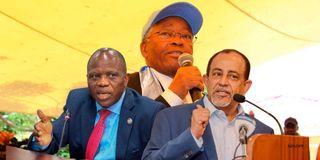
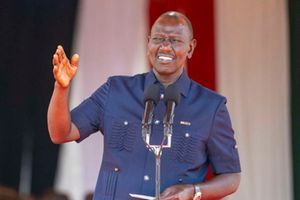
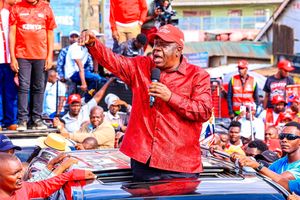
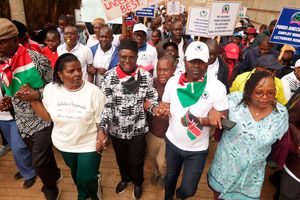
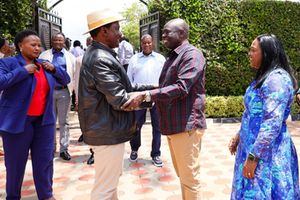
Siaya Governor James Orengo is courting Coast leaders in a bid to revive the Liberal Democratic Party (LDP) ahead of the 2027 General Election, vowing that the party will field candidates for all elective positions, including the presidency.
The move comes as a number of politicians in the Coast region revive dormant parties and form new ones, seeking independent platforms to contest in the next elections and negotiate political alliances.
LDP was once associated with former prime minister Raila Odinga. The party played a central role in the 2002 Kenyan general election by helping unite the opposition and secure the defeat of the ruling Kenya African National Union (Kanu), which had governed Kenya since independence.
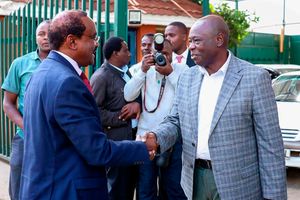
Azimio La Umoja leader Raila Odinga (right), accompanied by Siaya Governor James Orengo, during a relief food distribution exercise to flood victims at Muhondo grounds in Alego-Usonga in Siaya.
Photo credit: File| Nation Media Group
Former Transport Minister Chirau Makwere is pursuing its revival, and Governor Orengo confirmed that the party would be relaunched in Nairobi. According to the governor, much of its leadership will be drawn from the Coast region, where some of its founders have roots.
“Mr Makwere is among the founding party leaders of LDP, which gave the late President Kibaki the presidency. We will relaunch LDP in Nairobi, with some of its leadership coming from the Coast region because they are the founders,” Mr Orengo said.
He claimed that the late Odinga had advised him that LDP could provide an alternative if challenges arose within political parties in the future. Mr Orengo said the party would oppose President William Ruto in the run-up to the 2027 elections.
The governor who is allied to the Linda Mwananchi Movement said the party intended to field candidates for elective positions at county and national levels, including the presidency. The declaration adds a twist to the United Opposition’s bid to field a single presidential candidate.
Several opposition leaders, among them Nairobi Senator Edwin Sifuna, Wiper leader Kalonzo Musyoka and Jubilee’s Fred Matiang’i are already seeking support of the opposition to battle it out against Dr Ruto at the ballot.
Apart from LDP, other parties being revived in the Coast region include Federal Party of Kenya (FPK) and Kadu Asili. East African Legislative Assembly MP Suleiman Shahbal has also turned to The New Democrats to pursue the Mombasa governorship, while Mr Kambi is planning to establish a new party to vie for the Kilifi gubernatorial race.
The push follows a decision by the Pamoja African Alliance (PAA) to align with President William Ruto's United Democratic Alliance (UDA). Formed by Coast leaders to consolidate the region's political influence, PAA was expected to provide a common platform for negotiating with national parties.
Its decision not to field any candidates in 2027 has prompted some leaders to seek alternative political vehicles.
Tana River Governor Dhadho Godhana, who has taken over FPK, said Coast leaders should pursue national leadership positions instead of relying on appointments to government.
The governor said the party would seek to expand beyond the Coast region, adding that leaders should pursue national leadership instead of waiting to be appointed Cabinet secretaries.
“We can no longer agree to be appointed as Cabinet Secretaries,” he said.
Kadu Asili party leader Mudzo Nzili said his party intends to field candidates for all elective positions except the presidency, for which it would support Dr Matiang'i.
Former Knut chairman Mudzo Nzili.
Photo credit: File| Nation Media Group
Mr Nzili said the party would build structures down to the village level, drawing on his experience leading Kenya National Union of Teachers (Knut), which had networks at school level.
“You are aware I previously led Knut, which had structures down to the school level. KADU Asili will establish structures up to the village level. Within the next three months, we will be traversing the country and strengthening our presence. We have agreed with Jubilee that we will field all aspirants in this region apart from the presidency, where we will support Dr Matiang'i. We will sign a pact,” he said.
Former labour minister Kazungu Kambi, who is seeking the Kilifi governorship, said he had approached the former owners of Kadu Asili and Shirikisho about reviving the parties, but the efforts were unsuccessful. He is now considering launching a new party.
Meanwhile, Mr Shahbal, has turned to The New Democrats after leaving ODM which he will use to contest the Mombasa governorship in 2027, stressing that he would not withdraw his bid as he did in the previous election.
In 2022, Mr Shahbal stepped aside in favour of the incumbent governor, Mr Abdulswamad Nassir, following interventions by senior political leaders. He said he regretted the decision and would not repeat it.
“I was coerced to drop my bid. That is why this time I have decided to come up with my own political party. No one will blackmail me again, nor will I beg for an ODM or UDA party ticket. If they want to work with us, they must invite us. But this time I am taking the governor seat,” he said.
A Gazette Notice dated September 18 formalised leadership changes at The New Democrats, appointing his son, Samir Suleiman Shahbal, interim party leader.
However, Mr Shahbal said the party would elect new officials adding that it has structures across the country after it had established 24 offices and attracted aspirants seeking its tickets. He plans to use it to contest the 2027 elections.
Former Nyali MP Awiti Bolo said the developments signalled a shift in Coast politics, with voters increasingly demanding services, equitable representation and negotiations across communities.
“This time politics will change in the region; voters are enlightened. It’s about services and equity, not the current nepotism and ethnicity in most counties. There will be proper negotiations between different ethnicities. All communities must get a share, not ODM like it has been before. This time Mr Odinga is not on the table to carry people,” he said.
He added that no single party could win an election alone and that coalition-building would remain important.