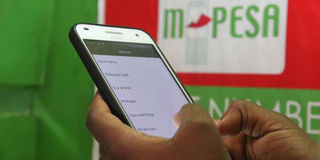
Did you know that if someone mistakenly sends you money via M-Pesa or bank account and you fail to reverse or return it you risk a jail term of up to two years, a fine of Sh200,000 or both?
Well, spending money that you know was sent to you erroneously is an offence according to Section 35 of the Computer Misuse and Cybercrimes Act, 2018.
The Section states that: "A person who intentionally hides or detains any electronic mail, message, electronic payment, credit and debit card which was found by the person or delivered to the person in error and which ought to be delivered to another person, commits an offence and is liable on conviction a fine not exceeding two hundred thousand shillings or imprisonment for a term not exceeding two years or to both."
According to lawyer Danstan Omari, the law provides that withholding money delivered erroneously to you is an offence.
"The key issue is what happens after you as the recipient knows, or becomes aware, that the payment was made in error," says Mr Omari.
"A person who receives money unexpectedly may initially have no reason to know that it was sent to them accidentally. But once the mistake becomes apparent, deliberately retaining or using the funds can create legal consequences," Mr Omari explained.
For mobile-money users, Mr Omari advises, that the safest response to an unexpected payment is simple; do not spend it.
"Check the transaction details, keep the money untouched and contact the mobile- money provider through its official channels for guidance on reversal. If the sender contacts you, avoid independently sending the money to an unrelated number. Use the recognised reversal process where possible,” he notes.
Kenya's mobile-money system allows funds to move within seconds, meaning a wrong number can quickly send money to a stranger.
The legal risk, according to the lawyer arises when a recipient decides to keep or use money that does not belong to them.
"If you decide to block the sender and spend the money, you will get into trouble. If you also send money to a wrong number, report the matter in a police station immediately. The police will track and charge the person who received the money and spent it without a second thought. You can also recover the money through the small claims,” he explains.
Lawyer Steve Kabita also warns that if money lands in your M-Pesa or bank account unexpectedly, you should not be convinced that you have received a windfall.
"It may be someone's money- a hospital bill, school fees or just upkeep cash and spending it after you know that, could turn an erroneous payment into a criminal case,” he says.
"Saying in court that the money was swallowed by an unpaid debt like Safaricom's Fuliza is not defense. It will not hold water in court," he warns.
Section 36 of the Computer Misuse and Cybercrimes Act, 2018 states that any person who unlawfully destroys or aborts any electronic mail or processes through which money or information is being conveyed commits an offence.
In Section 31 of the same law, unlawfully destroying such electronic mail can result in a more severe jail term.
The Section states that: “A person who unlawfully destroys or aborts any electronic mail or processes through which money or information is being conveyed commits an offence and is liable on conviction to a fine not exceeding two hundred thousand shillings or to a term of imprisonment not exceeding seven years or to both.”
Further, according to Section 268 of the Penal Code, using the money mistakenly sent to you results in theft.
Section 268 of the Code states that: "A person who fraudulently and without claim of right takes anything capable of being stolen, or fraudulently converts to the use of any person, other than the general or special owner thereof, any property, is said to steal that thing or property."
This is punishable by the code – this means that any offence committed contrary to the Penal Code is punishable by the law.
Several incidents of people withdrawing and spending money erroneously sent to them have been reported in the country in the past months.
In the most recent incident, detectives from the Banking Fraud Investigation Unit (BFIU) on Saturday, October 24, arrested a suspect accused of brazenly spending over Sh6.7 million that was mistakenly credited to his bank account.
The suspect, was apprehended along Lantana Road in the heart of Westlands, Nairobi.
The case dates back to November 18,2025, when a company was processing 74 electronic payments including rent of Sh72,000 owed to the suspect for its shop in Suswa, Narok County.
However, an error during processing led to a monumental blunder: both the rent and a staggering Sh6,744,354 intended for another company found their way into the suspect's bank account.
"The company sought to reclaim its funds, but the suspect allegedly spent the money instead of returning it to the rightful owner," DCI said in its statement.
The incident prompted an investigation by detectives from the Banking Fraud Unit, who forwarded the case to the Office of the Director of Public Prosecutions(ODPP) for review.
Following the review, the ODPP instructed that the suspect faces charges of intentionally withholding an erroneously delivered payment contrary to Section 35 of the Computer Misuse and Cybercrimes Act, of 2018, and Money Laundering, contrary to Section 3(b)(1) as read with Section 16(1)(a) of the Proceeds of Crime and Money Laundering Act.
Director of Criminal Investigations Mr Mohamed Amin has warned Kenyans to avoid spending money erroneously credited to their bank accounts or received through M-Pesa and other mobile money transfer platforms.
"Money mistakenly credited to your account does not become yours simply because it is within your reach. The law demands its return, and those who deliberately withhold and spend such funds will face the full force of the law," warned Mr Amin.
On September 19, two farmers who withdrew and spent Sh33,952 erroneously sent to them via M-pesa narrowly escaped a jail term after a court in Nairobi accepted their please for leniency.
Mary Nanjala and Roselyn Nyongesa, farmers hailing from Kakamega County, walked free after Co-operative Bank confirmed to the court that they had since paid back the money they spent.
In yet another incident in May 2025, a prison warder attached to Bomet GK Prison was arrested at Magereza House after allegedly refusing to refund Sh98,000 mistakenly sent to his mobile money account.