Kenya had presidential election petitions in 1992, 1997, 2013, 2017 and 2022.
In 1992, for instance, six petitions were filed in the High Court after the late President Daniel arap Moi won the poll.
The court threw out five cases on procedural grounds, even before their hearings commenced.
Kenneth Matiba's case was the only one heard, but the court later dismissed it because he did not sign the petition himself, as required by the law at the time.
In 1997, Moi’s win was again challenged by Mwai Kibaki, Kijana Wamalwa and Raila.
At that moment, the law required petitioners to serve respondents physically.
The three failed, arguing that process servers could not serve Moi inside State House.
The 2013 petitions alleged massive electoral fraud and malpractices that enabled former President Uhuru Kenyatta and then Deputy President William Ruto to win the presidency.
Former Prime Minister Raila Odinga and rights activists were among the litigants at the Supreme Court.
They lost the case, with judges saying the election complied with the law.
However, the Apex Court, in a historic decision and a first in Africa, nullified the 2017 re-election of former President Uhuru Kenyatta and then Deputy President William Ruto , citing illegalities and irregularities.
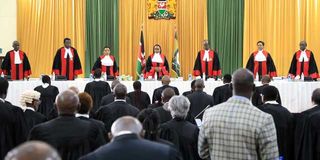
Supreme Court judges from left: Njoki Ndung'u, Smokin Wanjala, Philomena Mwilu, David Maraga, Jackton Ojwang', and Isaac Lenaola prepare to hear the presidential election petition at the Supreme Court on September 1, 2017. PHOTO | JEFF ANGOTE | NATION MEDIA GROUP
The National Super Alliance (NASA) presidential candidate and running mate, Raila Odinga and Kalonzo Musyoka , respectively, were the main petitioners.
The court ordered a fresh vote in 60 days, but NASA boycotted it. Uhuru won the fresh election, which was contested again by former legislator Harun Mwau, the Institute for Democratic Governance, and activists Khalifa and Njojo Mue.
In 2022, eight cases were filed at the Supreme Court: seven disputed the results of the presidential election and one sought to have the election upheld.
The process and timelines of a presidential election petition
Article 140(1) of the Constitution of Kenya grants the right to any person to challenge the presidential election result at the Supreme Court. The petition must be filed within seven days from the date the results are declared.
Rule 7(3) of the Supreme Court (Presidential Election Petition) Rules, 2017 says that if the petition is filed on the last day, it must be filed before 2pm.
"A person may file a petition in the Supreme Court to challenge the election of the President-elect within seven days after the date of the declaration of the results of the presidential election," states Article 140(1) of the Constitution.
The petitioner must deposit Sh1 million as security for costs, alongside court fees, and have the documents stamped by the Registrar. The petitioner must serve the respondents (typically the President-elect, the IEBC and the returning officer/chairperson) within 24 hours of filing the petition. The respondents have four days from the date of filing to submit their responses and defence papers to the court. On the fifth day, petitioners file any rejoinders or responses to the replies, alongside interlocutory applications or requests for specific orders (such as scrutiny of votes or access to servers). On the sixth and seventh days, the court then holds a pre-trial conference to frame the issues, set ground rules, determine third-party/amicus curiae applications and allocate time for oral submissions. Between the eighth and 13th day, the Supreme Court conducts the oral hearing, listening to arguments from petitioners, respondents and interested parties. The court delivers its final and binding verdict on the 14th day. The Supreme Court must hear and determine the petition within 14 days of filing.
The bench often issues a summary judgment on day 14, followed by a comprehensive, detailed ruling later.
"The Supreme Court shall hear and determine the petition within 14 days and its decision shall be final."
What the Supreme Court examines
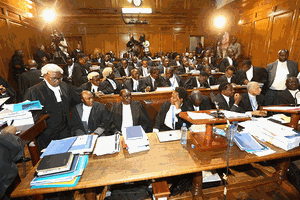
Lawyers for various parties at the Supreme Court of Kenya on August 26, 2017 during pre-trial of the presidential petition filed by Nasa leader Raila Odinga challenging the election of President Uhuru Kenyatta. The outcome will be determined after a gruelling battle unlike the past where petition was a mere formality. PHOTO | JEFF ANGOTE | NATION MEDIA GROUP
The Supreme Court evaluates whether the presidential election was conducted in accordance with the Constitution and electoral laws. The Apex Court checks if the Independent Electoral and Boundaries Commission (IEBC) adhered to the principles of transparency, security, verifiability and integrity under Article 86 of the Constitution. The court scrutinises the integrity of technology deployed, such as the Kenya Integrated Elections Management System (KIEMS) kits, biometric voter identification and the electronic transmission of results using Forms 34A, 34B and 34C, to check for data tampering, unauthorised access or system failures. The court also evaluates whether proven irregularities or non-compliance undermined the integrity of the election or quantitatively affected the final outcome. This includes assessing whether numerical discrepancies, missing results or rejected votes were large enough to mathematically alter the final outcome.
At the same time, the court evaluates whether systemic irregularities or illegalities were severe enough to compromise the foundational democratic integrity and overall credibility of the electoral process, even without a direct mathematical shift.
If the Supreme Court finds the election invalid due to severe non-compliance affecting integrity, it will annul the election and order a fresh vote within 60 days. If the petition lacks sufficient evidence, it is dismissed and the President-elect is sworn into office.