Happening Now: NTV KENYA LIVE | Senate Proceedings

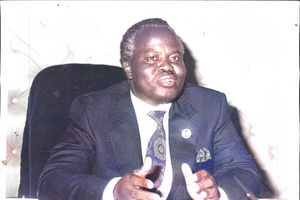
Mr Hezekiah Oyugi was Kenya’s most powerful permanent secretary for Internal Security.

The family of former powerful Internal Security Permanent Secretary the late Hezekiah Oyugi got a relief in their bid to repossess a Sh400m prime property in Nairobi’s Lavington Estate after the Court of Appeal restrained the current owner from selling or transferring it to a third party pending the outcome of case.
Three sons of the former Internal PS won round one of the long-running court battle.
The three appeal judges restrained Ms Timdar Said Sherman from “transferring or otherwise disposing of the suit property pending hearing and determination of the applicants’ appeal.”
The judges, however, declined to stay proceedings in the Environment and Lands Court (ELC).
“With regard to the application for stay of proceedings before the trial court, we are not satisfied that the continuation of such post-judgement proceedings as may be ongoing before the ELC will render the appeal nugatory (useless), and we decline to issue the order for stay of proceedings,” ruled the three-judge bench.

Hezekiah Oyugi.
The applicants— Job Okuna Oyugi, Douglas Odhiambo Oyugi and Joshua Onyango— suing as Administrators of the estate of the late Hezekiah Nelson Oyugi, sought an order restraining Ms Sherman from disposing of the upmarket property.
The administrators are urging the court of appeal to quash the ELC judgment declaring Ms Sherman as the bona fide owner of the suit property.
The sons are pressing for orders that the transfer of the suit property to Ms Sherman be declared null and void and that the “Registrar of Lands be ordered to amend the land register and reverse entries numbers 15 and 16 on the Grant Number I.R.11591.”
They are also asking the court to compel Ms Sherman to provide accounts for the rent collected to the appellants (Oyugi’s sons).
The appellants are challenging a judgment of the ELC of July 10, 2025, in which the judge declared Ms Sherman as the legal owner.
In the judgement the court “established that a constructive trust arose in favour of Ms Sherman.”
The judge held that it was justifiable to prevent the administrators of the estate of the deceased from rescinding (withdrawing from) an agreement for the sale of high-end property to Ms Sherman dated January 13 1998.
Also, the judge ruled “it would occasion unjust enrichment to the Oyugi sons and the estate of the deceased.”
The administrators claim that the ELC judge erred in determining the suit on the issue of constructive trust that was not pleaded by Ms Sherman.
They claim they were ambushed and condemned unheard, thereby holding that the transfer of the suit property to Ms Sherman was lawful and binding on the estate of the deceased.
However, Ms Sherman has opposed the appeal, saying it is not arguable and has no chance of succeeding.
The respondent (Sherman) has further stated that the sons of the deceased have not shown that she cannot compensate them by way of damages, even if the property is sold during the pendency of the appeal.
Dismissing the case brought by the administrators of the estate of Oyugi, the trial Judge-Justice Oscar Angote said it was a deeply troubling scenario in which one party deliberately placed a forged court order into circulation and then sought to rely on the very falsity of that document as a basis to defeat a transaction, which would have been otherwise valid.
The Environment and Land court judge ruled that there was evidence that the family sold the property to Ms Sherman, but they were trying to run away from the transaction in which they were part of.
“It raises fundamental questions not only of law, but of fairness, integrity and abuse of process. The Plaintiffs having procured the forged court order cannot rely on it to avoid the consequences of a transaction they had previously affirmed by word and conduct,” said the judge.
The estate administrators filed the case in 1998, alleging that Ms Sherman did not complete purchasing the property and had used forgeries to transfer the property to herself.
They also blamed the commissioner of Lands for facilitating the fraudulent transfer.
They told the court that in a sale agreement dated January 13, 1998, they agreed to sell the suit property to Ms Sherman for Sh10 million.
They said the agreement stipulated that she would pay Sh4.8 million and deposit the balance at the defunct Guilders International Bank Ltd.
The family said the former tenant turned buyer did not complete the payment as agreed, but went ahead and forged transfer documents while the succession matters were pending in court.
Job told the court that Oyugi, who died in August 1992, had,, between 1993 and 1994, left the property to Ms Sherma,n with rent payments being made to Betty Oyugi, one of the ex-PS's four wives.
He said the property formed part of the estate at the time of his demise and had not been transferred to any beneficiary.
And after discovering that Betty Oyugi was collecting rent from the property, the administrators dispatched auctioneers to recover the outstanding rent, and it was at this juncture that they uncovered the tenant’s attempts to purchase the property from the widow, despite her lacking authority to transact on behalf of the estate.
Job added that to avert potential criminal proceedings against Betty for monies received, they allegedly agreed that they would isolate the money paid as rent and those who drew an agreement to sell the property to her.
Ms Sherman said she and her family started residing on the property in 1991, initially as tenants, paying rent at the rate of Sh60,000 per month, which was given to an agent.
She said that in 1994, she and her husband, Mzahim Salim Bajaber, met Bett,y who represented herself as the owner of the property and that in April or May 1994, she agreed to sell the property to them.
She said Betty informed them that ex-PS Oyugi gifted her the property. She agreed to sell them the property for Sh11 million.
Ms Sherman said she paid Betty Sh4.8 million as a deposit, with the remaining sum being considered as rent paid.
Thereafter, the family executed a formal sale agreement dated January 13, 1998.
In support of her position, she produced three petty cash vouchers. Two of them are dated May 21, 1998, indicating payments of Sh2.2 million and Sh2 million, paid to Job Oyugi.
Additionally, she produced a petty cash voucher dated June 11, 1998, showing a payment of Sh1 million to Job, similarly signed as received.
She said the total amount in the three vouchers signed by Job was Sh5.2 million, being the balance of the purchase price.
Mr Job Oyugi denounced the signatures.
Justice Angote said Job admitted by himself that the Estate, in the entire transaction at all stages, collected Sh5.2 million in cash from the bank on two occasions, on the instructions of Ms Sherman or her husband, and signed three payment vouchers acknowledging receipt of the monies.
The court said the burden of proof to establish that his signature was fraudulently executed on the vouchers for the payments lay squarely upon Job.
“The 1st Plaintiff (Job Oyugi) did not adduce any expert evidence, such as a report of a handwriting expert, to demonstrate that the signatures appearing on the vouchers were forged. In fact, the evidence before this court shows that the 1st Plaintiff had also acknowledged payment of the deposit of shs4.8 million by signing a payment voucher which was also not presented to a document examiner for examination by the Plaintiffs,” said the judge.
The court said that at the time the family entered into an agreement with Ms Sherman, they were aware, and in possession of the said forged court order, which had been used earlier in different transactions.
“Consequently, this court is convinced that it is the Plaintiffs who procured the forged court order of 21st December, 1993 and used it to transfer the suit property to the 1st Defendant on 20th February, 1998,” said the judge.
The court added that the family used the same forged court order to transfer other properties to third parties, and, just like in the current suit, turned around to deny those transactions using the very order, with a view of having the titles nullified by the court.
“It is therefore not surprising that despite the criminality surrounding the said forged court order, or the allegation of their signatures on the transfer the Plaintiffs have never filed a complaint with the police, nor have they ever subjected the signatures on the transfer document for forensic examination,” said the judge.
The court said it was unfortunate that the administrators expected the court to condemn Ms Sherman and nullify the title on the ground that the same was obtained using a forged court order and transfer, after receiving the entire purchase price.
“That, in my view, are actions of parties who want to unjustly enrich themselves with the sanction of the court, a position that a court of equity and justice cannot countenance,” the judge said.
Follow our WhatsApp channel for breaking news updates and more stories like this.