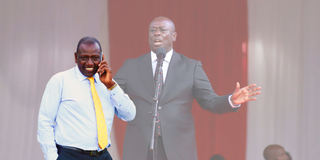
President William Ruto called a cardiologist treating his then deputy, Rigathi Gachagua , to inquire about his health condition after being admitted to hospital with severe chest pain during the Senate impeachment proceedings.
In a sworn affidavit filed in court, Dr Daniel Gikonyo says he received the President’s phone call on October 17, 2024, while attending to Mr Gachagua at the Karen Hospital, Nairobi.
“While the first petitioner (Mr Gachagua) was under my care, I received a telephone call from the President of the Republic of Kenya, H.E William Ruto, who inquired as to the first petitioner's condition,” Dr Gikonyo states.
“I confirmed that the first petitioner had indeed been admitted to Karen Hospital in Nairobi and was receiving treatment under my care,” adds the chief cardiologist and founder of the hospital.
The affidavit forms part of the court filings and Mr Gachagua’s evidence in an ongoing constitutional case that is challenging the legality of his removal as Deputy President.
The disclosure places the president at the centre of events on a day that proved pivotal in Mr Gachagua’s impeachment process.
Karen Hospital Chief Cardiologist and Founder Dr Dan Gikonyo addresses the media on the state of Deputy President Rigathi Gchagua on October 17, 2024.
Photo credit: Sila Kiplagat | Nation Media Group
Dr Gikonyo details his long-standing medical relationship with Mr Gachagua, stating that he has been treating him since 2006.
He says that the former deputy president, then aged 59, was admitted at about 3.00pm on October 17, 2024, after presenting himself complaining of severe chest pain.
Based on his expertise, Dr Gikonyo said such symptoms are clinically consistent with potential cardiac events, especially in individuals above 45 years and those with underlying conditions.
He listed risk factors including hypertension, diabetes, stress and obesity, which may predispose patients to cardiac complications.
The doctor said he conducted a comprehensive clinical assessment, including blood tests, a 12-lead electrocardiogram and a 2D echocardiogram, to determine the cause of the condition.
“I conducted a comprehensive clinical assessment of the 1stPetitioner, including physical examination and diagnostic investigations, inter alia, blood tests and other relevant cardiological evaluations,” he says.
Following this evaluation, he recommended that Mr Gachagua be admitted for 48 to 72 hours of close monitoring and further medical management.
Dr Gikonyo says he personally supervised the patient’s care during admission from October 17 to October 20, 2024, when he was discharged.
Hospital records attached to the affidavit show the patient was treated for severe retrosternal chest pain of acute onset.
The doctor has also attached a discharge summary to support his affidavit. It states that immediate stabilisation was undertaken, with medication administered to manage the condition and prevent further cardiac risk.
“The patient was stabilised and made a significant recovery upon improvement,” the report states, adding that he was discharged on oral medication and advised to continue regular follow-up.
Dr Gikonyo told the court he made the affidavit to assist in establishing that Mr Gachagua was duly admitted and undergoing treatment on the material date.
The evidence is central to the petitions before the court. The case is a consolidation of seven files lodged by 41 petitioners, including Mr Gachagua.
On the same day Mr Gachagua was admitted, the Senate proceeded with deliberations that culminated in upholding several impeachment charges against him.
Petitioners argue that the proceedings were hurried and were conducted in his absence, denying him a fair opportunity to defend himself.
The High Court is examining whether the impeachment process met constitutional thresholds, including the right to a fair hearing.
Kibwezi West MP Mwengi Mutuse shot to national prominence for moving the impeachment motion of Deputy President Rigathi Gachagua.
Photo credit: File | Nation Media Group
The case is part of a wider legal battle that has drawn in multiple institutions, including Parliament, the Attorney General, electoral commission and speakers of both the National Assembly and Senate. President Ruto is named as one of the 16 respondents.
The legal contest traces back to October 2024 when the National Assembly approved an impeachment motion against Mr Gachagua after MPs backed 11 charges tabled by Kibwezi West MP Mwengi Mutuse.
The accusations ranged from gross misconduct and abuse of office to alleged violations of the Constitution, including claims of undermining collective responsibility and engaging in divisive politics.
The motion triggered a Senate trial under Article 145 of the Constitution. The Senate convened a special sitting and, after hearing the charges, voted to uphold five of them, effectively removing Mr Gachagua from office. The vote was taken on October 17, 2024, the same day he was hospitalised, fueling claims that he was denied a fair chance to personally defend himself during the proceedings.
President William Ruto and Deputy President Kithure Kindiki inspect the Kulamawe–Garbatulla section of the 750km Isiolo–Mandera Road under the Horn of Africa Gateway Development Project on February 11,2026.
Photo credit: PCS.
President Ruto later nominated Prof Kithure Kindiki, who at the time was Interior Cabinet Secretary, as Deputy President, a move that has also been challenged in court.
The petitions raise broader questions about due process, the speed of parliamentary proceedings and the extent of judicial oversight in political matters.
Dr Gikonyo’s affidavit introduces medical evidence into the dispute, offering a detailed account of the events surrounding Mr Gachagua’s hospitalisation.
By confirming both the admission and the President’s inquiry, the testimony adds a new factual layer to the court’s examination of whether the process unfolded fairly.
The three-judge bench is expected to weigh the evidence alongside submissions from all parties as it considers the constitutional validity of the impeachment. The hearing resumes Thursday.