Former Deputy President Rigathi Gachagua has reshaped his impeachment battle, abandoning his demand for reinstatement and pivoting to a compensation claim.
At the heart of the legal dispute is not just whether his removal in 2024 was lawful, but what he stands to be paid if the court agrees with him.
Under the Retirement Benefits (Deputy President and Designated State Officers) Act, a retired deputy president is entitled to a monthly pension equal to 80 per cent of the last salary, plus a lump sum calculated as one year’s salary for each term served. A sitting DP earns a gross monthly salary of about Sh1.2 million, comprising a basic salary of Sh736,313, a house allowance of Sh300,000 and other allowances.
The Act further grants a retired DP two saloon vehicles (not exceeding 2000cc) and one four-wheel drive vehicle (not exceeding 3000cc), all replaceable every four years, alongside a fuel allowance set at 15 per cent of the current monthly salary. It also provides full medical cover, including overseas treatment, for the retired DP, the spouse and dependent children.
In addition, the retired deputy president is entitled to a support team comprising two drivers, a personal assistant, an accountant, a secretary, two housekeepers, two cooks, two gardeners and two cleaners, as well as armed security guards upon request.
The package also includes diplomatic passports for the officeholder and spouse, access to VIP airport lounges and a fully equipped office with maintenance expenses covered for the vehicles provided.
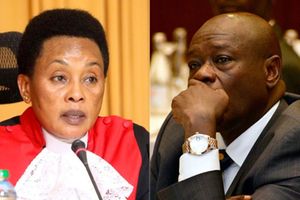
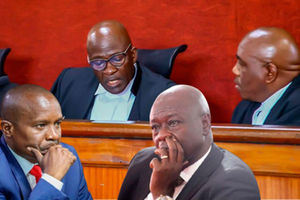
Appearing before a three-judge bench of Erick Ogolla, Anthony Mrima and Frida Mugambi on Monday, Mr Gachagua’s legal team said the case is no longer about the impeachment process, but compensation for what they termed an unlawful removal from office.
Senior counsel Paul Muite, the team’s lead counsel, told the court his client had dropped the prayer seeking reinstatement and amended his petition to pursue damages and benefits.
Senior Counsel Paul Muite at the Milimani Law Courts on April 27, 2026, during the hearing of the case challenging former Deputy President Rigathi Gachagua's 2024 impeachment.
Photo credit: Billy Ogada | Nation Media Group
He added that the case now seeks declarations that the impeachment was unconstitutional and financial compensation equivalent to what Mr Gachagua would have earned over a full five-year term (2022 to 2027). The claim includes salary, allowances and retirement benefits tied to the office, and unspecified financial damages.
Mr Muite framed the case as a personal grievance rather than a political contest. He argued that the impeachment process was rushed by both the National Assembly and Senate and failed to meet constitutional standards.
“To emphasise the lack of meaningful public participation, the exercise was not adequate or meaningful,” he told the court, adding that the public was only presented with allegations from the National Assembly. He said the process denied citizens the then deputy president’s side of the story, making it impossible for them to form informed views.
He added that the public participation session held at the Bomas of Kenya was presided over by select ODM MPs from Nairobi County who repeatedly asserted that the event was for invited guests only. The advocate described the exercise as “a mockery of effective public participation under the Constitution.”
Mr Gachagua attended the hearing session on Monday, accompanied by his spouse, Pastor Dorcas and political allies, as his lawyers opened submissions at the Milimani Law Courts in the consolidated petitions challenging his October 2024 removal.
His lawyers argued that denying him the benefits of a retired DP would compound what they described as a flawed and unconstitutional impeachment. They took issue with the speed of the impeachment proceedings, saying the National Assembly transmitted its resolution to the Senate at night.
“The normal working hours are daylight hours. How is it that the National Assembly could not even wait for the next day?” Mr Muite asked.
He invited the court to examine what he termed “breakneck speed” in the handling of the impeachment.
Another lawyer, Elisha Ongoya, told the bench the process bore the hallmarks of predetermined outcomes, comparing the proceedings to historical trials marked by what he called “malicious compliance”.
“I have reflected on a number of unjust trials in human history. The trial of Sir Thomas Moore, Socrates and Jesus Christ. One element characterises these trials: they are trials carried out with predetermined outcomes. Those taken through the trials are taken through the motions for the sake of it,” said Mr Ongoya. “The motions that the first petitioner was taken through at the National Assembly and the Senate of Kenya passed the test of malicious compliance.”
He argued that the Senate imposed strict timelines that limited Mr Gachagua’s ability to defend himself, including giving his team’s limited time to cross-examine witnesses.
On the “shareholding” remarks, Mr Ongoya told the court that the statements cited as grounds for impeachment were political rhetoric tied to the Kenya Kwanza coalition agreement and could not, on their own, amount to a constitutional violation warranting removal from office.
The court heard that the allegation of incitement was unfounded, arguing that Mr Gachagua’s remarks on “shareholding” were a political expression and “had no intention to incite the public or amount to hatred”.
Lawyer Dudley Ochiel argued that the Senate failed to follow constitutional procedure by not appointing a special committee to investigate the charges.
The “Senate Speaker misled the House on Mr Gachagua’s impeachment committee formation,” he said.
Former Deputy President Rigathi Gachagua arrives at the Milimani Law Court with his wife Pastor Dorcas Rigathi on April 27, 2026 during the hearing of his impeachment case
Photo credit: Billy Ogada | Nation Media Group
In further poking holes in the public participation, the lawyers highlighted that only a small fraction of the population participated in the process, raising doubts about its legitimacy.
“The National Assembly said it received 200,000 reviews out of 50 million Kenyans—about 0.4 per cent of the population. That means there was zero public participation. Public participation was not properly carried out,” said lawyer Tom Macharia.
“Also, the National Assembly received eight public memoranda countrywide. That was an unreasonable process. It lacked a fair hearing. The decision maker failed to make a fair decision,” he added.
Mr Macharia told the court that Mr Gachagua’s troubles partly stemmed from his remarks during the June 2024 Gen Z protests, where he criticised the National Intelligence Service and other security agencies over their handling of the demonstrations.
The court is now expected to determine whether the impeachment met constitutional standards and whether Mr Gachagua is entitled to compensation and retirement benefits.
The impeachment spawned more than 40 separate constitutional petitions filed in various High Courts, which have now been consolidated for joint consideration. They challenge not only the impeachment itself, but also the parliamentary and judicial processes surrounding his removal.
Former Deputy President Rigathi Gachagua appears at Milimani Law Courts alongside his wife, Pastor Dorcas Rigathi, on April 27, 2026, during the hearing of his legal challenge against his 2024 impeachment.
Photo credit: Billy Ogada | Nation Media Group
The legal saga started in October 2024 when the National Assembly passed the impeachment motion against Mr Gachagua on 11 charges, including alleged gross misconduct, tribal discrimination and violation of constitutional duties. Mr Gachagua denied all allegations.
The matter was referred to the Senate for trial, and on October 17, 2024, senators upheld five of the charges, affirming his removal from office.
At the time, the Senate voted on the charges, Mr Gachagua was in hospital and was not able to defend himself.
President William Ruto then nominated Prof Kithure Kindiki to replace Mr Gachagua as deputy president—a move briefly stalled by court orders before ultimately proceeding after the bench lifted the injunctions.
The case has 16 respondents, including the Attorney-General, the Speakers of the Senate and National Assembly, as well as eight interested parties led by Deputy President Kithure Kindiki and the Law Society of Kenya.