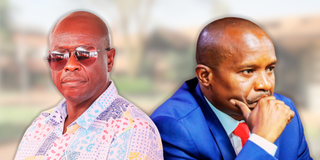
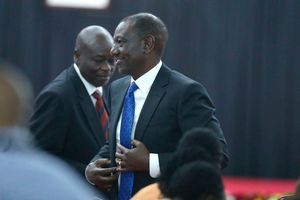
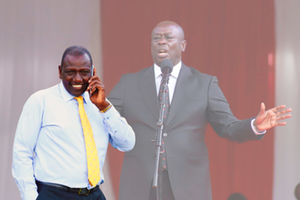
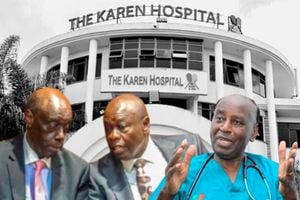
Prof Kindiki is challenging a sworn affidavit filed by Dr Daniel Gikonyo, informing the court that Gachagua had indeed been admitted and that President Ruto personally contacted the cardiologist while the former DP was undergoing treatment at Karen Hospital with severe chest pain.
The Deputy President wants the court to allow his advocates to cross-examine Dr Gikonyo over details of the affidavit, including Ruto’s phonecall and Gachagua’s hospitalisation.
Karen Hospital Chief Cardiologist and Founder Dr Dan Gikonyo.
Photo credit: Jeff Angote | Nation Media Group
His application comes days after the three-judge bench of the Constitutional and Human Rights division rejected his bid to expunge the affidavit from the court record.
Prof Kindiki says the late introduction of the medical evidence raises serious factual disputes that could only be tested through cross-examination.
He wants the court to permit cross-examination of Dr Gikonyo on “the preparation, timing, authenticity, accuracy, and prior non-disclosure” of the medical evidence.
“The affidavit and the medical records annexed thereto were never presented before the Senate during the impeachment proceedings,” Prof Kindiki’s advocate, Muthomi Thionkolu, states in the fresh court filings. He is listed in the impeachment petitions as the second interested party.
The medical evidence has become central to the petitioners’ attempt to overturn Mr Gachagua’s impeachment.
Mr Thionkolu, a senior counsel, argues that the evidence was introduced nearly one-and-a-half years after the impeachment proceedings and only after the petitioners had already closed their case and highlighted submissions.
“The affidavit belatedly raises contested factual issues which cannot fairly or satisfactorily be resolved solely based on affidavit evidence,” he says.
The application marks the sharpest direct courtroom confrontation yet between Prof Kindiki and Mr Gachagua since the former Interior Cabinet Secretary replaced him as Deputy President following the Senate vote that removed him from office in October 2024.
Deputy President Prof. Kithure Kindiki.
Photo credit: Jared Nyataya | Nation Media Group
The legal dispute has drawn President Ruto deeper into the constitutional battle over the historic impeachment.
In his affidavit dated April 26, 2026, Dr Gikonyo told the court the President personally called him while he was treating Mr Gachagua at Karen Hospital on the evening of October 17, 2024.
DP Gachagua is suffering intense chest pains - Muite
“While the first petitioner was under my care, I received a telephone call from the President of the Republic of Kenya, H.E William Ruto, who inquired as to the first petitioner’s condition,” Dr Gikonyo stated.
“I confirmed that the first petitioner had indeed been admitted at Karen Hospital, Nairobi and was receiving treatment under my care.”
If the court allows the cardiologist’s cross-examination, the court proceedings could evolve into a politically delicate inquiry into what the President wanted to know, or acknowledged about Mr Gachagua’s health during the Senate proceedings that culminated in his removal.
That possibility has elevated the medical evidence from a procedural issue into one of the most politically explosive aspects of the impeachment litigation.
Mr Gachagua and 40 other co-petitioners have relied heavily on the hospitalisation evidence to argue that the Senate breached constitutional fair hearing protections by proceeding with impeachment deliberations while he was admitted in hospital.
Dr Gikonyo told the court he admitted the former Deputy President at about 3pm on October 17, 2024, after he presented with severe chest pain consistent with a possible cardiac event.
A sworn affidavit by Chief Cardiologist Daniel Gikonyo reveals President William Ruto personally phoned the hospital on October 17, 2024 to inquire about the health of his then-Deputy, Rigathi Gachagua.
The cardiologist said he conducted extensive medical examinations, including blood tests, electrocardiogram assessments and cardiological evaluations before recommending admission for between 48 and 72 hours.
Hospital records attached to the affidavit showed Mr Gachagua remained admitted until October 20, 2024.
Petitioners argue the Senate ignored his medical condition despite Mr Gachagua’s advocate, Senior counsel Paul Muite, relaying the information to the House. They argue that the Senate proceeded with a rushed process designed to remove Mr Gachagua from office amid deepening political tensions inside the Kenya Kwanza administration.
Lawyers representing Mr Gachagua and allied petitioners have repeatedly described the impeachment as a politically orchestrated purge targeting a powerful Mt Kenya political figure ahead of the 2027 elections.
During submissions last week, the petitioners accused Parliament of acting under Executive influence and abandoning constitutional safeguards during the impeachment proceedings.
“The 13th Parliament has been captured by the Executive,” lawyers for the petitioners told the court.
They argued that both the National Assembly and Senate violated constitutional requirements on fair hearing, public participation and procedural safeguards.
The petitioners further claimed the Senate unlawfully bypassed the constitutional requirement for a special committee before debating and voting on the impeachment motion.
“There was no impeachment in the Gachagua case. It was a mockery of the Constitution,” lawyer Ndegwa Njiru told the judges.
The legal battle stems from the October 2024 impeachment motion sponsored by Kibwezi West MP Mwengi Mutuse, who accused Mr Gachagua of gross misconduct, constitutional violations and abuse of office.
The National Assembly approved the motion before the Senate upheld five impeachment charges in a late-night vote on the same day Mr Gachagua was admitted in hospital.
President Ruto later nominated Prof Kindiki as Deputy President, a move also challenged in the ongoing petitions.