President William Ruto has launched a State-backed framework to compensate victims of protests and demonstrations dating back to 2017, a concession that ticks off one of ODM leader Raila Odinga’s most persistent demands and underscores the cooperation between the two once-fierce political rivals.
The plan, announced in a Presidential Proclamation on Friday and affixed with the official state seal, cites a “compelling national interest” in redressing harm suffered by both civilians and security personnel during Kenya’s turbulent protest history.
It will be domiciled in the Executive Office of the President and coordinated by Prof Makau Mutua, Dr Ruto’s Senior Advisor on Constitutional Affairs and Human Rights.
President William Ruto's Senior Advisor on Constitutional Affairs and Human Rights Prof Makau Mutua.
Photo credit: File | Nation Media Group
The proclamation commits the government to deliver on reparations for those who lost lives or suffered bodily harm “during public protests and riots since the year 2017,” working alongside the Office of the Attorney General, the Ministry of Interior, and the National Treasury.
“The Constitution establishes the dual obligations of the State and its citizens to uphold the delicate balance between civic responsibility and the exercise of constitutionally guaranteed freedoms,” reads the proclamation.
For Mr Odinga’s ODM, the announcement is more than a human-rights victory, but a tangible signal that President Ruto is willing to bend to the 10-point Memorandum of Understanding (MoU) signed on March 7 between ODM and Dr Ruto’s UDA.
That pact, insiders say, could ultimately serve as the launchpad for a 2027 pre-election alliance unprecedented in Kenya’s political history.
Although president Ruto and Mr Odinga were bitter opponents in the 2022 presidential race, sources in State House and both party camps confirm that the two leaders are now working from a coordinated script.
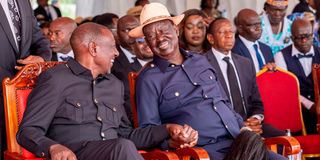
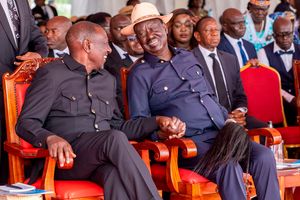
President William Ruto (right) with ODM leader Raila Odinga during the third National Executive Retreat at the KCB Leadership Centre in Kajiado County.
Photo credit: PCS
There is talk that their working arrangement plans, together with Prime Cabinet Secretary Musalia Mudavadi, mirrors their 2007 arrangement under what was popularly known as the ODM Pentagon.
In the run-up to the 2007 elections, Mr Odinga coined the now iconic ODM Pentagon, a regional power-sharing engine composed of himself, president Ruto, Mr Mudavadi, former Minister Najib Balala, and the late Joseph Nyagah—later joined by ex-Minister Charity Ngilu.
“President Ruto, Raila and Mudavadi are key cogs in the Kenyan political space. The three gentlemen are founder members of both ODM and the Pentagon. While they have pursued different political trajectories with mixed results, the Wednesday (July 30) meeting at State House meeting cannot go unnoticed. The meeting is significant in many ways than one and will potentially trigger alignments and re-alignments ahead of 2027 general elections,” says political analyst Dismas Mokua.
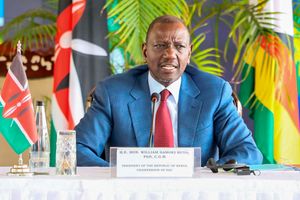
President William Ruto addresses mourners during the burial of former Karachuonyo MP Phoebe Asiyo in Wikondiek Village in Homa Bay County on August 8, 2025.
Photo credit: George Odiwuor | Nation Media Group
The compensation fund, a top-tier MoU item that could be the springboard for the pre-2027 coalition deal between the two leaders (Ruto and Raila), is being packaged as proof of good faith from Ruto’s side, even as ODM mobilises internally to ensure full implementation of the deal.
Mr Odinga has publicly ruled out any early exit from the “broad-based government” arrangement formed last year, which saw ODM-aligned Cabinet Secretaries and advisors join the Ruto administration.
“We have said that we are in the broad-based government until 2027. Beyond 2027 are issues we will discuss at the appropriate time, and the decision will be made by party members, not Raila Odinga alone,” he told the Daily Nation in a recent interview.
President William Ruto, Deputy President Kithure Kindiki and ODM leader Raila Odinga during the signing of a Memorandum of Understanding between ODM and United Democratic Alliance at the Kenyatta International Convention Centre in Nairobi on March 7.
Photo credit: File| Nation Media Group
ODM party’s Central Committee recently resolved to form a technical team to work with UDA counterparts on the MoU, a missing link that has slowed implementation.
The 10-point agenda includes: full implementation of the National Dialogue Committee (NADCO) report; inclusivity in budgetary allocations and public appointments; protection and strengthening of devolution; economic investment in the youth; promotion of leadership and integrity; elimination of government opulence; protection of the right to peaceful assembly; and compensation of victims of political violence.
Other pillars of the agreement include an audit of the national debt and its usage, an intensified fight against corruption, ending wastage of public resources, upholding constitutionalism and the rule of law, protecting civil liberties such as press freedom, and ending abductions and enforced disappearances.
Mr Odinga Raila has repeatedly linked justice for victims to Kenya’s democratic health, especially after police crackdowns during the Gen Z-led protests of June 2024 and 2025 left 61 dead, according to the Kenya National Commission on Human Rights (KNCHR), and at least 89 people disappeared, according to Amnesty International Kenya.
To Ruto allies, delivering on ODM’s demands is as much political calculus as it is policy.
Deputy President Kithure Kindiki recently let the cat out of the bag while in Mr Odinga’s backyard of Migori County.
“If you look at William Ruto, me, and now that we have His Excellency Raila Odinga on our team, do we look like people who can be defeated during campaigns?” he posed, suggesting a looming alliance.
While in Siaya County, Majority Leader in the National Assembly Kimani Ichung’wah lauded Mr Odinga for “standing with the President to stabilise the country,” while ODM MPs like Sam Atandi and Mark Nyamita have openly hinted at a 2027 “Ruto-Tosha” movement.
He calls the MoU “elite co-option” disguised as reform. “Raila Odinga is no longer in the opposition. That ended the moment ODM sat at the table with President Ruto. The regime gained legitimacy and breathing space amid growing public dissent,” he argues.
The push for victim compensation is not new. In 2023, the Azimio la Umoja Coalition sued the government seeking compensation for 75 people allegedly killed by police during anti-government protests between March and July that year.
Through lawyer Paul Mwangi, Azimio argued that police commanders bore “command responsibility” for the deaths, which it said violated constitutional rights to protest, demonstrate, and picket.
The petition also asked the court to compel investigations into the actions of police units involved and to declare that banning demonstrations was unconstitutional. While the case has yet to be concluded, the State-backed framework unveiled last week appears to be an administrative workaround — a way to offer reparations without waiting for drawn-out litigation.