Luhya leadership has carried a particular weight in Kenya’s political story for as long as the country has held elections.
It is a record of ambition, of moments that looked like national breakthroughs, and of a recurring struggle to convert regional strength into a unified national force. The community has produced figures whose influence reached well beyond Western Kenya, and it has watched each of them stop short of the office that would have confirmed it.
He built a career on conviction at a time when conviction carried a price, argued for a federal structure when centralism was winning, and stayed in opposition long after opposition had stopped being profitable.
He helped shape the multiparty push that reordered Kenyan politics in the early 1990s and died before he could collect on it. What he left behind was a template for principled Western politics and an unfinished claim on the presidency.
He was a parliamentary performer of rare quality, fluent and funny and hard to corner, and he built a following that was never confined to his own region.
When the opposition finally broke the ruling party’s grip in 2002, he arrived at the vice-presidency as the most nationally legible Luhya politician the country had produced. His death in office the following year cut short the nearest thing Western Kenya has had to a straight run at the top.
The presidency has stayed out of reach since, and not for want of talent. The obstacle has been assembly. Western Kenya is plural by nature, a region of distinct sub-communities with their own histories and their own preferred sons, and it has arrived at national bargaining tables with a large and dependable bloc of votes but rarely with a single mandate behind one name.
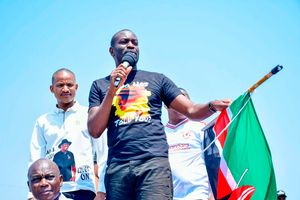
Nairobi Senator Edwin Sifuna during the burial of the late Gloria Sekeiyan Khalwale, wife of Kakamega Senator Boni Khalwale, in Malinya, Ikolomani Constituency, Kakamega County, on August 21, 2026.
Photo credit: Alex Odhiambo | Nation
That culture has made the region indispensable to other people’s coalitions and insufficient for its own. It has been a kingmaker for a generation, and never the king. The modern era produced new voices, and for a time they looked like the correction.
Musalia Mudavadi carried the hopes of a community that believed he could bridge regions and calm political storms. He had the résumé, the temperament and the acceptability, and he was positioned more than once as the compromise everyone could live with.
Moses Wetang’ula built a different kind of power, grounded in parliamentary craft, party machinery and the power of coalition talks, and he proved durable in rooms where durability is the whole game.
Each man was handed a moment that could have reshaped the community’s political destiny. Each spent it on accommodation, trading the harder path of building an independent national vehicle for a seat inside someone else’s. Both ended up well placed in government and no closer to the prize their region had been waiting on.
In Kakamega, Bungoma, Busia, Trans Nzoia and Vihiga, the language used about both men is blunt. They are described as leaders who hesitated when courage was required and compromised when conviction mattered most. They are called sellouts, cowards and opportunists whose season has closed. The judgment is harsh. It is also widely held, and it has created an opening.
A younger generation has moved into that space with a different energy, carrying the confidence of people who understand urban politics and the impatience of a restless electorate. They came up through media, litigation and party organising rather than through provincial administration. They also speak a national language by default.
Through every one of these waves, the community has remained central to Kenya’s political development, a bloc that commands attention and still searches for a leader who can turn regional loyalty into national momentum.
Edwin Sifuna stands within that lineage, though he arrives from an unusual direction. The Nairobi senator was formed by the capital rather than the rural heartland, and the city has shaped both his method and his constituency.
His seat was won in an electorate no ethnic bloc controls, among voters who reward argument and punish evasion, and he has spent his term defending civic space and giving voice to urban grievance in a register that travels.
Ask a Nairobi voter why they back him, and the answer is rarely about where his family comes from. That is the achievement, and it is a departure. His leadership reflects a modern Luhya presence in national politics, one defined less by regional identity than by a country asking for sharper voices and firmer accountability.
The position carries scrutiny alongside the opportunity, particularly when the people closest to a rising politician speak in ways that distort the identity he has spent years building.
The mourners had gathered in Kakamega last week to bury Gloria Khalwale. What they got from her widower was a campaign speech, and a careless one. Boni Khalwale stepped forward, and instead of a steadying word, he reached for a stereotype that has wounded his own community for generations.
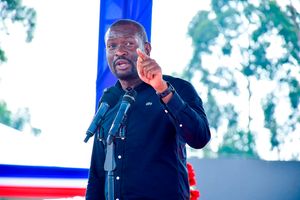
Kakamega Senator Boni Khalwale during the burial of his late wife, Gloria Sekeiyan Khalwale, in Malinya, Ikolomani Constituency, Kakamega County, on August 21, 2026.
Photo credit: Alex Odhiambo | Nation Media Group
Luhyas, he said, are known in Nairobi as cooks, watchmen, janitors, caretakers and housemaids. For that reason, he argued, the community is owed the presidency, and Sifuna is the man who should rise out of the caricature.
That framing has a long history in Kenyan politics, and it has almost always been used by people who wanted Western Kenya counted at the ballot box and nowhere else. In the 1990s, Joseph Kamotho deployed the same language to dismiss the region’s claim to national leadership.
Rival blocs have recycled it ever since, usually in the weeks when Luhya votes are being courted and Luhya candidates are being managed. To repeat it at a funeral, in the name of support, is to hand an opponent the argument fully assembled.
Khalwale has been building toward a moment like this for three decades. He has cultivated the persona of a populist champion, the self-styled Bullfighter of Ikolomani, and his career has been shadowed throughout by loose talk and theatrical missteps.
He has traded insults with rivals from the stage, reduced policy fights to personal ones, staged defections, and treated solemn occasions as available platforms. The performance sells locally. It has never travelled well, and the pattern is consistent enough that allies now brace for it.
This remark costs more than the usual theatre. It recasts Sifuna as a tribal project, a candidate whose legitimacy rests on ethnic entitlement rather than national vision.
The label sticks easily and comes off slowly. It shrinks a politician whose entire strength is his ability to speak across Kenya’s divides. Kenyan presidential politics has never rewarded that framing.
Mwai Kibaki won by assembling a coalition broad enough to embarrass an incumbent. Raila Odinga spent a career building partnerships from the lakeside to the coast and into the Rift Valley, and his defeats came in the years those partnerships thinned. Uhuru Kenyatta’s Jubilee was an engineered marriage of two blocs. William Ruto’s hustler campaign worked because it offered a class argument that cut across ethnic lines instead of following them.
No candidate in the country’s history has reached State House by asking one region to carry him there.
His positioning has been national from the start, built on accountability and urban frustration rather than ancestral claim, and his prospects depend on holding that line against people who keep trying to put him back in a smaller box.
Tribal branding alienates voters who might otherwise have come to him on his own terms. It hardens the suspicion that certain candidates are regional errands, not national contenders. And it complicates the coalition any Sifuna candidacy would eventually require.
If Khalwale genuinely wants a Luhya president, the work is not rhetorical. It is the unglamorous business of building alliances beyond Western Kenya, and of resisting a line that lands well with a crowd already convinced. Loose talk does not build movements. It fractures them.
The community has waited a long time for a leader who can carry its ambitions without shrinking them. Mudavadi and Wetang’ula had their opening and spent it. Sifuna represents a different proposition, which is urban in formation, national in appeal, and young enough to be judged on what he builds instead of what he inherited.
Whether that promise holds will depend on the discipline of his message and the reach of the alliances he chooses. Kenyan voters are attentive and impatient, and what they are asking for is an answer on the cost of living, not a claim of ethnic turn-taking announced over a funeral. Sifuna has shown he can speak to the first. His loudest supporter keeps answering the second.