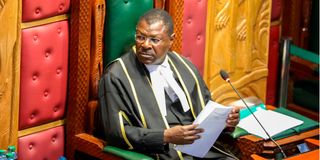
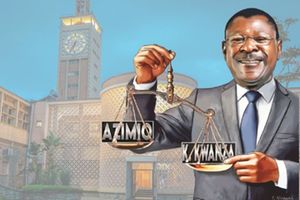
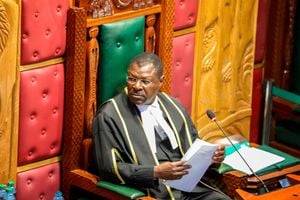
As the National Assembly resumed its sittings this week after a prolonged recess, attention has shifted to the man tasked with navigating one of the most loaded legislative periods in recent parliamentary sessions—Speaker Moses Wetang’ula.
The third part of the Fourth Session comes with a full in-tray, carrying everything from key legislative reforms to diplomatic approvals and sensitive national policy shifts.
For the man at the helm, this moment is as much about principle as it is about politics.
Speaker Wetang’ula now finds himself at the centre of debates that could define the direction of governance in the months ahead even as he urged members to remain focused on their mandate.
“As we resume our sittings after the long recess, I urge each member to embrace the spirit of service, and remain steadfast guardians of the hopes of Kenyan people.
“The nation looks to this House not for noise, but for solutions; not for division, but for unity; not for excuses, but for results. Let’s therefore legislate with dignity, oversight with courage, and represent with integrity, for history will judge us not by the words we speak, but by the service we render to Kenya,” Mr Wetang’ula stated.
The just-concluded recess offered MPs an opportunity to tie up committee work, return to their counties, meet with the Judiciary, and re-engage with constituents. The return to Parliament signals a pivot back to core business — legislation, representation, and oversight. And in this new season, all eyes are squarely on the Speaker to shepherd the House through intense deliberations on matters of national and international interest.
The House is expected to prioritise over 12 key Bills, four Sessional Papers, and more than a dozen additional pieces of legislation. These include politically charged motions and complex policy proposals requiring consensus, foresight, and steady leadership.
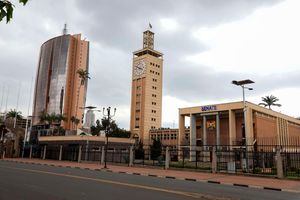
The National Assembly during a past session.
Photo credit: File I Nation Media Group
Among the first items up for debate are appointments to diplomatic missions — High Commissioners, Ambassadors, and Consuls-General — as well as new officials for the Office of the Registrar of Political Parties and the Kenya National Commission on Human Rights (KNCHR). These appointments are not only a test of the Executive's choices but also an opportunity for Parliament to affirm its role in governance vetting.
Mr Wetang’ula will also preside over debate on Sessional Paper No. 2 of 2025, which contains far-reaching policy shifts, including the privatisation of the Kenya Pipeline Company, a trade agreement with the United Arab Emirates, and Kenya’s participation in the Shelter Afrique Development Bank. Equally notable is the agreement between Kenya and Singapore aimed at eliminating double taxation, a measure seen as crucial in attracting foreign investment.
Under Speaker Wetang’ula’s watch, Parliament will also turn its attention to legislation with direct impact on everyday Kenyans.
The Employment (Amendment) Bill, for instance, seeks to introduce the “right to disconnect”, essentially protecting employees from work-related communication outside official hours. As Kenya’s workforce increasingly grapples with blurred lines between home and work due to digital tools, the Bill promises to ignite spirited debate across the aisle.
The Speaker is also expected to steer deliberations on the County Governments Additional Allocations Bill, a Senate proposal that will likely raise questions about the vertical sharing of revenue between national and devolved units. With his longstanding record of supporting devolution, Wetang’ula’s role in balancing fiscal realities with county demands will be closely scrutinised.
Also on the docket are a range of sector-specific Bills. The Coffee Bill, seeking to revive and regulate Kenya’s once-thriving coffee sector; the Natural Resources (Benefit Sharing) Bill, pushing for equitable resource distribution in extractive regions; the Startup Bill, aimed at supporting innovation and youth-led enterprise; and the National Disaster Risk Management Bill, which outlines a coordinated approach to preparedness and response.
Each of these Bills speaks to a different constituency, and their progression will reflect the National Assembly’s responsiveness under Mr Wetang’ula’s stewardship.
Perhaps one of the more delicate assignments ahead is navigating the Houses of Parliament (Bicameral Relations) Bill, a proposed law that aims to clarify how the National Assembly and Senate collaborate, especially in light of perennial turf wars. As an experienced legislator and debater, Mr Wetang’ula is expected to bring institutional maturity to the table and de-escalate inter-house friction.
At the county level, the County Governments (Amendment) Bill proposes a higher voting threshold for the removal of County Executive Committee members. The move, if passed, could strengthen executive stability at the county level—but not without resistance from those arguing for checks on county bosses.
With the government pushing for improved efficiency in state-owned entities, Parliament will consider the Privatisation Bill, a proposal to overhaul the legal framework for divesting public assets. The Bill seeks to inject transparency and competitiveness into how government handles its commercial holdings.
Also scheduled for review is the Kenya Roads (Amendment) Bill, which proposes a reclassification of public roads to clarify which roads fall under national or county jurisdiction. The change, if approved, will see county governments gain greater control over road maintenance—an issue that has long been contentious in the devolution debate.
The Air Passenger Service Charge (Amendment) Bill will also come up for debate, proposing to distribute proceeds from the charge to entities such as the Tourism Fund, Kenya Meteorological Service, and the Kenya Airports Authority. It’s a move aimed at ring-fencing revenue for sectoral development while increasing transparency in the aviation industry.
As by-elections loom and the newly appointed IEBC officials prepare to assume office, Speaker Wetang’ula is expected to oversee budgetary discussions critical to enabling the electoral commission to meet its constitutional obligations. This includes timely allocation of funds and legislative support for operational readiness.
Mr Wetang’ula, a former Foreign Affairs minister, is also expected to continue championing parliamentary diplomacy. In his role as Chairperson of the East Africa Speakers’ Bureau, he is leading efforts to strengthen Kenya’s relationships with global legislative bodies such as the Commonwealth Parliamentary Association, Pan-African Parliament, East African Legislative Assembly, and the Inter-Parliamentary Union.
“One of the greatest leadership lessons I carry with me is that a leader serves the people.” Quoting former US President Grover Cleveland, he added, “Office holders are the agents of the people, not their masters.”
“The National Assembly is headed to a busy session with a full in-tray. I am sure Members are prepared and ready after their break. Priority will be given to given to legislative business before the House and other emerging issues,” said Mr Samuel Njoroge.