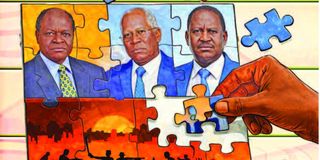
Former President Mwai Kibaki (left) Former Electoral Commission of Kenya chairman Samuel Kivuitu, and former Prime Minister Raila Odinga.

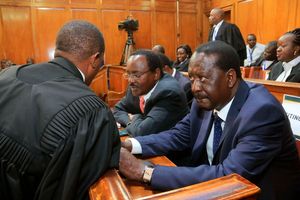
By the afternoon of December 30, 2007, the usually orderly hall inside the Kenyatta International Convention Centre (KICC) was chaotic. Politicians shouted across the stage, with some ODM stalwarts even moving to the very table where the commissioners were seated.
Security officers surrounded the commission as Samuel Kivuitu, the Electoral Commission of Kenya chairman, struggled to read out results amid the uproar.
There was a titanic battle for the Presidency, with incumbent Emilio Stanley Mwai Kibaki hoping to ward off his wildly popular main challenger, Raila Odinga.
Across the country, millions watched the unfolding drama live on television.
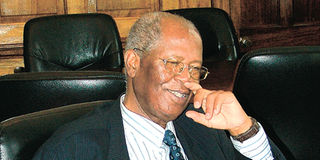
Electoral Commission of Kenya Chairman Samuel Kivuitu PHOTO/ FILE
But what viewers did not know was that behind the scenes, another set of conversations was taking place, as some of the country’s most influential politicians and power brokers plotted to ensure that the incumbent would retain the seat.
Somewhere in Nairobi, a police officer was being told to prepare for an unusual assignment.
Elsewhere, discussions were underway about cutting the electric power supply at the tallying centre inside the KICC.
And inside government offices, a plan was being formed to ensure that the results showing Kibaki’s victory were announced.
Within hours, those decisions would set in motion a sequence of events that would move rapidly from KICC to State House.
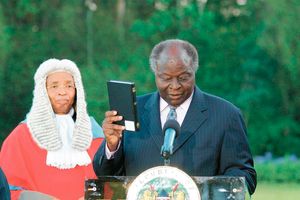
It would begin with a phone call and end with a hurried swearing-in ceremony before nightfall.
That, too, would trigger another series of events often touted as Kenya’s lowest moment, which would require the intervention of the international community, eventually birthing the Grand Coalition Government and Kenya’s second Prime Minister since independence, Odinga.
The tension was palpable on the afternoon of December 30, 2007. Millions of Kenyans, having cast their votes three days earlier, remained glued to their television sets. They were waiting for the Electoral Commission of Kenya (ECK) to declare the winner of one of the most fiercely contested elections in the country’s history.
Nearly two decades later, interviews the Nation conducted with key individuals who were present, including electoral commissioners, security officers, government officials and media executives, have offered a reconstruction of the three tense days that culminated in the most controversial presidential declaration since the return of multiparty democracy. The election itself began with a sense of historic anticipation.
Before dawn on December 27, 2007, Kenyans lined up outside polling stations across the country. Long queues snaked around school compounds and community halls as voters waited patiently to cast ballots in what many believed would be a defining political moment.
The race pitted incumbent President Mwai Kibaki of the Party of National Unity (PNU) against Raila Odinga of the Orange Democratic Movement (ODM). Both are now deceased.
But the contest had been years in the making.
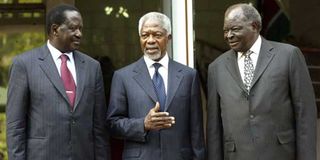
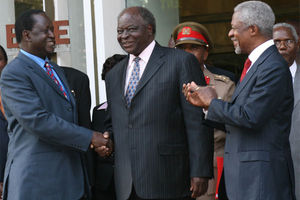
From left: Opposition leader Raila Odinga, former UN Secretary General Kofi Annan President Mwai Kibaki during negotiations to end the 2007 political stalemate. FILE PHOTO | REUTERS | NOOR KHAMIS
The political rivalry between the two leaders deepened after the collapse of the National Rainbow Coalition (NARC) government that had swept Kibaki into power in 2002. Odinga and his allies accused Kibaki of reneging on a power-sharing understanding that had promised a new constitution and the creation of a prime minister’s office.
The split widened during the 2005 constitutional referendum when Odinga’s “Orange” camp defeated the government-backed “Banana” side with a landslide, shattering the unity of the coalition government. This saw President Kibaki dissolve the entire Cabinet in a shock move that pushed out Odinga, then the Minister of Roads and Public Works, from the corridors of power. This move alone saw the ODM wave grip the entire country with a frenzy.
By 2007, the political divide had hardened into a two-horse race that was believed could end Kibaki’s presidency.
But even before the voting process was complete, something unusual happened.
Jack Tumwa, who served as a commissioner at the Electoral Commission of Kenya, recalls receiving a disturbing phone call on the morning of election day.
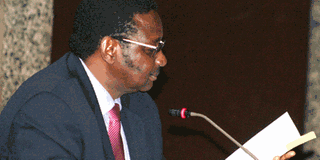
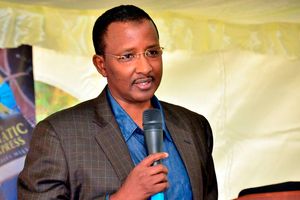
Former ECK commissioner Jack Tumwa. FILE
“Come election day, what hit us first?” Tumwa said while recalling the moment.
“I had gone to Jamhuri Polling Station when I got a call that Raila’s name was not on the voters’ register.”
Odinga had voted at the same polling station in Kibra in previous elections.
“Kivuitu himself had to go to Kibra to confirm Raila’s name was there,” Tumwa said. “His team argued that this is where he had been voting since 1992, 1997 and 2002. How come the name was missing in 2007?”
Months before the election, ODM had already insisted that they needed to be given access to the master roll, also called the ‘black book’, which was the manual register of all voters in the country and was in ECK’s custody.
As such, the news that Raila’s name was not in the register set off alarm bells across the country. For ODM’s followers, this cemented their belief that there were plans to rig the elections.
The anomaly was eventually resolved, but the incident left election officials unsettled.
As evening fell and ballot boxes were sealed across the country, attention shifted to Nairobi, where constituency results would be delivered to the national tallying centre at KICC.
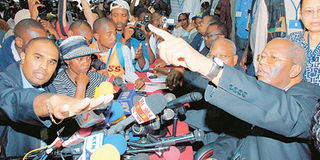
Former Election Commission Chairman Samuel Kivuitu (right) addressing a press conference at KICC just before the announcement of the results of the disputed 2007 General Elections.. PHOTO/ FILE
Commissioners expected the first returns by late evening.
But the night passed with almost no movement.
“At KICC we expected to start receiving results at 10pm,” Tumwa said.
“I don’t know what happened or what unfolded throughout the whole night. There were hardly any results coming in until the following day.”
The slow pace puzzled the commissioners.
By the next morning, the tally centre had begun filling with party agents, politicians and journalists. Television cameras were trained on the stage where the commission sat.
But the results continued to arrive slowly.
“We started wondering,” Tumwa said.
Even more perplexing was the fact that some returning officers could not be reached by phone. It was at this point that the late Kivuitu made a statement that many Kenyans believe was a hint at the manipulation of the figures in the presidential poll.
“Mr Kivuitu said that even if the returning officers from Kiambaa were cooking the results, they were now overcooking them, adding that even if they had decided to come to KICC on foot, they would have arrived,” Commissioner Tumwa recounted.
This statement, another commissioner, Muturi Kigano, believes was taken out of context, saying that “Kivuitu made some jokes which I would say were ridiculous and silly, with a lot of respect to him.”
The delayed submission of results did not augur well for the ECK commissioners, who had expected the exercise would be swift and efficient.
“We were shocked as ECK that places like Nairobi, here in Pangani, and a few others were not bringing in results,” Tumwa said.
“You expect far-flung areas to delay, but not areas in Nairobi.”
Despite the delays, the early tallies that had arrived suggested that Odinga was establishing a significant lead.
Media houses began reporting that the ODM candidate was ahead.
Inside KICC, however, the atmosphere grew increasingly tense as the hours passed.
Returning officers continued arriving with constituency results that had to be verified and announced.
Then something changed.
Results from several constituencies considered strongholds of the incumbent began arriving almost simultaneously.
The numbers dramatically narrowed the gap between the candidates.
“On the final day of counting, we went into the afternoon and suddenly results started coming from Kibaki’s strongholds, including the three famous ones — Tharaka Nithi, Juja and Kiambaa.
“The graph just started rising, and Raila was losing... this looked suspicious,” Tumwa said.
Opposition representatives protested loudly.
They argued that the figures being read out did not match the forms signed by their agents at constituency tally centres.
Inside the hall, shouting matches erupted between politicians from rival camps.
At one point, the commission halted the announcement of results to allow verification following demands by the opposition.
“We took the whole night verifying them with both sides present,” Tumwa said.
That night inside KICC would later be remembered by many who were there as one of the most tense moments of the election. Stacks of forms were spread across tables as election officials and party agents pored over numbers constituency by constituency.
Fatigue began to set in among commissioners and staff who had been working almost without sleep for days.
Outside the hall, crowds gathered, waiting for news. Inside, arguments broke out repeatedly.
At times, security officers had to step in to separate rival politicians.
“At some point, we reached a level where we thought people were going to start fighting,” Tumwa said. “Some of the politicians came on to the stage, and GSU officers were all around there.”
Muturi Kigano, another commissioner, remembers how volatile the situation had become.
“Mwadime (the then GSU Commandant) came and chased people like William Ruto, who was aggressive,” Kigano said. “Word also came that one of them, I don’t want to name him, was armed with a grenade to throw at us.”
Security was tightened immediately.
The commissioners were moved into a guarded room away from the crowd.
The tension inside the electoral body itself was also growing.
Some commissioners privately questioned whether the figures arriving from constituencies were consistent.
Tumwa later said the sudden surge of results had left many officials uneasy.
“Results that came in with a bang shocked all of us. Really, there was something wrong,” he said.
Four commissioners eventually issued a statement expressing reservations about the process. “We needed transparency,” Tumwa said. “The public needed to know.”
Outside the tally centre, the political pressure was mounting. The media were broadcasting provisional tallies that appeared to show Raila Odinga ahead. Inside government circles, alarm was growing about how the unfolding drama was being reported.
Alfred Mutua, then the government spokesman, while appearing on national television days after Mwai Kibaki died in 2022, said the administration believed the media’s figures were inaccurate. “When it came to the last days of counting votes, the whole Tharaka Nithi thing, two things happened,” Mutua said. “We were a bit confused. Our figures were showing Kibaki winning, but the media showed he was losing.”
The government summoned media executives from leading media houses to Harambee House. Waithaka Waihenya, then editor-in-chief of the Kenya Broadcasting Corporation, remembers the confrontation.
“Minister John Michuki was very agitated and was accusing the media of blowing this thing up, and the main message was that we needed to de-escalate the situation,” he said.
The anger was triggered in part by newspaper headlines reporting Odinga’s early lead. The Standard Group had that morning published “Raila Takes Early Lead” as its splash, and the government did not like it at all. The Nation Media Group, Mr Waithaka remembers, had prepared a huge headline, “President-Elect”, with a photo of Odinga ready.
“It (the meeting) was so bad. They accused The Standard and KTN, too, of having their own figures. Their editor was particularly under fire,” Waihenya said. Government officials believed some broadcasters were fuelling tension by publishing their own tallies before the electoral commission had announced official results. Journalists, on the other hand, insisted they were simply reporting figures coming from polling stations and tally centres.
The clash between government officials and media houses would become one of the defining features of the final days of the election count. “The one voice of reason, who I would say was not agitated, he was not angry, was Francis Muthaura (then Head of Public Service). He was talking very calmly,” Waihenya recounted. Inside KICC, the situation continued to deteriorate.
Follow our WhatsApp channel for breaking news updates and more stories like this.
In Part 2 tomorrow, we reveal who was called, how Kivuitu was evacuated from a chaotic KICC covered in darkness to State House, and who switched off the lights at amid pressure to declare a Kibaki win on the national broadcaster