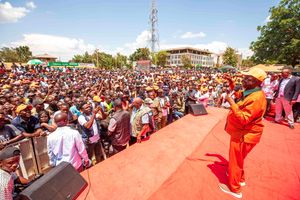
Just as the Linda Mwananchi wave spearheaded by perceived ODM rebels is stirring the country’s political scene, a fresh twist has emerged — an application to register the movement as a political party.
The surprise filing at the Office of the Registrar of Political Parties (ORPP) has sparked suspicion across camps, with even the owners of the movement expressing surprise.
Three theories have so far emerged: this could be a fallback plan by the perceived ODM rebels; a hostile takeover of the popular name; or a calculated business gamble by political merchants.
The application lodged last week appears to have jolted the youthful movement associated with the embattled Orange Democratic Movement (ODM) Secretary General Edwin Sifuna and his allies.
Now under review at the ORPP, the application to reserve the name of the party has triggered suspicion and quiet calculations across rival camps — raising three pressing questions.
Is it a fallback plan by Mr Sifuna’s camp? Is it a scheme by their ODM rivals or by factions within the wider opposition and broad-based government to lock them out of the name? Or could it be a commercial gambit - a “Mugambi Imanyara moment” — where an individual moves swiftly to secure a political brand before its perceived owners?
At the centre of the controversy is a Mr Charles Wanyonyi, who confirmed that he applied to reserve the name.
“It’s true I’ve made the reservation but I cannot comment on the matter at the moment because it is still under review by the Registrar of Political Parties,” Mr Wanyonyi said. “Until it is approved, we can wait.”
Nation confirmed that indeed the application for reservation of the name had been lodged, even though the Registrar of Political Parties, John Cox Lorionokou, declined to delve into the specifics of the application, but explained the process.
“For review, it is within 14 days of the application by dint of Section 4B of the Political Parties Act,” Mr Lorionokou said. “A provisional certificate shall be issued only upon compliance with Sections 5, 6, 7, 8 and 9 of the Act which give the provisions.”
“Once applications come, they are processed. It’s true at the moment we are processing this and a communication will be made to the applicant,” the official said. “The name is looked at against Section 8 of the Political Parties Act. If it meets the parameters, it’s approved; if it doesn’t meet them, it’s rejected.”
Edwin Sifuna observes a moment of silence for Vincent Ayomo, who was shot in Kitengela Rally during the Linda Mwananchi Rally at Amalemba grounds in Kakamega on February 21, 2026.
Photo credit: Alex Odhiambo | Nation
ODM National Chairperson Gladys Wanga challenged the Linda Mwananchi faction to be transparent about its political direction, noting that their recent rallies have distanced themselves from ODM symbolism.
Ms Wanga said the group must clarify whether it intends to form a new party, especially in light of the reported application, instead of leaving supporters uncertain about its true agenda.
“They should come out clean and declare their intentions coupled with the fact that their rallies have abandoned ODM colours and they appear to be charting own path. They should come out clear on their real intentions in light of this application to form a new political party,” Ms Wanga told Nation .
Mr Sifuna did not comment on the matter despite several attempts by Nation to reach out to him, but his allies vehemently denied being part of the plan to register the movement as a political party or coalition.
ODM co-deputy party leader Godfrey Osotsi, who is also a founder of the Linda Mwananchi movement and Vihiga Senator, dismissed suggestions that the group had reached that stage.
“As a team we haven’t discussed anything of that nature because we haven’t reached that stage,” Mr Osotsi said. “We are determined to resolve the issues in ODM party and that is our priority.”
“Hii sasa ni nini?” he posed rhetorically. “Ingekuwa renaissance maybe tungeongea. We have not discussed registration of Linda Mwananchi as a political party.”
Yet privately, some observers argue that the mere existence of such an application suggests contingency thinking.
Since its emergence as a rallying cry to “protect the citizen,” Linda Mwananchi has grown beyond an internal ODM pressure group into a national brand drawing crowds in Nairobi, Western, and parts of Rift Valley. The group is opposed to a pre-election coalition deal between the party and the ruling outfit, UDA, and is campaigning against President Ruto’s re-election.
ODM Secretary-General Edwin Sifuna addresses supporters in Kitengela on Sunday, February 15, 2026.
Photo credit: Stanley Ngotho | Nation Media Group
Political analyst Chris Omore says the movement’s rapid growth may have forced its architects to contemplate institutionalisation.
“When a movement begins to command national visibility and numbers, the question of structure inevitably arises,” he says. “Registering a party can be both a bargaining chip and an insurance policy.”
If the Sifuna camp were to fall out irreparably with the ODM leadership under Dr Oburu Oginga, or if internal resolutions stall, a registered vehicle could offer an exit ramp.
Still, those close to the movement maintain that their immediate battle remains within ODM — resisting what they perceive as rapprochement between sections of the party and President Ruto’s United Democratic Alliance (UDA).
The second scenario carries more intrigue. Could rivals have moved swiftly to reserve the name in order to deny the movement legal control of its own brand?
“They are desperate people but they shall be defeated,” he said. “This movement is bigger than just a name. They’ve taken the letter of the law but the spirit of the law is still with the people. The movement is not in the name.”
His remarks suggest suspicion that political opponents — either within ODM, the Kenya Kwanza administration, or even factions within the United Opposition — may be seeking to outmanoeuvre the youthful bloc.
Former Jubilee Party Secretary General Jeremiah Kioni linked the government to the rush to reserve the name.
“Given the panicky nature of the regime in office and their inability to fulfill or deliver on any of their promises, that naturally is my immediate line of thought. It's the government dark force at work,” said Mr Kioni.
ODM Leader Oburu Oginga at Linda Ground in Siaya County.
Photo credit: Pool
The timing is politically delicate. Linda Mwananchi has unsettled both ODM insiders and opposition heavyweights, including former Deputy President Rigathi Gachagua, Wiper leader Kalonzo Musyoka, and Jubilee deputy party leader Fred Matiang'i.
For the Gachagua-led Democracy for the Citizen’s Party (DCP) and its allies, the Sifuna wave presents both energy and arithmetic risk. Should Linda Mwananchi morph into a standalone political party and field candidates in 2027, it could fracture the anti-Ruto vote.
Equally, if ODM mainstream feels threatened by the generational shift championed by Mr Sifuna, Babu Owino, Mr Osotsi and Siaya Governor James Orengo, they may see strategic advantage in clipping its wings early.
A senior opposition insider, speaking off the record, said control of a political name can determine campaign financing, ballot placement and coalition negotiations.
“In Kenyan politics, branding is power,” he said. “Lock someone out of a name and you complicate their logistics, messaging and legal standing.”
In 2005, lawyer and politician Mugambi Imanyara famously registered the Orange Democratic Movement (ODM) name ahead of the constitutional referendum, later negotiating its transfer.
Is the Linda Mwananchi application a similar entrepreneurial move — a pre-emptive registration in anticipation of future demand?
Legal experts note that Kenyan law does not require an applicant to demonstrate ideological ownership of a name at the reservation stage. Compliance with statutory provisions is what matters.
If the name is approved and the movement later seeks to use it formally, negotiations — financial or political — could follow.
“This could simply be someone betting that the name will gain even more traction and positioning themselves accordingly,” says Mr Omore. “It would not be unprecedented.”
Mr Wanyonyi’s guarded response — acknowledging the application but declining further comment — has only fuelled speculation.
Beyond the legal wrangles lies a deeper political question: Is Linda Mwananchi destined to remain a movement within ODM and the broader opposition, or is it evolving into a standalone force?
On NTV’s Fixing the Nation , Mr Sifuna recently struck a careful tone about unity.
“We have had a conversation that all of us who are saying Ruto must go, must be available to go him,” he said. “All of us must answer the call because we hear it across the country that people are yearning for a different leadership.”
“I have been amazed by the outpouring of support from Kenyans from all walks of life,” he said in a recent rally. “This country is going to change not because of one individual but building a critical mass.”
Encouraging youth participation, he added: “Nobody should threaten you that it takes rocket science or some magic. What Kenyans are looking for is the message and the vision.”
The broader opposition — rebranded as the United Alternative Government — is grappling with its own leadership puzzle. Mr Gachagua, Mr Musyoka and Dr Matiang’i each harbour presidential ambitions. Martha Karua, Eugene Wamalwa, Justin Muturi and Peter Munya add further complexity.
United Opposition leaders, from left: Fred Matiang'i of the Jubilee Party, Stephen Kalonzo Musyoka of the Wiper Patriotic Front, Rigathi Gachagua of the Democracy for Citizens Party (DCP), and Eugene Wamalwa of the Democratic Action Party–Kenya, during a church service at PCEA Utawala in Nairobi on Sunday, February 22, 2026.
Photo credit: Dennis Onsongo | Nation Media Group
The method of selecting a flag bearer — whether early or late — could determine cohesion or collapse.
If Linda Mwananchi were to formalise as a party, it could either serve as a negotiating bloc within a coalition or splinter votes in key counties. In tight electoral arithmetic, even a modest share of ballots can alter outcomes.
Prof Gitile Naituli of Multimedia University argues that the optics of unity matter as much as legal structures.
“If rival camps use rallies to signal individual ambitions, the events could expose the very divisions they seek to conceal,” he says.
The Registrar’s review clock is ticking. Within 14 days, the application will either proceed or be rejected.
Mr Owino’s assertion that “the movement is not in the name” reflects confidence that Linda Mwananchi’s appeal lies in its message rather than its paperwork.