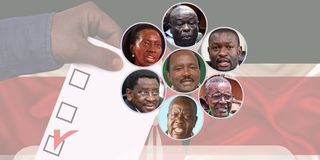
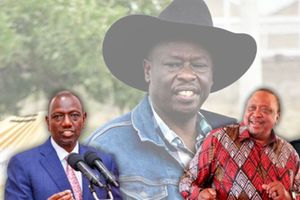
Two years ago, no one would have predicted that Embakasi MP Babu Owino would refer to former Deputy President Rigathi Gachagua as 'father' (fadhe), despite having previously labelled him the 'face of tribalism'.
Nor would anyone have imagined that Siaya Governor James Orengo, who was among those who led the charge in Mr Gachagua’s impeachment, would praise him today.
Siaya Governor James Orengo.
Photo credit: Alex Odhiambo | Nation Media Group
“Kenya is not a republic established on the basis of shareholding. It is a republic of citizens. So, when a deputy president talks about protecting the interests of watu wa murima (the people of Mt Kenya region), whatever that may mean, it is not in compliance with the constitution,” said Mr Orengo during the impeachment proceedings in 2025.
Mr Gachagua, who once declared that people from Mr Orengo's region were not shareholders in the Kenya Kwanza administration and would remove them from the queue for government handouts or goodies, is now reaching out to the same constituency and saying how great a people they are.
In the loose coalition building ahead of the General Election are individuals who have previously called each other thieves, tribalists, watermelons, goons, and graft lords, and even incited ethnic hatred against each other. But the tectonic plates are now moving fast.
As the British Prime Minister Harold Wilson once said, “a week is a long time in politics”. In Kenya, even a day is too long, and the impossible becomes possible.
ODM Secretary-General Edwin Sifuna addresses delegates during the People’s Delegate Convention organised by the Linda Mwananchi faction of the ODM at Ufungamano House in Nairobi on March 27, 2026.
Photo credit: Wilfred Nyangaresi | Nation Media Group
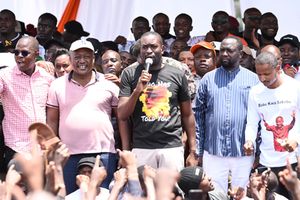
Mr Edwin Sifuna, the de facto leader of the Linda Mwananchi faction of ODM and the party secretary-general, said this week that the leaders should lock themselves in a room and air their grievances before embarking on the journey to oust President William Ruto.
“Even Rigathi Gachagua (when he was DP) would wake up at 6am and hurl tear gas at us when we were with Baba (the ODM leader Raila Odinga, who died in October last year). But if he’s the one who will help us wrestle the enemy, then so be it. Matiangi (former Interior CS Fred Matiang'i) can hold the other leg," said Mr Sifuna, the senator for Nairobi.
He added: “This conversation will not be an easy one. There are a few things I’d also like to tell Matiang’i. We have all been mean to each other. I remember mishandling Kalonzo (Wiper leader Kalonzo Musyoka) when I was SG. During a by-election in Bonchari a few years ago, Matiang’i really put us under pressure. We inhaled a lot of tear gas. In that room, we would say all these, and then begin the journey with lighter burdens. Matiang’i’s tear gas is nothing compared to the economic hardship that Ruto has subjected Kenyans to.”
Jubilee Party deputy leader Fred Matiang'i during an interview at office in Nairobi on February 12, 2026.
Photo credit: Evans Habil | Nation Media Group
There is an American parallel. In Team of Rivals, Doris Kearns Goodwin recounts how Abraham Lincoln, after the election of 1860, pulled his former competitors—William Seward, Salmon Chase, Edward Bates—into his Cabinet, binding their egos to the survival of the Union. Kenya’s current realignment echoes Lincoln’s logic, but the texture is different. Where Lincoln’s rivals shared a constitutional culture, Kenya’s coalition is held together by something more primal: shared threat of incumbency, the memory of past wounds, and the deeply personal calculus of who can be trusted until the votes are counted.
DCP leader Rigathi Gachagua speaks during the reception of former nominated Senator Millicent Omanga at the party headquarters in Nairobi on March 19, 2026.
Photo credit: Bonface Bogita | Nation Media Group
Mr Gachagua, now the face of anti-Ruto sentiment in the mountain, once stood at Dr Ruto’s inauguration and delivered a tongue-lashing so searing against the retiring President Uhuru Kenyatta that it became a national and diplomatic spectacle.
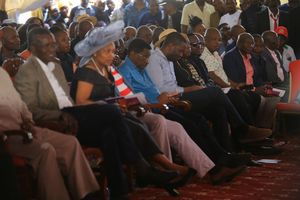
Goons later raided the Kenyatta family farm in Northlands; livestock vanished. Yet in April, at the burial of former Kirinyaga Senator Daniel Karaba, former President Uhuru Kenyatta and Mr Gachagua were sharing light moments, embracing while mourners cheered. Water under the bridge, it seems. But in Kenyan politics, water moves fast enough to carve canyons.
Mr Sifuna, who helped eject Mr Gachagua from the deputy presidency, now speaks of him as a necessary soldier. Dr Matiang’i, who once ordered the arrest of opposition protesters—and faced his own attempted arrest in 2023 with Mr Gachagua’s apparent blessing—now receives praise from Governor Orengo, the same Orengo who once accused him of strangling civil liberties.
“When I see you here,” Mr Orengo told him, “I see the spirit of Raila.”
Even Mr David Maraga, the former CJ with his own presidential ambitions, has signalled readiness to fold into the opposition, cautioning only that minority communities must not be sidelined. “It would be a terrible tragedy if we allow Ruto to return,” he said.
Former Chief Justice David Maraga speaks during the declaration of his 2027 presidential bid on the United Green Movement Party ticket, at the party headquarters, Nairobi, on October 2, 2025.
Photo credit: Wilfred Nyangaresi | Nation Media Group
On the other side of the field, ODM is learning what it means to live without its sun. Raila Odinga’s death removed not just a leader but a gravitational field. For three decades, Odingaism was the organising principle of the opposition—charismatic, unpredictable, structurally dominant. Without him, ODM has become a house of competing ambitions, with a rift opening between Mr Sifuna, who speaks the language of the Gen Z moment, and Homa Bay Governor Gladys Wanga, who represents the Nyanza establishment.
The State House is reportedly manoeuvring to influence ODM strongholds, fragmenting the base while maintaining the veneer of cooperation. The party chose Raila’s octogenarian brother Oburu Oginga as interim leader.
Opposition chiefs are keen to learn from the 1992 and 1997 elections when Daniel Moi won with ‘minority vote’. Together, the leading opposition candidates pooled nearly 50 per cent—enough to have forced a runoff in the two occasions. But they were not united. There were four regional campaigns running in parallel, each drawing support overwhelmingly from its leader’s ethnic stronghold.
It took a united opposition to break the spell. In 2002, NARC did what FORD failed to do in 1992. It stitched together the Democratic Party, FORD-Kenya, the Liberal Democratic Party, and smaller formations into a single vehicle with a single purpose: to remove KANU from power. Mwai Kibaki won with 62.2 per cent against Uhuru Kenyatta’s 31.6 per cent. NARC captured 125 of the 210 parliamentary seats. The lesson was seared into the national consciousness: fragmentation preserves incumbents; unity dislodges them.
President Ruto knows this history as well as his opponents know it. That is why the funerals of Kenya have become, once again, the negotiating tables of the republic. At a burial in Kisii, Mr Sifuna—who once led the parliamentary whip count to impeach Gachagua—stood before mourners and offered his hand to Dr Matiang’i, whose security forces had tear-gassed Mr Sifuna’s own party leader in the streets. “We were at war at the time,” Sifuna said. “Not anymore.” Dr Matiang’i nodded. He would soon visit Western Kenya to hunt for votes. The arithmetic driving these reconciliations is as brutal as it was in Moi’s era. TIFA polls place Ruto at roughly 24 per cent — competitive, but oddly stacked against the Opposition - if they were to unite. Kalonzo Musyoka–Fred Matiang’i ticket polls at 31 per cent. A Kalonzo–Sifuna pairing draws 28 per cent.
Combined with the constituencies that Mr Gachagua, Ms Karua, and other principals command, the united opposition holds a decisive advantage. Even if fragmented, the polls suggest, they could deny Dr Ruto a first-round victory and force a runoff in which a consolidated anti-Ruto front would likely prevail. The only way to bell the cat, as Mr Sifuna admits, is jointly.
Wiper leader Kalonzo Musyoka addresses the media at SKM Command Centre in Nairobi on December 30, 2025.
Photo credit: Wilfred Nyangaresi | Nation Media Group
“He’s no walkover, our opponent is an accomplished politician,” he said. These men are reading from the same 2002 playbook.
Yet the fragility of the arrangements is their most honest feature. Unlike legal contracts enforceable by courts, these alliances are held together by the thinnest membrane of mutual need. Even within the Linda Mwananchi camp, there are those like Saboti MP Caleb who say they should chart their own path instead of teaming up with the United Opposition. In Central Kenya, a supremacy war is simmering between Ms Karua and Mr Gachagua, and other leaders who continue to seek a new pathway, like Moses Kuria, who is leading UDA's quest in the upcoming Ol Kalou by-elections. Mr Kenyatta’s Jubilee also views Mr Gachagua with suspicion.
Ms Karua, a political veteran, feels she has seen it all and should not play second fiddle to a one-term Mathira MP elevated by accident to the deputy presidency.
People's Liberation Party leader Martha Karua speaks at Ambassador Church in Ciagiini village, Kirinyaga County.
Photo credit: George Munene | Nation Media Group
The question of who commands the mountain is existential. The mountain is highly fragmented. There's also Deputy President Kithure Kindiki in the mix, and there's no telling what shall become of the Ruto running mate position.
By next year, the current labels—broad-based government, Linda Mwananchi, Linda Ground, United Alternative Government—may have dissolved into new configurations, just as FORD dissolved into FORD-Asili and FORD-Kenya, just as NARC dissolved into its constituent factions once victory was secured.
What the polls make unmistakably clear is that the political craft of alliance building is what will deliver next year’s presidency.
Dr Ruto remains a formidable campaigner with the machinery of incumbency, and the opposition’s history is littered with coalitions that collapsed under the weight of ego before they reached the ballot.
But the gravitational pull of 2002 is strong. The opposition understands, at a cellular level, that they have done this dance before—twice for Moi, once for Kibaki—and that the only fatal mistake is believing yesterday’s picture will look anything like tomorrow’s.
At the Kisii funeral, Mr Musyoka offered the coalition’s quietest, most revealing promise. “Ruto is one-term,” he said. “But elections are a process.” The words hung in the air—not as prophecy, but as instruction.
Between now and August 2027, the process will demand more handshakes, more public forgiveness of private wounds, more jigsaw pieces jammed into configurations that bewilder the outside world.
Kenya’s democracy does not reward consistency; it rewards reinvention. And the men and women currently stitching this alliance together understand that in this particular puzzle, the only permanent truth is that nothing stays permanent for long.