Calls for the formation of new political parties have exposed fresh cracks in efforts to unite the Luhya voting bloc ahead of the 2027 General Election, with leaders divided over the best vehicle to advance the region’s political interests.
The emerging push has reignited debate on whether the community should consolidate behind an existing party or create a new platform capable of bargaining for influence in the next political dispensation.
The divisions come amid renewed attempts by Luhya leaders to forge a common political front after years of fragmented support across different parties.
A recent meeting by Western leaders allied to the Linda Mwananchi Movement at the home of Trans Nzoia Governor George Natembeya has reignited calls for the formation of yet another outfit, laying bare deep divisions over the community's political future ahead of the 2027 General Election.
The leaders drawn from the community also resolved to front Mr Sifuna for the 2027 presidential contest through the yet-to-be established outfit.
The politicians announced their intention to unveil a new political party, signalling a plan by Mr Sifuna to end the ongoing legal battle to remain as ODM secretary-general.
The resolutions were made during a meeting hosted by Trans Nzoia Governor George Natembeya and attended by Mr Sifuna, Vihiga Senator Godfrey Osotsi, Kabuchai MP Majimbo Kalasinga and Bumula MP Wamboka Wanami, among other leaders.
“Our resolution is that Mr Sifuna will contest the presidency in 2027. Soon, we shall announce the party we will use to seek the presidency,” said Mr Natembeya.
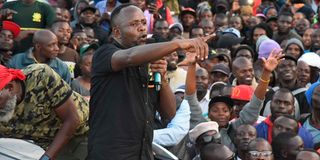
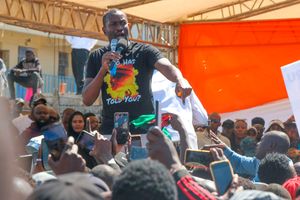
Nairobi Senator Edwin Sifuna, address a crowd at Mazembe Grounds in Nakuru City on April 19, 2026.
Photo credit: Boniface Mwangi | Nation Media Group
“We are going to launch vigorous grassroots campaigns in all 38 constituencies in Western Kenya to mobilise our people to register as voters and support our political agenda,” the governor added.
The proposals have exposed the competing interests among Luhya leaders at a time when calls for unity have intensified.
Rather than consolidating political influence under a common platform, the region now risks further fragmentation, with several parties already claiming to represent Western Kenya's interests.
The Natembeya meeting comes barely days after a growing chorus of leaders began questioning whether existing political parties have adequately championed the region's interests in national politics.
Those present argued that Western Kenya requires an independent political vehicle capable of negotiating from a position of strength in coalition politics.
But critics say adding another party to an already congested field could further dilute the community's bargaining power instead of strengthening it.
But political analysts and Kanu party’s Nairobi gubernatorial aspirant Tony Gachoka argues that the new Sifuna-Natembeya outfit’s main objective would be to consolidate the Western Kenya vote under one banner.
“This will strengthen the region's bargaining position within the opposition owing to the fact that Natembeya’s Tawe Movement had already gathered traction in the area,” Mr Gachoka said.
Today, Western Kenya is arguably home to more regionally associated political parties than any other part of the country.
Ford Kenya party leader Moses Wetang'ula.
Photo credit: Dennis Onsongo | Nation Media Group
National Assembly Speaker Moses Wetang'ula leads Ford-Kenya, the oldest surviving party associated with the region and one that traces its roots to the struggle for multiparty democracy.
Prime Cabinet Secretary Musalia Mudavadi's Amani National Congress (ANC) also remains legally in existence after a High Court ruling halted its dissolution into UDA, although the Mudavadi faction has appealed that decision.
Former Defence Cabinet Secretary Eugene Wamalwa heads the Democratic Action Party-Kenya (DAP-K), which has positioned itself as one of the leading opposition parties with a significant base in Western Kenya.
Former Mumias East MP Benjamin Washiali is also associated with the Kenya Union Party (KUP), while Saboti MP Caleb Amisi recently unveiled the People's Renaissance Movement, describing it as a fresh political home for progressive leaders.
Kakamega has also emerged as the headquarters of the Maendeleo Democratic Party (MDP), another regional outfit seeking to expand its influence.
Former Budalang'i MP Ababu Namwamba remains associated with the Labour Party of Kenya, whose national chairperson is veteran politician Dr Julia Ojiambo.
Other parties with links to the region include the United Patriotic Movement (UPM), associated with Kakamega Senator Boni Khalwale, the Liberal Democratic Party, the Justice and Freedom Party of Kenya led by Justus Juma, and the Roots Party of Kenya under 2022 presidential candidate George Wajackoyah, whose support base extends into Western Kenya.
Until his death in a road accident late last year, businessman and veteran politician Cyrus Jirongo led the United Democratic Party (UDP), another outfit that drew considerable support from the region.
Besides these parties, major national outfits including the ruling United Democratic Alliance, Orange Democratic Movement and the Democracy for the Citizens Party (DCP) also enjoy substantial support in Western Kenya and boast influential Luhya leaders within their top leadership structures.
Political analysts argue that the proliferation of parties reflects both the vibrancy and the persistent disunity that has characterised Luhya politics for decades.
“Unlike other regions that have periodically rallied behind a dominant political vehicle, Western Kenya has often approached elections divided among several parties and leaders, making it difficult to negotiate collectively for national leadership positions,” argues Mr Geoffrey Mboya.
The latest proposals from Mr Natembeya's meeting therefore appear to have reopened an old debate: whether the community requires yet another political party or whether leaders should instead consolidate existing formations.
Although Mr Sifuna has steadily gained national prominence through his role as ODM Secretary-General and his outspoken opposition politics, the proposal introduces another possible presidential option from Western Kenya at a time when the opposition has yet to agree on a single candidate.
It also potentially places Mr Sifuna alongside other nationally recognised figures from the region, including Mr Mudavadi, Mr Wetang'ula and Mr Wamalwa, each of whom commands a distinct political following despite belonging to different political outfits.
Mr Mboya adds that “…rather than uniting behind one leader, Western Kenya appears to be generating more centres of political influence.”
The developments come against the backdrop of renewed efforts by various leaders to revive the Mulembe unity agenda, an initiative that has repeatedly surfaced before every election but has rarely translated into lasting political cohesion.
Over the years, attempts have been made to persuade Luhya leaders to shelve personal ambitions and rally behind a common political vehicle.
Those efforts have often collapsed under the weight of competing interests, ideological differences and alignments with national coalitions.
Influential national leaders
The community has traditionally produced influential national leaders, yet they have frequently found themselves on opposing sides of Kenya's political divide.
Amani National Congress party leader Musalia Mudavadi.
Photo credit: Jared Nyataya | Nation Media Group
Mr Wamalwa is among the leading figures in the opposition. Mr Natembeya has increasingly emerged as one of the government's sharpest critics while maintaining an independent political posture.
Dr Khalwale is keen on whipping the community to unite under a new outfit, while Mr Amisi is among the outspoken ODM legislators allied to the opposition.
These divergent political loyalties have complicated efforts to build a single regional political movement.
Although the High Court recently ruled that the party still legally exists after nullifying aspects of its merger into UDA, leaders aligned to Mr Mudavadi have appealed the decision, leaving questions over the party's future unresolved.
At the same time, new parties continue to emerge.
Dr Khalwale recently unveiled the United Patriotic Movement, saying it would offer a home to leaders dissatisfied with existing political parties, while Mr Amisi's People's Renaissance Movement has also joined the growing list of regional outfits seeking relevance ahead of the 2027 polls.
Dr Khalwale said the outfit was intended to provide "a home to leaders dissatisfied with existing political parties," underscoring growing disquiet with the current political formations in the region.
Kakamega Senator Boni Khalwale.
Photo credit: Dennis Onsongo | Nation Media Group
For analysts, the irony is difficult to ignore.
While politicians publicly speak of the need for Mulembe unity, the region continues to witness the birth or revival of more political parties than perhaps anywhere else in the country.
Each party argues it represents the aspirations of Western Kenya. Yet together they compete for the same political space, the same leaders and largely the same voter base.
If the proposal for a new party gains traction, it would add another player to an already crowded field, raising fresh questions about whether the community is moving closer to political unity or drifting further away from it.
The discussion on backing Mr Sifuna for the presidency equally signals that Western Kenya's leaders are beginning to think beyond the traditional role of kingmaker and are exploring the possibility of fielding one of their own for the country's top seat.
Whether that ambition can be realised, however, may ultimately depend on resolving the very divisions that have long frustrated attempts to forge a united Luhya political front.
As political realignments gather pace ahead of 2027, Western Kenya once again finds itself at a familiar crossroads — rich in political talent, abundant in political parties, but still searching for the elusive formula that can transform regional unity from an election slogan into a lasting political reality.