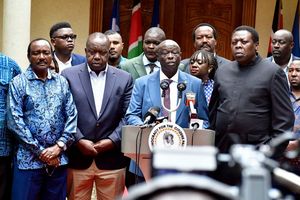
Linda Mwananchi’s campaign to unite Kenya’s opposition for the 2027 General Election is facing its first major test after Siaya Governor James Orengo entered the race for the movement’s presidential ticket, insisting that a credible nomination process must precede any choice of flag bearer.
In an exclusive interview with the Nation on Tuesday, Mr Orengo said he was prepared to face Nairobi Senator Edwin Sifuna or any other aspirant, arguing that competing ambitions do not weaken opposition unity if the process eventually produces one candidate to challenge President William Ruto .
“There is nothing wrong with competing ambitions within Linda Mwananchi or the opposition. What matters is that we subject all candidates to a credible nomination process and, at the end of it, we emerge with one candidate to face Ruto. That is what opposition unity is all about,” Mr Orengo said.
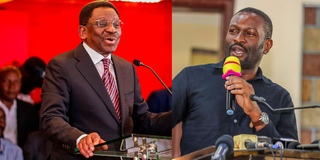
Siaya Governor James Orengo speaks at Safari Park Hotel, Nairobi on August 17, 2026 during a press briefing. Mr Orengo has declared interest in running for president on a Linda Mwananchi ticket.
Photo credit: Lucy Wanjiru | Nation Media Group
His entry has turned the emerging coalition’s presidential project into its first significant internal contest, with Mr Sifuna’s allies maintaining that the Nairobi senator has already emerged as the movement’s preferred candidate through rallies and grassroots mobilisation.
Mr Orengo, however, is resisting any attempt to close the contest before a formal mechanism for choosing the flag bearer is agreed.
For him, the issue is not simply who is best placed to carry the ticket but whether the movement can establish a process that gives competing aspirants a legitimate opportunity to make their case. Asked which nomination formula he preferred, Mr Orengo was cautious, saying it was too early to prescribe one.
“It’s still too early to talk about that,” he said, noting that even the wider United Opposition had yet to agree on how to nominate its presidential candidate.
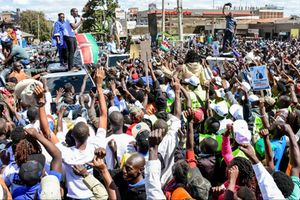
Siaya Governor James Orengo (right) and ODM Edwin Sifuna address residents of Ugunja town during a public rally by Linda Mwananchi faction on February 8, 2026.
Photo credit: Alex Odhiambo | Nation Media Group
But he was unequivocal that the process should not be predetermined or conducted behind closed doors.
“All I’m saying is that there are some processes; issues of candidates for any position can be determined through some kind of process. Instead of having it being a closed exercise,” he said.
Mr Orengo cited the 2007 ODM presidential contest, in which Raila Odinga , William Ruto, Musalia Mudavadi, Najib Balala and Joe Nyaga competed for the party’s presidential nomination before delegates settled on Mr Odinga.
He also pointed to the 2002 opposition alliance, when competing parties negotiated and eventually rallied behind Mwai Kibaki, producing a united ticket that defeated Kanu candidate Uhuru Kenyatta.
His point, he said, was not that Linda Mwananchi should copy either model, but that opposition unity does not require competing presidential ambitions to be eliminated before a candidate-selection process begins.
“I am committed to the principle that there should be one opposition candidate and it could come from any of the formations,” Mr Orengo said.
His position puts him on a collision course with Mr Sifuna’s allies, who have increasingly portrayed the senator as the natural choice to carry the movement into the 2027 election.
A section of Western Kenya leaders allied to Linda Mwananchi publicly backed Mr Sifuna in July during a meeting hosted by Trans Nzoia Governor George Natembeya.
They also announced plans to establish a political party through which he would pursue the presidential contest.
Mr Natembeya has since sought to downplay Mr Orengo’s candidature, arguing that the movement’s supporters have already made their preference clear. “In every political conversation, in every meeting that we go, you hear people saying Sisi Ndio Sifuna (We are Sifuna),” Mr Natembeya said, warning that Mr Orengo’s entry could create confusion among supporters.
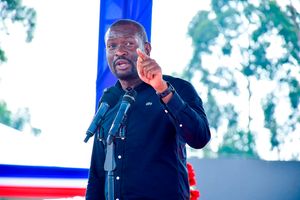
Siaya Governor James Orengo addresses a Linda Mwananchi political rally at Amalemba Grounds in Kakamega on February 21, 2026.
Photo credit: Alex Odhiambo | Nation Media Group
“We don’t want confusion. Kenyans have pronounced themselves in every Linda Mwananchi rally that they want Edwin Sifuna to be the presidential candidate,” he said.
The position has also been echoed by other Sifuna allies within the movement, who argue that the senator has built momentum through months of nationwide mobilisation and is better placed to carry the opposition message into the election.
Vihiga Senator Godfrey Osotsi, while acknowledging Mr Orengo’s stature and reform credentials, said the movement had mechanisms that could eventually resolve the contest.
“The movement has huge respect for Governor Orengo given his high pedigree and credentials on matters of reform. At the right moment, we shall have internal mechanisms to amicably deal with that question,” Mr Osotsi told the Nation.
Ms Pauline Njoroge, speaking during the movement’s rally in Meru last weekend, similarly suggested that supporters had already settled on their preferred candidate.
“Our supporters are very clear and unequivocal that they have already settled on one presidential candidate, and that candidate is Edwin Sifuna. Their position is that Sifuna is the person they want to carry the Linda Mwananchi ticket into the 2027 election,” she said.
The governor’s decision has nevertheless unsettled a political project that was beginning to take shape around the senator, raising questions about whether Linda Mwananchi can accommodate competing ambitions without losing momentum.
Mr Orengo insists that his candidature should not be interpreted as an attempt to derail the movement.
Political analyst Dismas Mokua said the decision would test whether Linda Mwananchi could manage internal competition without allowing it to consume the broader opposition project.
“The former could preserve momentum around Sifuna but risk alienating senior figures and constituencies that do not feel adequately consulted,” he said.
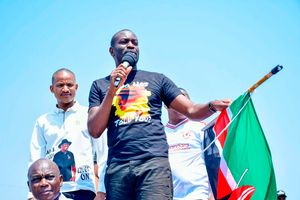
Nairobi Senator Edwin Sifuna addressing a Linda Mwananchi rally at Mazembe Grounds in Nakuru City on April 19, 2026.
Photo credit: Boniface Mwangi | Nation Media Group
President Ruto has repeatedly portrayed his opponents as lacking a coherent alternative to his administration.
In an interview, he dismissed the idea that insults, slogans and name-calling could constitute a political programme and challenged his competitors to explain what they would do differently if elected.
“They should tell Kenyans what they will do differently,” Dr Ruto said, arguing that an opposition seeking power must demonstrate how it would improve on his record rather than merely attack his administration.
He cited the Hustler Fund and the Bottom-Up agenda as examples of what he considers concrete policy programmes, contrasting them with what he sees as an opposition dominated by slogans.
“My competitors must therefore go beyond insults and slogans and tell Kenyans what they will do,” he said.
Mr Omore said the argument gives added significance to the emerging Orengo-Sifuna contest, because an opposition movement seeking to convince voters that it can govern must first demonstrate that it can manage competing ambitions.
On Tuesday, Mr Orengo again explained his insistence that he is not seeking to derail the movement.
“I am committed to the principle that there should be one opposition candidate,” he said, while leaving open the possibility that the candidate could emerge from any of the opposition formations.
For Mr Sifuna’s camp, Mr Orengo’s candidature risks disrupting a project already gathering momentum around the senator.
For Mr Orengo, conceding without a process would amount to accepting that a presidential ticket had been determined before the opposition agreed on how such a decision should be made.
The contest could therefore become the first major test of Linda Mwananchi’s internal democracy, determining whether the movement emerges from the rivalry stronger and more legitimate — or whether the struggle for its presidential ticket becomes the division that President Ruto is warning Kenyans about.
The outcome will also shape the coalition’s credibility as it seeks to persuade voters that it can offer a viable alternative in 2027.