A simmering dispute between the United Democratic Alliance (UDA) and the Orange Democratic Movement (ODM) over electoral zoning is steadily unsettling Kenya Kwanza’s fragile coalition, throwing its affiliate parties into a state of anxiety and strategic confusion ahead of the 2027 General Election.
At the heart of the storm is a simple but politically explosive question on who gets to field candidates where in a potential UDA-ODM pre-election arrangement.
Initially presented as a strategic truce between President William Ruto’s camp and ODM, the arrangement has quickly spiralled into a fierce battle for political space, laying bare divisions within Kenya Kwanza and undermining the push for a unified party structure.
The tension escalated following ODM’s recent National Delegates Convention (NDC), where the party formally opened the door to coalition talks with UDA, signaling a significant shift from its traditional opposition stance.
But even as it embraced negotiations, the Dr Oburu Oginga-led ODM party made it clear it would not cede ground easily.
Dr Oginga struck a firm tone, insisting the party would enter any coalition talks from a position of strength.
“As we continue to negotiate in this broad-based arrangement, we are going to remain there up to 2027,” he said, before drawing a clear boundary: “Where ODM has MCAs, MPs, senators and governors, that is non-negotiable. That is ODM. We start from there.”
ODM Director of Elections Junet Mohamed amplified the message, warning potential partners against underestimating the party’s political weight.
“Anyone who wants to negotiate with ODM, we will not negotiate on our parliamentary strength,” he said. “Anywhere we have an MCA, MP, Senator, Governor or Woman Rep, it will remain with ODM.”
His remarks underscored a growing assertiveness within the party and hinted at an aggressive push for zoning arrangements that protect ODM strongholds.
“ODM zones are well known. Let’s respect each other. ODM is a major party,” he added.
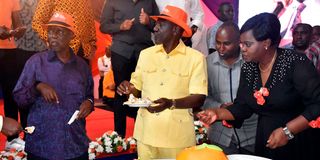
ODM Party leader Dr Oburu Oginga (left), President William Ruto and ODM Chairperson Gladys Wanga share a cake during ODM@20 celebrations at Sarova Whitesands in Mombasa on November 16, 2025
But UDA Secretary-General Hassan Omar dismissed the proposal outright, contending that the strength of any party must ultimately be tested at the ballot.
“ODM claims it is the strongest party, yet insists on zoning. Let us meet at the ballot,” he said.
For those against zoning from the ODM side, they argue “that those pushing for political zoning are insecure and want direct nominations at the expense of credible party primaries.
These hardline positions have inevitably put ODM on a collision course with UDA, which has its own ambitions of expanding its footprint into regions historically dominated by ODM.
Recent reports indicate growing friction between the two camps, with insiders pointing to disagreements over key counties and constituencies—particularly in Nyanza, Western Kenya, and parts of the Coast.
For UDA, zoning is not just about avoiding internal competition; it is central to President Ruto’s broader strategy of building a unified political machine capable of delivering a decisive victory in 2027.
But ODM’s insistence on ring-fencing its territories threatens to limit UDA’s expansion, effectively forcing the ruling party to either concede ground or risk a bruising fallout with its newfound ally.
As the two giants jostle for space, it is Kenya Kwanza’s smaller affiliate parties that are bearing the brunt of the uncertainty.
The Kenya Kwanza Alliance is a coalition of diverse political parties, each with its own regional base and leadership structure, brought together under a common electoral platform during the 2022 General Election.
UDA party secretary general Omar Hassan.
Photo credit: File | Nation Media Group
According to records from the Office of the Registrar of Political Parties, Kenya Kwanza alliance consists of the ruling United Democratic Alliance (UDA), alongside a wide array of affiliate outfits that include the Democratic Party (DP), Ford-Kenya, the Communist Party of Kenya (CPK), the National Agenda Party of Kenya (NAP-K), and the United Democratic Movement (UDM).
Others in the coalition are the Farmers Party (FP), Economic Freedom Party (EFP), Chama Cha Mashinani (CCM), Amani National Congress (ANC), the Devolution Party of Kenya (DPK), Maendeleo Chap Chap Party (MCCP), Grand Dream Development Party (GDDP), The Service Party (TSP), Chama Cha Kazi (CCK), Tujibebe Wakenya Party (JIBEBE), Pamoja African Alliance (PAA), and Umoja na Maendeleo Party (UMP).
While these parties collectively form the Kenya Kwanza Alliance, their continued existence as distinct entities has increasingly become a subject of political debate, particularly amid ongoing efforts to consolidate them under a single dominant party ahead of the 2027 General Election.
Many are now unsure whether they will be allowed to field candidates in their traditional strongholds or be forced to step aside in favour of UDA or even ODM nominees.
The uncertainty is particularly acute given President Ruto’s sustained push to dissolve affiliate parties and consolidate them under UDA.
While the President has argued that a single party would enhance cohesion and streamline governance, the reality on the ground tells a different story.
Most affiliate parties have resisted full dissolution, opting instead for a cautious approach that keeps their political vehicles intact—even as they publicly pledge loyalty to UDA.
What is emerging is a delicate balancing act—one in which affiliate parties are playing a double game.
On one hand, they align themselves with UDA to remain within the ruling coalition. On the other, they retain their party structures as insurance against an unpredictable political future.
The resurrection of Amani National Congress (ANC) following a High Court ruling nullifying its merger with UDA has only reinforced this strategy.
Despite its earlier dissolution, ANC is now legally operational, providing Prime Cabinet Secretary Musalia Mudavadi a crucial “backdoor” bargaining chip as coalition dynamics shift.
Similarly, PAA, associated with Senate Speaker Amason Kingi, remains intact despite pledges not to field candidates in 2027.
Ford-Kenya, led by National Assembly Speaker Moses Wetang’ula, has taken an even firmer stance, outright rejecting calls for dissolution and warning against attempts to impose a de facto one-party system.
Ford-Kenya Secretary-General and Tongaren MP John Chikati.
Photo credit: File | Nation Media Group
“To demand the dissolution of Ford Kenya now is to bite the finger that once fed you,” party secretary general John Chikati has warned.
The zoning dispute has further complicated President Ruto’s merger agenda, exposing contradictions at the heart of his political strategy.
While the push for a unified party is meant to eliminate internal competition, the introduction of ODM into the equation has effectively expanded the battlefield.
Instead of streamlining candidate selection, zoning negotiations are now adding another layer of complexity—forcing UDA to juggle demands from both ODM and its own affiliate parties.
For many within Kenya Kwanza, this has heightened fears of political marginalisation.
Leaders who were previously assured of tickets under UDA now face the possibility of being edged out to accommodate ODM interests—a prospect that has triggered quiet resistance within the coalition.
The unfolding scenario stands in sharp contrast to the relatively smooth consolidation of parties under the Jubilee banner ahead of the 2017 elections.
Then, the merger of URP and TNA into Jubilee created a cohesive political machine with minimal internal friction.
“Kenya Kwanza is not Jubilee,” notes political analyst Dismas Mokua. “It is a coalition of parties with distinct identities, regional bases, and leadership ambitions. Forcing them into a single structure without clear guarantees is bound to create tension.”
The entry of ODM into the mix, he adds, has fundamentally altered the equation.
Homa Bay Governor Gladys Wanga speaks during the Orange Democratic Movement (ODM) Special Delegates Convention at the ASK Dome, Jamhuri Expo Centre in Nairobi.
Photo credit: Bonface Bogita | Nation Media Group
“You now have a scenario where UDA must negotiate not just with its affiliates, but also with a former rival that commands significant political capital.”
Faced with this uncertainty, affiliate parties are increasingly prioritising survival.
In Ukambani, divisions within Maendeleo Chap Chap have already surfaced, with factions aligning differently in response to UDA’s consolidation push.
Elsewhere, leaders are quietly fine-tuning their strategies—strengthening grassroots networks, courting new alliances, and preparing for multiple electoral scenarios.
The emergence of former Deputy President Rigathi Gachagua’s Democracy for the Citizen’s Party has further underscored the risks of entering elections without a political vehicle—a lesson that many within Kenya Kwanza appear determined not to repeat.
The zoning row has also emboldened critics within ODM and Kenya Kwanza, who view the broad-based arrangement with suspicion.
Some ODM leaders have warned against external interference in the party’s affairs, while others fear that zoning concessions could dilute the party’s identity.
Within Kenya Kwanza, concerns are growing that the accommodation of ODM could come at the expense of long-standing allies.
Nandi Senator Samson Cherargei has been among those pushing for full dissolution of affiliate parties, arguing that unity is essential for electoral success.
Nandi Senator Samson Cherargei.
But such calls have done little to allay fears, instead reinforcing perceptions of a top-down approach that prioritises control over consensus.
As the zoning dispute intensifies, the broader Kenya Kwanza coalition is beginning to show signs of strain.
What was once presented as a cohesive alliance is increasingly revealing itself as a collection of competing interests—held together more by necessity than shared vision.
The inclusion of ODM, through the broad based framework, while politically strategic, has introduced new complexities that threaten to destabilise the coalition’s internal balance.
For President Ruto, analysts say, the challenge will be to navigate these competing demands without alienating key allies or undermining his consolidation agenda.
With elections coming next year, the stakes could not be higher.
Zoning agreements—if successfully negotiated—could provide a framework for cooperation and minimise electoral losses.
“…but if mishandled, they risk triggering defections, independent candidacies, and intra-coalition battles that could weaken Kenya Kwanza’s electoral prospects,” argues advocate and political analyst Chris Omore.
Ultimately, he argues, the UDA-ODM zoning row is more than just a dispute over electoral boundaries, but a test of political trust, strategy, and survival.
“It exposes the delicate balancing act required to manage a broad-based coalition in a highly competitive political environment, and for Kenya Kwanza’s affiliate parties, it is a stark reminder that in the shifting sands of Kenyan politics, certainty is often the first casualty.”