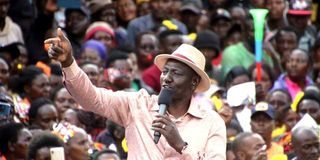
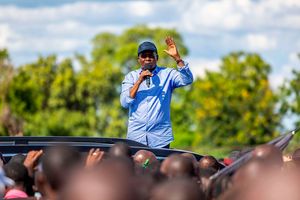
When President William Ruto stood to address mourners in Ol Kalou on Wednesday in a politically charged atmosphere, his body language and pronouncements projected a posture of a man not ready to retreat from the region’s perceived hostility.
Facing a barrage of political salvos and criticism from his former deputy, Mr Rigathi Gachagua and other local leaders, the President still proceeded to talk about his ‘unbroken’ relationship with the locals, making more promises to them while appearing confident of getting their backing for his 2027 re-election bid.
It is no secret that the region that swept Dr Ruto to power in 2022 by handing him close to three million votes has been drifting away from the Kenya Kwanza administration following the impeachment of Mr Gachagua in October 2024. There are also sentiments of alleged unfulfilled promises and tax policies that have run down businesses.
But the President and his allies, including Deputy President Kithure Kindiki, have continued to woo the region and project an image that all is not lost ahead of the next polls.
Analysts observe that the President has to maintain a posture of dominance to sustain the perception that he remains a central political player in the region that has remained critical in successive elections.
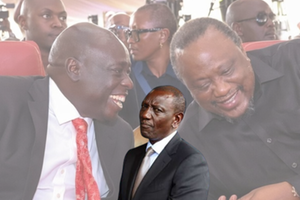
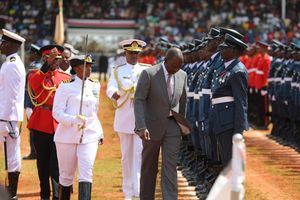
President William Ruto, his Deputy Kithure Kindiki, Speaker of the National Assembly, Moses Wetangula, other leaders arrive at Captain grounds in Ol Kalou during a requiem mass for area MP David Kiaraho on April 8, 2026. (inset) Former DP Rigathi Gachagua and Nyandarua Senator John Methu.
Photo credit: Boniface Mwangi | Nation Media Group
They also argue that the efforts by the President are not meant to make him dominant in the region, but to secure some votes as well as fragment the region. Giving up, they argue, would allow the region to consolidate and vote as a bloc against him.
But loyalists of Mr Gachagua insist that his political manoeuvres would translate to no ballot in the 2027 polls, while his allies in the region maintain that he remains the man to beat because of his development track record.
As part of his strategy to continue endearing himself to the region, the President has continued to hold a series of meetings with political, religious and grassroots leaders from the region. In some of the meetings, he has continued doling out major development projects to the region. A majority of his Cabinet is made up of individuals from the region.
Just hours before attending the funeral service of the late Ol Kalou MP David Kiarao, the President held meetings with leaders from Nyeri and Murang’a counties.
In his meeting with Nyeri leaders, he promised completion of the Kenol-Karatina-Marua dual carriageway, 8,000 affordable housing units, 20 modern markets and hostels for universities and colleges. Among politicians in attendance was Governor Mutahi Kahiga, a perceived ally of Mr Gachagua.
Similar promises of roads, hospitals, markets, among others, were made to politicians drawn from Murang’a who visited State House on Tuesday.
"We should stop this primitive style of politics. In 2027, every leader will be voted based on his development record. I urge leaders to stop introducing own selfish fights to cause rifts between me and the people who voted for me overwhelmingly. People of Mount Kenya are very clever," said President Ruto during the requiem mass.
“I know the people from Mt Kenya voted for me. I understand that, and I am not a mad person or a fool. The friendship I have built with the people of Mt Kenya is not something that was accomplished in two or three days. Those who are pointing fingers at me here, I will answer them with my actions and deeds. Kenyans know who has worked, who is fueling insults and chaos, and who has no vision for the country.”
The 10 Mt Kenya counties and the seven from the North Rift collectively handed Dr Ruto 4.5 million votes, which translated to 63 per cent of his total votes.
Laikipia, Tharaka-Nithi, Murang’a, Kiambu, Nyeri, Kirinyaga, Nyandarua, Embu, Meru and Nakuru collectively gave Dr Ruto nearly three million votes. Losing this bloc would require replacement with another vote-rich bloc, which is highly implausible with the internal wars in the Orange Democratic Movement (ODM).
President William Ruto chats with Public Service CS Geoffrey Ruku at Runyenjes town in Embu County on April 4, 2025 during his tour of Mt Kenya region.
Photo credit: Joseph Kanyi | Nation Media Group
Frankline Mukwanja, Executive Director at Centre for Multiparty Democracy (CMD-Kenya), notes that allowing the region to consolidate and vote as a unified bloc against the President would be detrimental to his bid for a second term.
He says one of the President’s strategies would involve securing a sizeable slice of that vote while encouraging fragmentation of the remainder by indirectly facilitating or fielding competing candidates in a scheme reminiscent of the 1992 machinations by then President Daniel Moi in splitting the opposition votes.
“Giving up (on the region) would be like shooting himself in the foot — politically, it would amount to suicide. President William Ruto must retain a posture of dominance to sustain the perception that he remains a central political player. This includes visibly showcasing elected and aspiring leaders who are loyal to him. In this regard, numerical strength and visible alliances remain a critical factor,” notes Mr Mukwanja.
Prof Masibo Lumala of Moi University says Ruto’s determination to hold onto Mt Kenya is anchored in the region’s electoral weight and its role in sustaining a national coalition.
Despite the hostility, Prof Lumala observes that Dr Ruto does not require total dominance, but just a significant share of the vote to remain competitive nationally beyond his Rift Valley base.
He says that Dr Ruto has an opportunity to exploit incumbency to counter the hostility by ensuring no single political leader monopolises the region politically.
He cites the position of Prof Kindiki as a major factor in how the region would respond to the overtures by Dr Ruto.
Deputy President Kithure Kindiki speaks during the Broad-Based Parliamentary Group meeting at Kenyatta International Convention Centre in Nairobi on March 10, 2026.
Photo credit: Wilfred Nyangaresi | Nation Media Group
President Ruto, he says, is likely to appeal to more moderate, technocratic, and less confrontational segments of Mt Kenya should he retain his deputy. He argues that retaining Prof Kindiki has the potential of softening resistance without necessarily winning back hardline Gachagua loyalists.
“On the other hand, dropping Kindiki could be interpreted as political recalibration—either an attempt to bring in a more electorally dominant Mt Kenya figure or to reset alliances—but it also risks creating uncertainty or appearing transactional, which might erode trust further.”
“In effect, Ruto is unlikely to lose Mt Kenya solely based on the deputy choice; rather, that decision will influence how he performs—whether he secures a respectable, broad-based share or faces a more fragmented, volatile contest,” notes Prof Lumala.
Prof David Monda – a US-based university lecturer and political analyst – holds similar views, while highlighting the region’s numerical strength. He argues that the region commands nearly 35 per cent of the national tally.
“So he's really hedging his bet. Trying to balance any losses from ODM strongholds with at least marginal gains in the Mountain. So at least getting some of the Mountain vote rather than losing it all,” explains Prof Monda.
The President’s decision to continue wooing the region, he argues, is also a message to ODM that he cannot be held hostage to their political demands.
The success of his political schemes, Prof Monda argues, will depend on political dynamics closer to the 2027 election.
“Politicians are rational actors, looking to maximise gain and lower risk in pursuit of material interests - in this case, chasing power. So, Gachagua/Mountain will be weighing where to throw their weight depending on whether the opposition or UDA appears more likely to win.”
Allies of Mr Gachagua and members of the United Opposition, however, appear clear in their thinking that the region is long gone despite the promised development projects and presence of some political leaders loyal to the President.
President William Ruto (then deputy president) pushes a wheelbarrow, the symbol of hustlers. His campaign massage for the 2022 elections was that of “dynasties versus hustlers.”
Photo credit: File | Nation Media Group
Gatanga MP Edward Muriu told Nation that Kenya Kwanza has lost significant ground in the region following the impeachment of Mr Gachagua. He said the region’s politicians, who are still with Dr Ruto have become unpopular in the country so much that they can rarely make public appearances in the region. He claimed that the President goofed by having Prof Kindiki and National Assembly Majority Leader Kimani Ichung’wah as his point men in the region.
He linked Dr Ruto’s insistence on wooing the region to denial and disbelief that the region that voted him to the last man has since rejected him three years into his presidency.
“He is also held hostage by elected members from the region who cheered him on as he was impeaching his Deputy. They are threatening him that if he abandons the Mountain, he will have thrown them under the bus for the second time.”
Embakasi Central Benjamin Gathiru alias Mejja Donk said that the President was struggling to create a perception that he still enjoys support in the region.
“But that is not the position. The leaders who are still with him do not have the support of the people. It is not just Mt Kenya, but generally those who supported him on the strength of the promises he made, which he has failed to deliver.”
Former Nyeri Town MP Ngunjiri Wambugu, a member of Jubilee Party, said the President seems keen to reap the political investment he has put into the region for the last 15 years.
“Politics is about adding, not subtracting. He needs to add to what he had in 2022, not subtract. Which is why he will not give up on the region for sure.”
In his analysis of the current political realignments, Kitui Senator Enoch Wambua, a close ally of Wiper leader Kalonzo Musyoka, said Dr Ruto stands no chance in the region.
He claimed that all simulations point to a near-total rejection of the President and his UDA party in the region.
“It is difficult to see a pathway for the President to win back the Mount Kenya voting bloc. Worse still, the mountain has grown bigger and with it comes the widening of the rejection. The inclusion of the Lower Eastern region (Mount Kenya South) into the political arithmetic of the “mrima” is a big blow to the President’s chances of re-election.
“The combined strength of the larger Mount Kenya region, including its diaspora spread all over the country, would easily marshal at least 8 million votes. These votes in one presidential ballot box must present a real nightmare to any rival,” he claimed.