President William Ruto once saw Kiharu MP Ndindi Nyoro as a promising young politician who could be groomed for national leadership.
At a joint media interview at Sagana State Lodge on March 31, 2025, the Head of State went out of his way to describe the Kiharu legislator as “a very fine gentleman” and revealed that he was personally mentoring him.
“He is a young man whom I’m mentoring. There are things I cannot say here. Ndindi Nyoro is a leader and one of the young ones I’m mentoring,” President Ruto said, adding that it was his responsibility to guide young leaders even when they “faulter”.
Less than 18 months later, that political relationship appears to have reached a dramatic political rupture.
On Monday night, Mr Nyoro formally broke ranks with the President's United Democratic Alliance (UDA), unveiled the Peoples’ Party of Kenya (PPK) and declared that he would work with opposition leaders to chart a different political and economic direction for Kenya.
The announcement at Safari Park Hotel in Nairobi answered months of speculation over the Kiharu MP’s political future, but it also raised a bigger question: What exactly is Ndindi Nyoro up to?
Is he genuinely building an independent national political movement, positioning himself for the 2027 presidential contest, or could his new political vehicle become part of a wider strategy to fracture the opposition and neutralise the growing anti-Ruto sentiment in Mt Kenya?
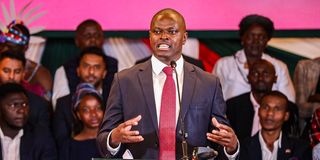
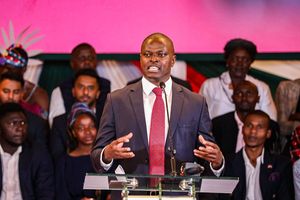
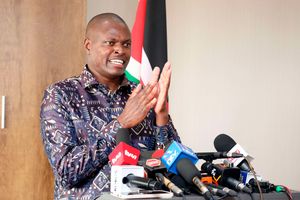
Kiharu MP Ndindi Nyoro addressing journalists at Safari Park Hotel, Nairobi, on August 17, 2026.
Photo credit: Lucy Wanjiru | Nation Media Group
Political analyst and Multi-Media University of Kenya lecturer Prof Gitile Naituli believes the development could ultimately serve President Ruto's interests, particularly in a region that has become increasingly hostile to the Kenya Kwanza administration.
“It’s Ruto’s plan,” Prof Naituli quipped.
He argued that Mt Kenya remains strategically important because of its large voter population and that one possible way of weakening the region's opposition to the President would be to divide its political leadership.
“Ruto’s target is Mt Kenya region with the highest number of voters. So, the only way Ruto can win the election without support of Mt Kenya is to divide it,” he said.
Prof Naituli’s views were, however, dismissed by Mr Nyoro’s supporters and some analysts, who argued that several leaders from the Mt Kenya region have either declared or been linked to presidential ambitions, yet none has attracted similar claims of being a President Ruto sympathiser.
Mt Kenya region already boasts a crowded field of potential presidential contenders, including Democracy for the Citizens Party leader Rigathi Gachagua, People’s Liberation Party leader Martha Karua, Safina Party chief Jimi Wanjigi, Democratic Party leader Justin Muturi and Party of National Unity leader Peter Munya.
Political analyst Dismas Mokua thus rejects the argument that Mr Nyoro's party should automatically be viewed as a State House project.
He said Kenya's democratic system gives every citizen the right to form a political party, contest elections and pursue political ambitions.
“Kenya is a democratic State and therefore citizens have agency to exercise their democratic rights either as voters or candidates for political office,” Mr Mokua said.
He argued that even if Mr Nyoro were acting independently or as someone's political proxy, the Constitution still gives him the right to pursue his political ambitions.
“It matters not whether Mr Ndindi Nyoro is running on self-motion or as a proxy. He has agency and the Constitution allows him to be a party leader and run for any political office he so desires,” he said.
Mr Mokua went further, warning that dismissing Mr Nyoro's political project without evidence amounts to political mischief.
He said President Ruto would be expected to recalibrate his 2027 strategy and could use a range of political tactics to weaken his opponents.
“Kenyans should therefore not be surprised if President Ruto crafts a strategy to confuse and deconstruct the opposition,” he said, adding that this could include supporting presidential, gubernatorial and parliamentary candidates to increase the President's chances of securing the constitutional threshold of 50 per cent plus one and the required county spread.
“There are no ISO standards in politics. Presidential candidates will use all tools in the shade to secure electoral victory,” Mr Mokua said.
But Prof Naituli compared the emerging strategy to the political manoeuvres of the past, arguing that Mr Nyoro risks being perceived as an establishment project rather than the independent politician he has sought to portray himself as.
Kiharu MP Ndindi Nyoro addressing journalists at Safari Park Hotel, Nairobi, on August 17, 2026.
Photo credit: Lucy Wanjiru | Nation
“He was a young emerging leader but now he has let people down,” he said, adding that the perception could damage Mr Nyoro's political career.
He argued that Dr Ruto and Mr Kenyatta remain locked in a political history that makes it difficult for either to trust another emerging power centre.
“I’ve never believed Uhuru wants anyone else except Ruto,” Prof Naituli said.
He described the emerging political manoeuvre as “wheelbarrow phase two”, drawing parallels with the political vehicle that helped propel Dr Ruto to power in 2022.
Mr Nyoro, however, insists that his political decision is driven by the national interest rather than a secret arrangement with State House, adding that he had formally quit the ruling party.
Speaking at Safari Park Hotel, he said he had spent months consulting political leaders from across the political divide before deciding to leave UDA.
“My heart has been burdened for many months. I have been praying that whatever political decision I make, Kenyans will be at the centre of it,” he said.
“It is obvious we left the government long ago. For the record, we disengaged with UDA and the wheelbarrow government long ago,” Mr Nyoro said.
“From today, Peoples’ Party of Kenya. We have today joined the opposition.”
The statement represents a remarkable turnaround for a politician who was once among the most prominent young figures in the Kenya Kwanza establishment.
Mr Nyoro was closely associated with Dr Ruto's presidential campaign and subsequently became one of the administration's most visible young defenders, particularly on economic and budgetary matters.
His influence grew rapidly, prompting speculation that he could eventually emerge as one of the leading contenders for the presidency after President Ruto.
But his political fortunes have since become intertwined with the turbulent relationship between the President and Mt Kenya, particularly following the removal of Mr Gachagua as Deputy President.
The region's politics have since become increasingly emotional, with questions of betrayal, political representation and the future relationship between Mt Kenya and President Ruto dominating public debate.
The Kiharu MP stopped short of explicitly declaring that he would run for president in 2027. However, his language strongly suggested that he is positioning himself for the highest office in the land
He repeatedly spoke about what his political team would deliver “after the August 2027 election” and presented PPK as a vehicle capable of producing leaders who can take Kenya in a new direction.
He said the party would work with opposition formations and train candidates for elective positions across the country.
Mr Nyoro also revealed that he had held extensive consultations with opposition figures, including former Deputy President Rigathi Gachagua, former Cabinet Secretary Fred Matiang’i, Wiper leader Kalonzo Musyoka, Martha Karua, Peter Munya and Siaya Governor James Orengo.
“I have taken time to consult almost all the opposition leaders,” he said. “I have sat down with Peter Munya, Martha Karua and James Orengo. You know Sifuna is my brother. I have sat down with Rigathi Gachagua and Kalonzo Musyoka.”
He added: “I want to confirm to you, I have had almost a year-long consultation with most of them, including Dr Fred Matiang’i.”
Mr Nyoro is entering an opposition field already populated by heavyweight politicians, including Mr Gachagua, Dr Matiang’i, Mr Musyoka, Ms Karua and leaders associated with the Linda Mwananchi movement.
His challenge, according to political pundits, will be to convince voters that PPK is not simply another political vehicle created to accommodate politicians seeking refuge from an unpopular government.
The question is whether voters will see the new party as a genuine break from UDA or simply a change of political vehicle.
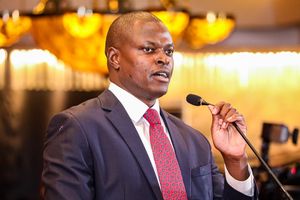
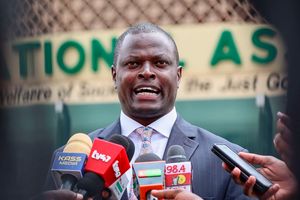
Kiharu MP Ndindi Nyoro during an interview outside the National Assembly on June 11, 2026.
Photo credit: Wilfred Nyangaresi | Nation Media Group
On September 13, 2025, while touring Mr Nyoro's Murang'a backyard, DCP leader Mr Gachagua accused the Kiharu MP of being a government project, alleging that he was helping create another political vehicle through which allies of the President could masquerade as opposition politicians.
Mr Gachagua alleged that President Ruto had encouraged young politicians to establish a “wheelbarrow” party through which government allies could hide while pretending to oppose President Ruto.
The allegation has never been established as fact, but it provides the political backdrop against which Mr Nyoro's latest move will be judged.
Political analyst Dismas Mokua rejects the argument that Mr Nyoro could be working for President Ruto but identified the MP’s greatest challenge as the perception that he remains President Ruto's “special purpose vehicle” in Mt Kenya.
That perception could become the biggest obstacle to his national ambitions, he says.
“Mr Nyoro's attempt to establish himself as an opposition politician therefore goes beyond forming a party. He must persuade voters that his political break is genuine.”
Rather than presenting PPK merely as an anti-Ruto platform, Mr Nyoro devoted considerable attention to education, healthcare, employment, agriculture, infrastructure, debt management, manufacturing, tourism, energy and governance.
He promised free basic education, including secondary education, from January 2028 and proposed pooling resources from the national and county governments and NG-CDF to finance the programme.
He also proposed a new commission to manage and harmonise the affairs of ECDE teachers and called for increased funding for university education.
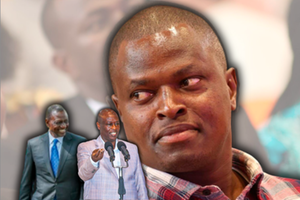
Budget and Appropriations Committee Chairperson Ndindi Nyoro. In a report tabled in the National Assembly on the Sh16.3 billion expenditure incurred in the 2022/23 financial year without the approval of MPs, the committee noted that given the closeness to the end of the financial year, “some of these expenditures may not be realised”.
Photo credit: Lucy Wanjiru | Nation Media Group
In healthcare, he proposed a government-owned system for managing the sector and a Kenya Doctors and Healthcare Workers Commission to oversee employment and welfare.
He further suggested reducing contributions to the National Social Security Fund and redirecting part of the money to healthcare.
On jobs, he proposed that every Cabinet secretary be given specific employment targets and that government publish regular data showing the number of jobs created.
He also called for reforms in agriculture, including improved seeds, irrigation, better markets, reduced post-harvest losses and greater value addition.
On debt, he proposed an audit after the 2027 election, restructuring domestic debt and reducing wasteful expenditure.
He said Kenya must exploit its mineral and oil resources without allowing political elites to capture the wealth.
The breadth of the proposals suggests that Mr Nyoro wants PPK to be judged not simply as an anti-government party but as an alternative governing platform.
That ambition received an endorsement from Siaya Governor James Orengo, who attended the launch alongside Wundanyi MP Danson Mwashako and Nyamira Senator Okong'o Omogeni, all members of the Nairobi senator Edwin Sifuna’s Linda Mwananchi Movement.
“I believe Nyoro is capable of doing that. I look forward to working with you, Ndindi Nyoro,” Mr Orengo said.
He accused the Kenya Kwanza administration of abusing public resources and urged opposition leaders to intensify mobilisation ahead of the election.
“We must make Kasongo’s life very difficult now, now next year,” he said, referring to President Ruto.
Senator Omogeni also welcomed Mr Nyoro into the opposition, while Mr Mwashako described his decision as courageous.
Analysts say that he now has to build structures outside Kiharu, recruit credible candidates, develop a national message and establish an independent political identity.
They say that he must also navigate the competing ambitions of the opposition leaders he has courted.
For Mr Gachagua, Dr Matiang'i, Mr Musyoka, Ms Karua and other opposition figures, PPK, they say, could either become a valuable addition to a broader coalition or another competing centre of power.
For President Ruto, it could become a threat, or an opportunity, and for Mr Nyoro himself, the stakes are even higher.
He has spent years cultivating an image of a young, articulate and economically minded politician capable of rising beyond parliamentary politics.
“His decision to leave the political establishment that helped propel him to prominence could either become the defining moment of his political career or the beginning of its decline,” argues advocate Chris Omore.
The central question, therefore, he says, is no longer simply Mr Nyoro's political destination, but whether he is building a genuine alternative movement—or merely creating another vehicle in Kenya's crowded political marketplace.
Political analyst Javas Bigambo said Ndindi Nyoro, as a Kenyan, is sheltered by the enjoyment of political rights in Article 38 of the Constitution.
“No one should be hindered from free enjoyment of the said rights. Nonetheless, Ndindi has acted coy and exalted fence-sitting for so long at crucial times, hence the emerging labelling that he is a pawn in President Ruto's political playbook. “But I think he is his own man, and with capabilities and sizeable following that is now attracting the envy of DCP and Senator Methu, who want to have absolute control of Mt. Kenya. No one has the paternalistic right to control any region, and Methu's condemnation of Nyoro is antithetical to the true spirit of democracy,” he said.