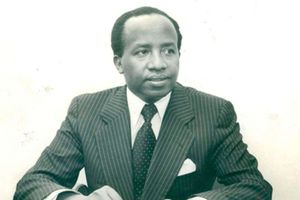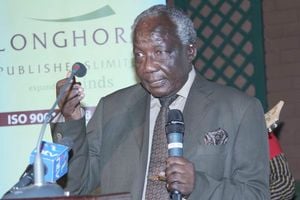
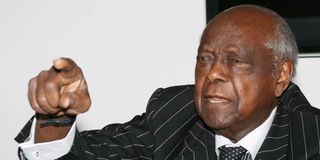
Retired journalist George Githii, who died on November 7, 2025 at the age of 89.

George Githii was a titan of Kenya’s press — fearless, sharp-witted, and unrelenting in his belief that journalism could confront power and shape a nation’s conscience.
Small in stature but commanding in presence, Githii cut a striking figure: impeccably dressed in his trademark spotted bow tie, with a pistol often concealed beneath his tailored suit. Restless and audacious, Githii pushed boundaries others dared not touch — and though the flames of controversy often licked at his heels, he never stopped testing how far truth could go.
By the time he died on Friday in Canada aged 89 after a short illness, Githii had long vanished from the public stage, a ghost from Kenya’s tempestuous media past. Few outside journalistic circles remembered the man behind the bow tie — yet his fingerprints lingered everywhere in the newsroom culture he helped create. For those who had worked with him, he was a thunderous editor, unpredictable but brilliant; a man who could turn a newspaper into both an instrument of truth and a weapon of manipulation. To his enemies, he was dangerous — a journalist who knew too much, and a courtier who refused to stay in his lane.
Born in Kiambu in the 1930s, George Githii came of age when education itself was an act of rebellion. For young Githii, books were more than tools of learning — they were weapons. He belonged to that first generation of postcolonial Africans who believed intellect and audacity could unlock doors long sealed by colonial power.
Ignored warning
After studying in Kenya and abroad, he returned home just as the new nation was taking shape. Drawn irresistibly to the gravitational pull of Jomo Kenyatta, the country’s founding president, Githii soon became part of the inner orbit of power. His first major post — Kenyatta’s press secretary — gave him a ringside seat to the choreography of statecraft. Yet even from within, he sensed the tension between loyalty and truth. When he began to criticise the regime, Kenyatta summoned him and, in a tone both paternal and menacing, said: “I know your mother very well, and she would not have approved.”
The warning went unheeded. By 1965, at just 29, Githii was appointed Editor-in-Chief of the Daily Nation — a meteoric rise for a man who only years earlier had served the president’s pen. It was the Cold War era, and the battle for Africa’s soul played out not only in embassies and parliaments but also in headlines. Githii’s dual identity — insider and truth-teller — made him uniquely suited to the moment. He was fluent in the coded language of power and unafraid to use the press as both mirror and megaphone.
Official corruption had already begun to gnaw at the fabric of the young republic, but few dared to name it. Githii did. When he discovered that Nairobi’s mayor, Charles Rubia, planned to have the City Council purchase a Rolls-Royce for his official use, Githii unleashed a front-page campaign dripping with sarcasm and outrage. Why, he asked in bold print, could the mayor not use his own Humber Super Snipe — and how, exactly, had a lowly clerk been promoted overnight to a lucrative post? The questions were rhetorical, the damage real.
Kenyatta stroke
The young editor’s fearlessness was magnetic, but it drew danger as surely as light draws moths. His first serious collision with the State came over the Preservation of Public Security Bill of 1966, which granted the president sweeping powers of detention without trial. In his editorials, Githii denounced the Bill as a betrayal of the very ideals of independence. Summoned to State House, he faced Kenyatta and Attorney-General Charles Njonjo. The president listened silently, then warned him not to go “too far.” When Githii refused to relent, the police commissioner — an old school friend — phoned him late at night. The message was clear: you’ve made your point; stop now. He did not.
Former Attorney-General Charles Njonjo.
In May 1968, fate tested him. Kenyatta suffered a stroke during a visit to the Coast. The government scrambled to conceal the truth; the myth of the invincible Mzee could not be disturbed. But Githii refused to play along. The Nation ran a lead story reporting that the president was suffering from a “slight indisposition.” Within hours, Nairobi was ablaze with rumour. The government issued a furious denial — Kenyatta, they insisted, merely had a “fever.” But the damage was done. Githii had broken an unspoken covenant: the president could never be seen as mortal. Within days, he was dismissed, quietly exiled from the newsroom he had ruled. He left for studies abroad, carrying with him both the pride of defiance and the sting of betrayal.
Links to ‘Duke of Kabeteshire’
When he returned in the 1970s, the landscape had changed. Kenyatta’s hold on power was waning, and new political centres were emerging. Githii, older and shrewder, was reappointed to helm the Nation — and later, The Standard. This time, he was more than a journalist; he was a political actor cloaked in editorial authority. His close alliance with Njonjo — the urbane “Duke of Kabeteshire” — would define the tone of Kenyan journalism for a decade. Under Githii’s stewardship, The Standard became both sword and shield. Njonjo’s enemies found themselves under relentless scrutiny, their missteps magnified in bold headlines. During the “maize scandal” of the late 1970s, the paper accused Agriculture Minister Jeremiah Nyaga of authorising dubious exports. The exposé titled, “Where Did the Maize Go?” sent Parliament into uproar. Nyaga, livid, accused the paper of being weaponised by shadowy political forces. He was right. Githii, behind his desk, was scripting a drama larger than news.
The battle soon expanded. Vice- President Mwai Kibaki, then the image of quiet competence, became a frequent target. The Standard ran a series of barbed critiques portraying him as indecisive. When Kibaki finally snapped in Parliament — saying there is nothing special in being an Editor-in-Chief — Githii struck back in print: “Equally, there is nothing special about being a vice-president either.” It was vintage Githii: irreverent, eloquent, and unafraid.
The late politician Josiah Mwangi (JM) Kariuki.
Yet if the 1970s were his zenith, they were also his moral undoing. In 1975, when the populist MP JM Kariuki vanished and his mutilated body was later found, the Nation published false reports claiming JM was alive and in Zambia. The misinformation, widely believed to have been sanctioned by Githii, shielded powerful figures implicated in the murder. The parliamentary inquiry named him directly. For a man who had once championed truth, it was a devastating stain — but not a career-ending one. Power still needed his pen.
By the late 1970s, Kenya’s elite was rehearsing for Kenyatta’s inevitable departure. The press, now openly partisan, mirrored the fractures within the ruling party. The Standard spoke for Njonjo’s faction; the Nation leaned toward Kibaki’s. Editorials read like coded communiques from rival courts. When Uganda’s State media accused Kenya of harbouring rebels, Githii’s Standard accused the Nation of “treasonous sympathy,” asking whether it had “been recruited into the Obote camp.” Nationalism became his favourite disguise — a cloak for intrigue.
Silenced after coup
After Kenyatta’s death in 1978, Githii pivoted deftly to the new order. President Daniel arap Moi, pragmatic and watchful, found him useful and appointed him chairman of The Standard. Old habits persisted. When famine followed the bumper harvest of 1979, Githii’s editorials blamed Kibaki and Nyaga, reigniting old feuds.
“We know who these newspapers are working for,” Kibaki fumed in Parliament. Everyone knew what he meant: Njonjo — and, inevitably, Githii.
Power, however, has no permanent allies. In 1981, when Moi reinstated detention without trial, Githii — perhaps out of principle, perhaps out of instinct — broke ranks. He denounced the move in print, recalling the ideals of freedom Kenya had once fought for. It was a rare moment of repentance, or rebellion. Either way, it sealed his fate. He was dismissed soon after, stripped of his platform and his influence. Then came the coup attempt of August 1982. Moi’s government struck back with fury, detaining dissidents and confiscating passports. Among those silenced was George Githii. The man who had once dictated the nation’s headlines now found himself erased from them. His pen, once sharp enough to wound presidents, was still.
Press, politics’ uneasy marriage
In his later years, Githii became a spectral figure — part legend, part warning. He had soared too close to power, believing he could harness it. He had used journalism as a sword and discovered it could also be a noose. Yet even his fiercest critics acknowledged his genius: his quicksilver prose, his theatrical flair, his unerring sense of drama. He transformed Kenyan journalism from a colonial relic into a stage for national debate — sometimes noble, often cynical, always electrifying.
In the end, George Githii’s life traced the uneasy marriage between the press and politics in postcolonial Kenya — a union of seduction and betrayal, where truth was both a tool and a casualty. His story mirrors that of the nation’s media itself: idealistic in birth, compromised in maturity, defiant in decline. Long after his fall, his spirit lingered — in every editorial that dared to question authority, in every reporter who believed that words still mattered. For better or worse, George Githii proved that in Kenya, the pen could be as powerful as the presidency — and just as perilous.
Follow our WhatsApp channel for breaking news updates and more stories like this.
[email protected] @johnkamau1