In his death, former Prime Minister and ODM leader Raila Odinga joins a group of prominent African names that were very influential in their days but never captured the power to lead their countries.
Some of them, prominent African leaders, now deceased, who despite their popularity never became presidents include Etienne Tshisekedi, the father of the current DR Congo president Felix Tshisekedi, who became president in 2019.
There is also the late John Garang De Mabior of South Sudan, the late Patrice Lumumba (DR Congo), and Nigerians Moshood Kashimawo Abiola, whose June 1993 presidential victory was annulled by the State, and Obafemi Awolowo.
Raila himself is regarded by his supporters to have won the people’s power to lead the country in the four general elections he contested-- 2007, 2013, 2017 and 2022-- but was denied the victory.
In 2017, he successfully petitioned the Supreme Court against President Uhuru Kenyatta’s victory in what he called sham presidential election.
But when the country’s electoral commission failed to assure him of a fair playing ground in the fresh presidential election as decreed by the Supreme Court, he boycotted the election. And on January 30, 2018, he swore himself as people’s president at the country’s historical Uhuru Park grounds, Nairobi.
University of Nairobi (UoN) lecturer Herman Manyora notes that Raila goes down in history as the President Kenyans never had. “You see the scenes that greeted the arrival of Raila’s body and you only imagine the love that the people had for him. These scenes cannot be compared to the deaths of Moi and Kibaki.
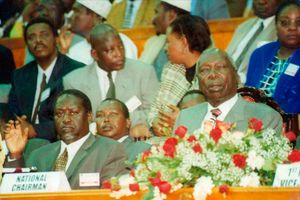
From left: Leaders John Garang, Moshood Abiola, Patrice Lumumba and Raila Odinga.
Photo credit: File | Nation Media Group
He is truly an enigma,” says Mr Manyora. The first time he contested for the presidency was in 1997, then as Nairobi’s Lang’ata MP, coming a distant third after then president the late Daniel Moi and the late Mwai Kibaki, who later in 2002, became president.
In 2007 Raila’s victory is believed to have been stolen sparking post-election violence after Samuel Kivuitu, the then chairman of the defunct Electoral Commission of Kenya (ECK), remarked that he did not know who between Raila and Kibaki won the election.
The Independent Review Commission (IREC), a commission of inquiry, was established in 2008 to analyse the constitutional and legal framework and identify weaknesses and inconsistencies in the electoral laws.
In its report, IREC proposed that ECK be renamed Independent Electoral and Boundaries Commission (IEBC). Kitui Senator Enock Wambua notes that Raila was a leader that Kenya will not get for ages. “In the three elections that our party leader Kalonzo Musyoka was his running mate or supported him, our people voted for him and gave him the highest percentage of votes. Unfortunately, he never became the president,” says Wambua.
Etienne Tshisekedi, was a prominent Congo DR Congo politician and Opposition leader who served as Prime Minister (PM) three times- 1991, 1992-1993 and 1997. He was the leader of the major Opposition party in DRC, the Union for Democracy and Social Progress (UDPS).
According to Mr Manyora, “just like Raila, Etienne Tshisekedi was known for his democracy advocacy, human rights and social justice and played a significant role in the country’s struggle against authoritarian rule.” Tshisekedi was born on December 14, 1932 in Luluabourg, Belgian Congo, now Kananga, DRC and died on February 1, 2017 in Brussels, Belgium.
“Each time Tshisekedi served as the PM, he was either dismissed or obstructed by then President the late Mobutu Sese Seko,” says Mr Manyora.
As the opposition leader, he founded the UDPS in 1982 and remained a vocal critic of Mobutu’s regime and later the governments of the late president Laurent-Désiré Kabila, and his son, Mr Joseph Kabila.
John Garang was the founder of the Sudan People’s Liberation Movement (SPLM) and former First Vice President of Sudan. Garang fought so hard for the liberation of the people of South Sudan but did not become its leader.
Governance expert Barasa Nyukuri says Garang, who died in 2005, at 60, largely contributed to South Sudan gaining independence in 2011 from Sudan, Khartoum after a referendum where 98.83 percent of voters chose to secede.
“This followed decades of conflict between the north and south, culminating in the 2005 Comprehensive Peace Agreement that paved the way for the referendum,” says Mr Nyukuri.
Mr Nyukuri notes that Garang’s death largely contributed to the instability in the world’s youngest nation. The late Lumumba was a Congolese politician and Independence leader who served as the first Prime Minister of DR Congo from June to September 1960.
City lawyer David Ochami says although Lumumba’s legacy is viewed as complex, with some viewing him as a hero and others criticising his leadership style and decisions, he played a key role in the country’s fight for independence from Belgium.
“Just like Raila Odinga, Lumumba was known for his charisma, oratory skills and the vision for a united and independent Congo,” says Mr Ochami.
Born on July 2, 1925, in Onalua Village, Sankuru District, Belgian Congo, now DR Congo, Lumumba was a key figure in his country’s independence movement, advocating for an end to Belgian colonial rule.
He became the first Prime Minister of DR Congo after Independence was declared on June 30, 1960. He was assassinated on January 17, 1961, in Elisabethville, now Lubumbashi, Katanga province, DR Congo
Moshood Abiola, popularly known as MKO Abiola, was a Nigerian business magnate, publisher and politician.
He won the June 12, 1993 presidential election, widely regarded as Nigeria’s freest and fairest election, but was denied the presidency by the military regime of Gen Sani Abacha. Gen Abacha annulled his victory despite the victory transcending ethnic and religious divisions, winning 19 out of 30 states, including his opponent’s home state of Kano.
Born on August 24, 1937, in Abeokuta, Ogun State, Nigeria, Abiola founded Abiola Farms, Abiola Bookshops, Radio Communications Nigeria, Wonder Bakeries, Concord Press and other businesses.
He joined the National Council of Nigeria and the Cameroons (NCNC) at 19, later becoming a prominent figure in the Social Democratic Party (SDP).
He declared himself president in 1994, leading to his arrest and imprisonment by Gen Abacha’s regime and died in custody on July 7, 1998.